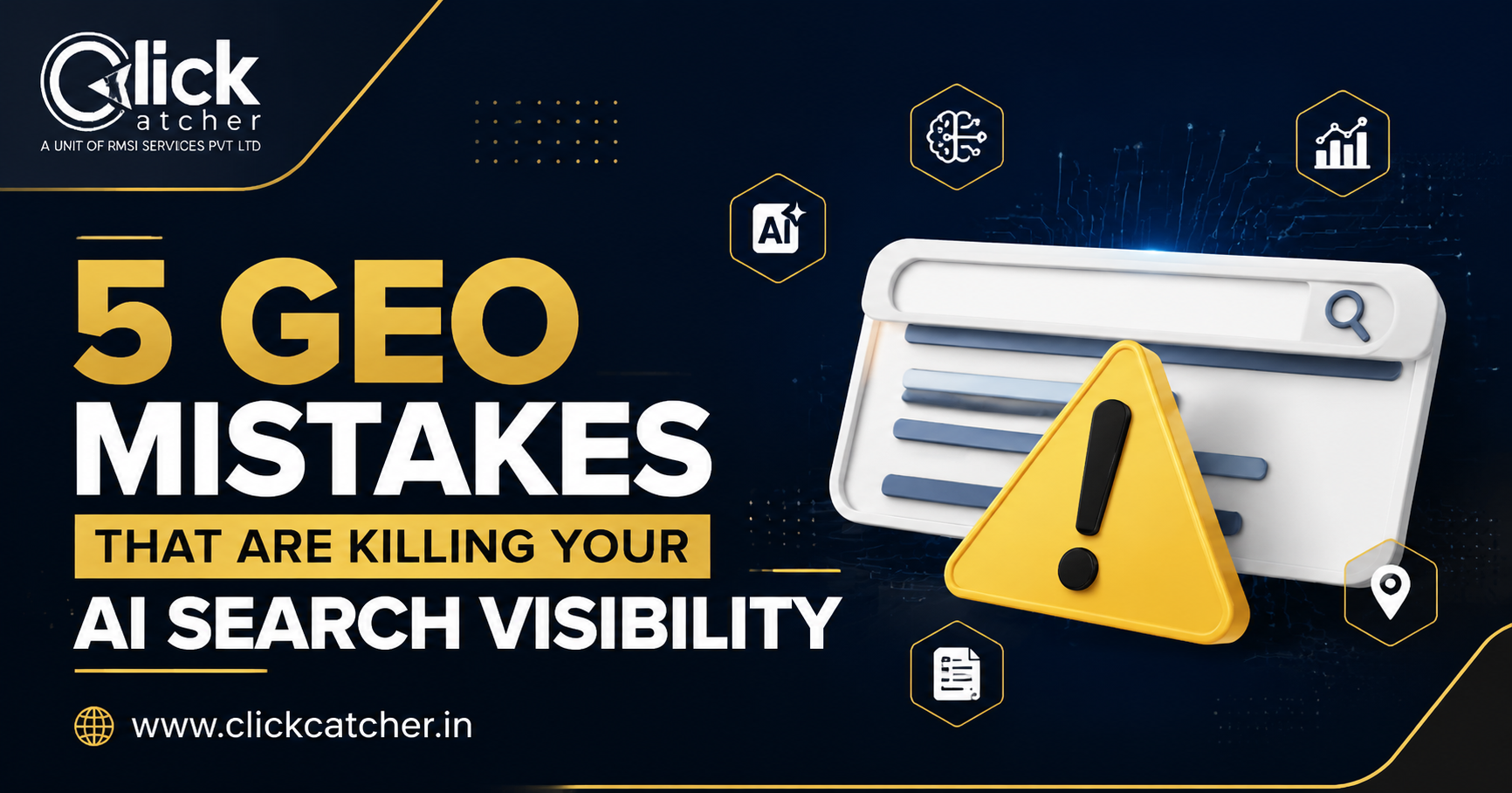
If ChatGPT, Perplexity, and Google’s AI Overviews never mention your business, one of these five mistakes is probably why.
Search has quietly split into two worlds. There’s the world your website was built for — blue links, meta descriptions, click-throughs. And there’s the new world, where a customer asks ChatGPT, Google’s AI Overview, or Perplexity a question and gets one confident, synthesized answer — with maybe three or four brands mentioned by name.
If your business isn’t one of those names, it doesn’t matter how well you rank on page one anymore. This is what Generative Engine Optimization (GEO) is about — optimizing your content so AI systems actually cite, quote, and recommend you.
Most businesses in Noida and Delhi NCR haven’t touched their GEO strategy at all. They’re still optimizing purely for traditional SEO — and that’s exactly why they’re invisible in AI-generated answers. Here are the five mistakes we see most often, and exactly how to fix each one.
Why This Matters Now
AI Overviews and chatbot answers are increasingly answering queries without the user ever clicking through to a website — a trend often called “zero-click search.” If AI engines don’t know your business, you don’t exist in that answer, no matter your Google ranking.
What is GEO, Quickly
GEO is the practice of structuring and optimizing content so that AI answer engines — ChatGPT, Google AI Overviews, Perplexity, Gemini, and similar tools — can easily understand, trust, and cite your content when generating responses. Unlike traditional SEO, which optimizes for ranking algorithms and click-through rate, GEO optimizes for being quoted directly inside an AI-generated answer.
The two aren’t separate strategies anymore — they overlap heavily. But GEO adds a new layer most businesses are ignoring completely. Let’s get into the mistakes.
The 5 GEO Mistakes Killing Your Visibility
1. Writing Only for Google, Not for AI Answer Engines
Most content is still written the old way — keyword in the title, keyword sprinkled through the body, a meta description aimed at click-through rate. That formula was built for ranking algorithms, not for language models trying to extract a clear, quotable answer.
AI engines favor content that answers a specific question directly, in the first few lines, in plain language. If your article buries the actual answer under three paragraphs of introduction, the AI model skips you and cites a competitor who got to the point faster.
Fix: Open every section with a direct, one-to-two sentence answer to the implied question, then expand with detail and context afterward.
2. Skipping Structured Data and Schema Markup
Schema markup (FAQ schema, Article schema, Organization schema, LocalBusiness schema) is how you hand search engines and AI crawlers a clean, machine-readable summary of your content. Without it, AI systems are left guessing at context — and guessing usually means they move on to a competitor’s page that made it easy.
This is one of the most common gaps we find auditing NCR business websites — pages full of good content, zero structured data behind it.
Fix: Add FAQ schema to every blog post, LocalBusiness schema to your homepage and location pages, and Article schema to blog content. It takes minutes and materially improves how AI systems parse your site.
3. Weak E-E-A-T Signals
Experience, Expertise, Authoritativeness, and Trust (E-E-A-T) matter more to AI engines than they ever did to traditional SEO. AI models are specifically trained to prefer content from sources that demonstrate real expertise and are corroborated elsewhere on the web.
If your blog posts have no author byline, no credentials, no case studies, and no mentions of your business anywhere else online, you’re a low-trust source in the eyes of an AI model — even if your writing is technically accurate.
Fix: Add real author bios, showcase case studies with actual numbers, and get your business mentioned on directories, partner sites, and industry publications.
4. Ignoring Conversational, Question-Based Queries
People don’t type into ChatGPT the way they type into Google. Instead of “best digital marketing agency Noida,” they ask, “which digital marketing agency in Noida is good for a small business with a limited budget?” That’s a full, conversational, specific question — and most business content isn’t written to match that pattern at all.
Fix: Build content around real conversational questions your customers actually ask — FAQ sections, “how to choose” guides, and comparison content that mirrors natural language, not just keyword phrases.
5. No Citations or Brand Mentions Across the Web
AI engines cross-reference multiple sources before deciding what’s trustworthy enough to cite. If your brand only exists on your own website — no press mentions, no directory listings, no third-party reviews, no guest content — you’re invisible to that cross-referencing process, no matter how good your own pages are.
Fix: Build a consistent presence across Google Business Profile, industry directories, review platforms, and relevant local publications. Every mention adds a signal AI engines can verify you against.
Traditional SEO vs. GEO — Quick Comparison
| Factor | Traditional SEO | GEO (AI Search) |
|---|---|---|
| Goal | Rank on page one, earn clicks | Get cited directly inside AI answers |
| Content style | Keyword-optimized, long intros | Direct answers, conversational, front-loaded |
| Trust signal | Backlinks, domain authority | E-E-A-T, structured data, cross-web mentions |
| Format | Blog posts, landing pages | FAQs, schema-marked content, comparison tables |
| Success metric | Ranking position, CTR | Citation frequency in AI answers |
Quick Self-Check
Open ChatGPT or Perplexity right now and ask a question a customer might ask about your industry in your city. If your business doesn’t show up, you have a GEO gap — and every day you wait, a competitor is more likely to fill it first.
How to Start Fixing This This Week
- Audit your top 10 blog posts — do they answer questions directly in the first two lines?
- Add FAQ and LocalBusiness schema markup sitewide.
- List your business on 5–10 relevant directories and industry sites.
- Rewrite your “About” and service pages to include real credentials, numbers, and case studies.
- Test your visibility monthly by asking AI tools questions your customers would actually ask.
Frequently Asked Questions
Is GEO replacing SEO?
No — GEO builds on top of SEO fundamentals. You still need a technically sound, well-ranked website. GEO adds the layer needed to also appear inside AI-generated answers.
How long does it take to see GEO results?
Most businesses start seeing early citation improvements within 4–8 weeks of consistent schema markup, content restructuring, and off-site mentions, though full visibility gains typically build over 3–6 months.
Do small businesses in Noida/NCR really need GEO?
Yes — arguably more than larger brands. Local searches are increasingly answered by AI Overviews, and small businesses that get GEO right early can outrank much bigger competitors who haven’t adapted yet.
What’s the single highest-impact fix to start with?
Adding structured data (schema markup) sitewide, paired with rewriting key pages to answer questions directly in the opening lines. Both are fast to implement and immediately improve how AI systems read your site.
Ready to Fix Your GEO Gaps?
Click Catcher helps Delhi NCR businesses get found — on Google, and now on ChatGPT, Perplexity, and AI Overviews too.