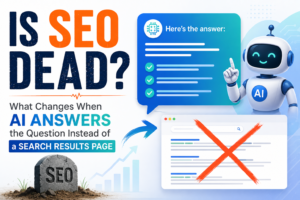
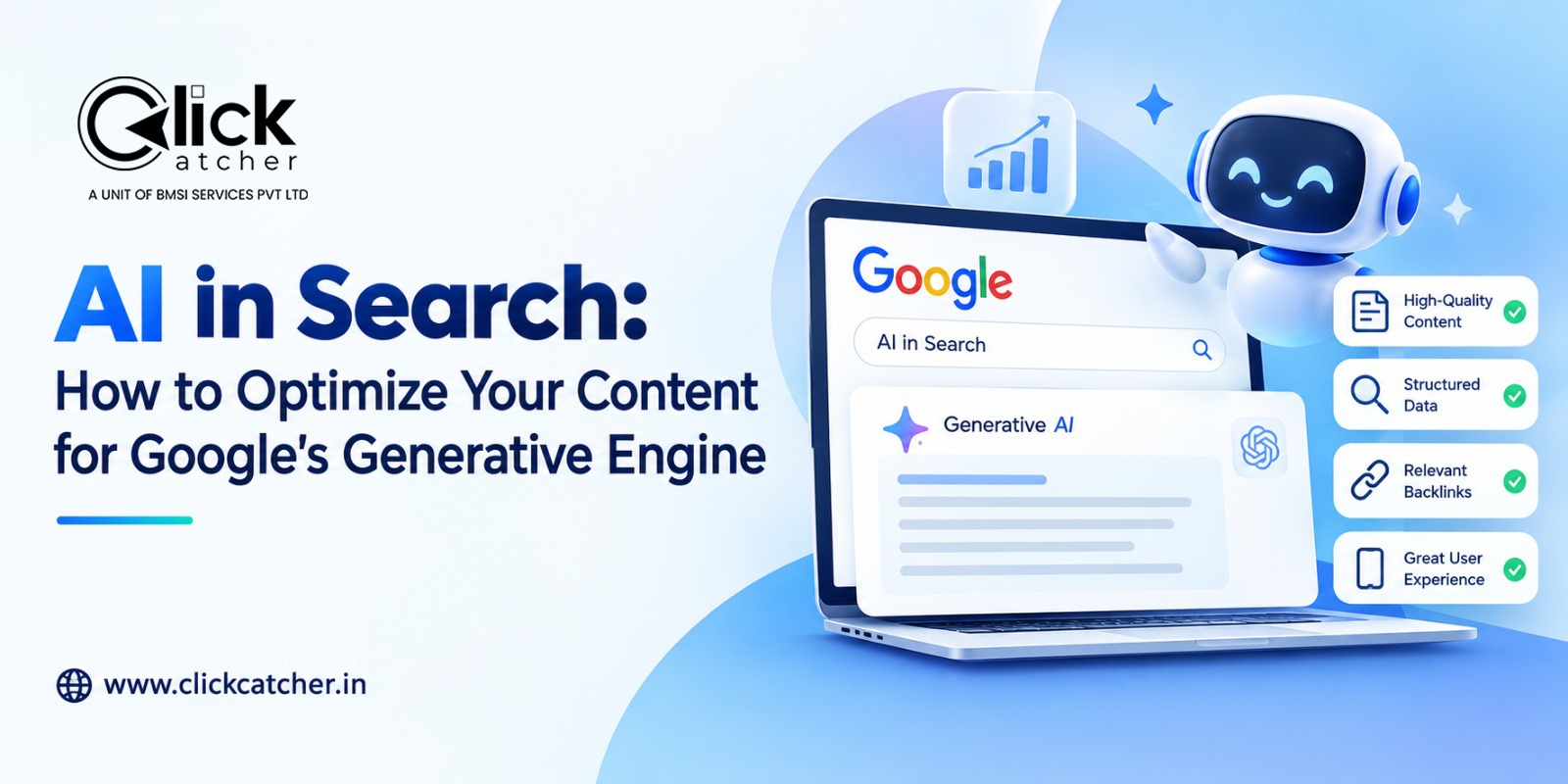
Search has quietly stopped being a list of ten blue links. Google’s AI Overviews now surface directly inside search results for a huge share of queries, and a growing number of users are switching to AI Mode for multi-step, conversational research instead of typing keywords one search at a time. If your content strategy still treats Google purely as a keyword-matching engine, you are already optimizing for a version of search that is disappearing.
This shift has a name in the marketing world: Generative Engine Optimization (GEO). It sits alongside traditional SEO rather than replacing it, but it demands a different way of structuring, writing, and proving your content. This guide breaks down what’s actually changed, how AI systems decide what to cite, and the practical steps to get your brand featured inside AI-generated answers.
What Changed: From “10 Blue Links” to AI-Generated Answers
Three shifts define the current search landscape:
- AI Overviews are mainstream. Google’s AI-written summaries now appear at the top of a large and growing share of search results, and Google has moved them onto more advanced Gemini models to improve response quality (TechCrunch).
- AI Mode is a full search tab. Instead of one query, users can ask a complex question, get a synthesized answer, and keep asking follow-ups in the same conversation — a pattern that behaves more like ChatGPT than classic Google Search.
- Competing answer engines are growing fast. ChatGPT search, Perplexity, and Copilot are pulling in users who want a direct answer rather than a page to click through, which means your content now needs to earn visibility across multiple AI systems, not just Google’s algorithm.
For businesses, the practical impact is “zero-click” search: a user can get a complete answer without ever visiting your website. Ranking #1 in classic SEO terms is no longer enough if the AI Overview above it answers the question and moves on.
Traditional SEO vs. Generative Engine Optimization
| Factor | Traditional SEO | Generative Engine Optimization (GEO) |
|---|---|---|
| Goal | Rank in the top 10 organic results | Get cited or quoted inside the AI-generated answer |
| Content unit | Whole page ranks for a keyword | Individual passages/sections get pulled into answers |
| Key signal | Backlinks, keyword relevance, domain authority | Clarity, structure, factual accuracy, and citations the AI can trust |
| Format that wins | Long-form pages optimized for one primary keyword | Direct, well-structured answers: definitions, steps, comparisons, data |
| Success metric | Rankings, organic traffic, CTR | Share of AI citations, brand mentions in AI answers, assisted conversions |
How AI Search Engines Decide What to Cite
AI Overviews and AI Mode don’t “crawl” content the way a human skims a page. They pull specific passages that directly and cleanly answer a query, then attribute or link to the source. Google has confirmed AI Overviews are influenced by core search quality updates (Search Central guidance), meaning the same E-E-A-T (Experience, Expertise, Authoritativeness, Trustworthiness) fundamentals still matter — they’re just applied at the passage level, not just the page level.
In practice, generative engines favor content that is:
| What AI Engines Look For | Why It Matters |
|---|---|
| Direct, self-contained answers near the top of a section | Easy to lift as a clean quote without extra editing |
| Clear structure (H2/H3, lists, tables) | Machines parse structure faster and more accurately than dense prose |
| Original data, statistics, or first-party experience | Unique information is more citation-worthy than repeated commentary |
| Recent publish/update dates | Freshness signals relevance for fast-moving topics |
| Consistent entity signals (brand, author, NAP data) | Helps AI systems trust and correctly attribute the source |
7 Steps to Optimize Content for AI Search
1. Answer the question in the first two sentences
Lead every section with a direct, quotable answer, then expand with context, examples, or nuance. AI systems reward content that doesn’t bury the answer under a long introduction.
2. Structure content for extraction, not just readability
Use descriptive H2/H3 headings phrased as questions where natural, bullet points for lists, and tables for comparisons. This is the single easiest change most websites can make, and it’s the format Google’s own structured data guidelines already reward.
3. Build topical depth, not just keyword volume
Generative engines synthesize answers from multiple angles of a topic. A cluster of interlinked pages covering a subject thoroughly outperforms a single page stuffed with keyword variations.
4. Add original data and first-hand expertise
Case studies, proprietary statistics, client results, and expert commentary are harder for AI engines to find elsewhere — which makes them more likely to be cited by name.
5. Strengthen E-E-A-T signals sitewide
Author bios, credentials, business information, and transparent sourcing all feed into how much an AI system trusts your content enough to cite it.
6. Mark up content with structured data
FAQ schema, Article schema, and Organization schema give AI crawlers explicit signals about what your content means, not just what it says.
7. Earn citations and mentions elsewhere on the web
AI models increasingly weigh how often a brand is mentioned or linked across trusted third-party sites — a modern version of digital PR that reinforces authority signals AI engines look for.
Common Mistake: Writing content that’s optimized purely for keyword density rather than clarity. AI engines penalize vague, repetitive phrasing because it’s harder to extract a clean, trustworthy answer from it — even if the page still ranks in classic organic results.
A Quick GEO Content Checklist
| Checklist Item | Status |
|---|---|
| Direct answer within the first 2–3 sentences of each section | ✅ |
| Clear H2/H3 structure with question-style headings where relevant | ✅ |
| At least one comparison table or data point per page | ✅ |
| FAQ section with schema markup | ✅ |
| Author byline and business credentials visible | ✅ |
| Content updated within the last 6–12 months | ✅ |
| Internal links to related topic-cluster pages | ✅ |
Frequently Asked Questions
What is Generative Engine Optimization (GEO)?
GEO is the practice of structuring and writing content so it can be understood, trusted, and cited by AI-powered search tools like Google AI Overviews, AI Mode, ChatGPT, and Perplexity — rather than only optimizing for traditional keyword rankings.
Is GEO replacing SEO?
No. GEO builds on the same foundations as SEO — authority, relevance, and trust — but adds a layer focused on how AI systems extract and cite specific passages, not just how pages rank.
Does GEO reduce website traffic?
Zero-click AI answers can reduce clicks for simple factual queries, but well-structured content that earns citations still drives brand visibility and qualified traffic for consideration and decision-stage searches.
How long does it take to see results from GEO?
Most businesses see early citation improvements within 8–12 weeks of restructuring key pages, similar to typical SEO timelines, though this varies by industry and competition.
Sources: TechCrunch coverage of Google AI Overviews and AI Mode updates; Google Search Central developer documentation.
Get Found in the Age of AI Search
Click Catcher helps Delhi NCR businesses turn their websites into AI-citation-ready assets — through GEO, AEO, and technical SEO built for how people actually search today.