Organic traffic remains one of the most valuable sources of website visitors because it brings users who are actively searching for products, services, or information online. Businesses that appear prominently on search engines often receive higher visibility, better credibility, and more long-term growth opportunities. However, ranking on search engines has become more competitive than ever.
Modern SEO is no longer just about inserting keywords into pages. Search engines now prioritize websites that demonstrate expertise, relevance, structured content organization, and user-focused information. This is where topical authority and SEO silo strategy become powerful tools for improving organic traffic.
By building content around specific topics and organizing pages strategically, businesses can strengthen search engine visibility and improve rankings across multiple keywords. In this blog, we will explore how topical authority and SEO silo strategy help increase organic traffic and create sustainable SEO growth.
What Is Organic Traffic?
Organic traffic refers to visitors who land on your website through unpaid search engine results. These users discover your website naturally by searching for related queries on search engines like Google.
Organic traffic is important because it:
- Brings targeted visitors
- Improves lead generation
- Builds long-term online visibility
- Reduces dependency on paid advertising
- Increases brand credibility
The challenge is that achieving consistent organic traffic requires strong SEO practices and a well-structured content strategy.
Learn how to increase traffic with effective SEO strategies.
Understanding Topical Authority in SEO
Topical authority refers to the expertise and trust your website builds around a particular subject or niche. Instead of publishing random content across unrelated topics, websites should focus on covering one industry or subject comprehensively.
For example, a website focused on digital marketing should consistently publish content related to:
- SEO
- Content marketing
- Technical SEO
- Link building
- Website optimization
- Google Search Console
- Keyword research
- Local SEO
When search engines notice that your website regularly publishes valuable and relevant information around a specific topic, they begin recognizing your website as an authority in that niche.
This improves:
- Search rankings
- Organic impressions
- User trust
- Website credibility
- Keyword visibility
Why Topical Authority Helps Improve Organic Traffic
Topical authority helps search engines better understand your website’s expertise. As your website gains authority in a subject area, it becomes easier to rank for multiple related keywords.
Benefits include:
Better Keyword Rankings
Search engines are more likely to rank authoritative websites higher because they provide extensive information on a topic.
Increased Organic Visibility
Publishing multiple related blogs increases your chances of appearing in search results for different search queries.
Improved User Engagement
Users are more likely to stay on websites that provide complete and useful information.
Higher Trust Signals
Consistent and relevant content improves trust among both users and search engines.
What Is an SEO Silo Strategy?
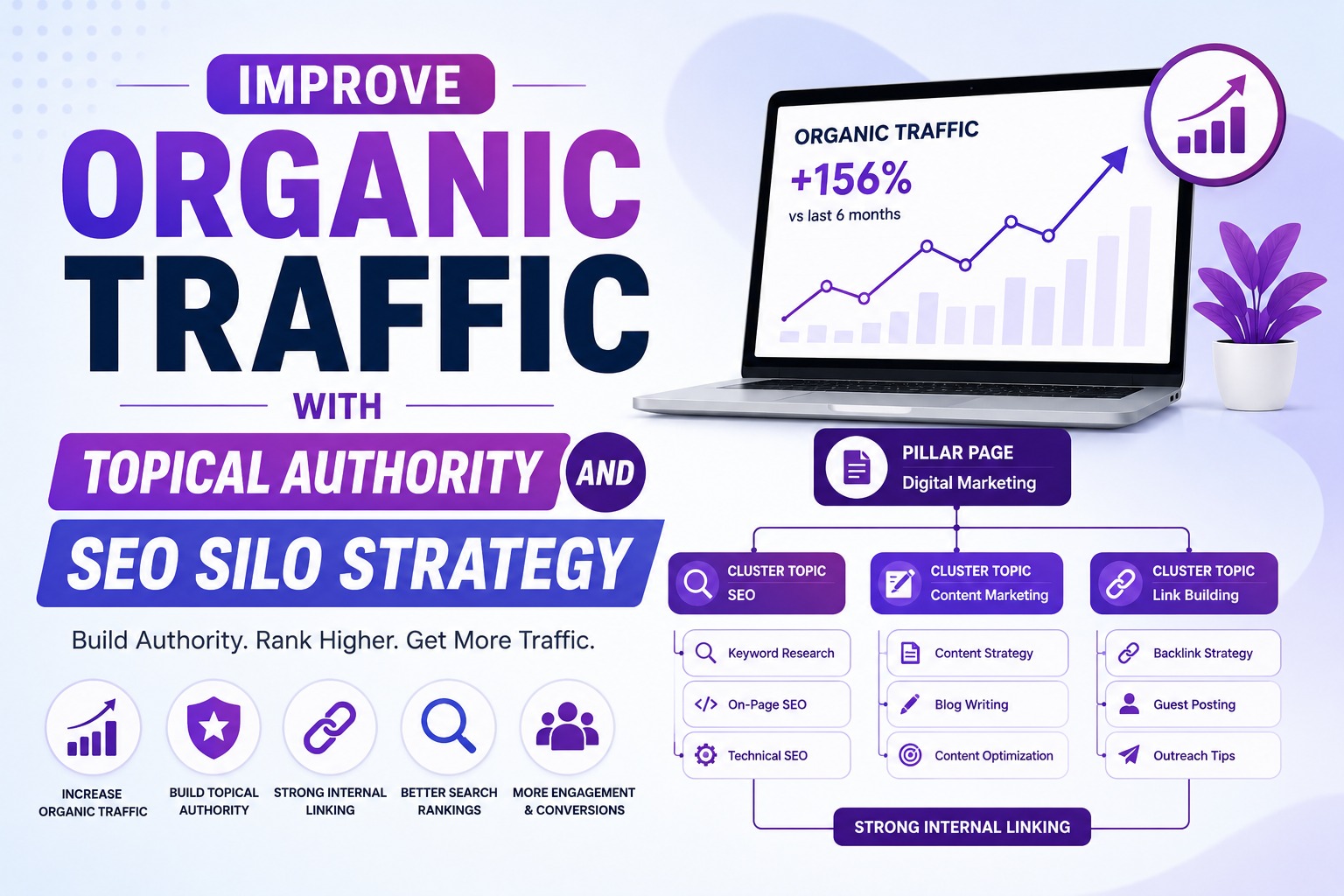
An SEO silo strategy is a method of organizing website content into clear topic-based sections. It creates a logical structure that helps search engines understand the relationship between pages.
In a silo structure:
- Main topic pages act as pillar pages
- Related blogs support the main topic
- Internal links connect related pages
For example:
Main SEO Service Page
- SEO Services
Supporting Blog Cluster
- Benefits of Technical SEO
- How Internal Linking Helps SEO
- SEO Keyword Research Guide
- Mobile SEO Optimization
- Common SEO Mistakes
All related blogs connect back to the main SEO page while also linking to one another where relevant.
This creates strong topic relevance and improves overall SEO performance.
How Silo Structure Improves Organic Traffic
Better Search Engine Understanding
A structured website makes it easier for search engines to crawl and categorize content.
Improved Internal Linking
Silo structures naturally support strong internal linking, which helps distribute page authority.
Increased Keyword Coverage
Supporting blogs target long-tail keywords that drive additional traffic.
Lower Bounce Rates
Users can easily navigate related content, improving engagement and session duration.
Faster Indexing
Search engines can discover and index organized content more efficiently.
Building Topical Authority Through Blogging
Blogs are essential for building topical authority because they allow websites to target various subtopics within a niche.
Create Topic Clusters
Instead of publishing isolated blogs, create clusters around specific themes.
For example, under digital marketing:
- SEO guide
- Local SEO strategies
- Technical SEO tips
- Content optimization
- Website performance improvements
This strengthens your website’s expertise in that area.
Publish Long-Form Content
Detailed blogs often perform better because they:
- Cover topics comprehensively
- Include related keywords naturally
- Improve user engagement
- Increase dwell time
Long-form content also creates more opportunities for internal linking.
Focus on User Intent
Every blog should answer a specific user query or problem. Understanding search intent helps create content that users actually want.
Examples of search intent include:
- Informational
- Transactional
- Navigational
- Commercial investigation
Matching content with search intent improves rankings and engagement.
Importance of Internal Linking in Silo SEO
Internal linking is one of the most important parts of silo strategy.
Benefits of internal linking include:
- Better page authority distribution
- Improved crawlability
- Enhanced navigation
- Increased page views
- Stronger topical relevance
Best practices include:
- Link related pages naturally
- Use descriptive anchor text
- Avoid excessive links
- Regularly update older blogs with new links
A strong internal linking structure creates a connected content ecosystem.
Keyword Strategy for Topical Authority
Keyword selection plays a major role in building topical authority.
Use Primary Keywords
Primary keywords target broad topics with higher search volume.
Examples:
- SEO strategy
- Organic traffic
- Technical SEO
Target Long-Tail Keywords
Long-tail keywords often have lower competition and higher conversion potential.
Examples:
- How to improve organic traffic through blogs
- SEO silo strategy for websites
- Ways to build topical authority
Long-tail keywords help attract targeted users more effectively.
Technical SEO and Organic Traffic
Content strategy alone is not enough. Technical SEO also affects organic traffic significantly.
Improve Website Speed
Slow websites often experience:
- Higher bounce rates
- Lower rankings
- Poor user experience
Improve speed by:
- Compressing images
- Using caching
- Minimizing scripts
- Choosing reliable hosting
Optimize for Mobile Devices
Google uses mobile-first indexing, meaning mobile performance directly impacts rankings.
Ensure:
- Responsive design
- Fast mobile loading
- Easy navigation
- Readable content
Fix Crawl and Indexing Issues
Regularly monitor:
- Broken links
- Redirect errors
- Duplicate pages
- Indexing problems
A technically healthy website performs better in search results.
Updating Existing Content
Refreshing old blogs is another effective SEO strategy.
Updating content helps:
- Improve rankings
- Add current information
- Increase relevance
- Strengthen internal linking
Search engines prefer fresh and updated content.
Common Mistakes to Avoid
While building topical authority and silo structures, avoid mistakes such as:
- Publishing unrelated content
- Weak internal linking
- Thin or duplicate content
- Keyword stuffing
- Ignoring technical SEO
- Poor website structure
These issues can negatively affect organic visibility.
Measuring Organic Traffic Growth
SEO performance should be monitored regularly using tools like:
- Google Search Console
- Google Analytics
- SEO auditing tools
Key metrics to track include:
- Organic clicks
- Impressions
- Average keyword position
- CTR
- Bounce rate
- Indexed pages
Consistent monitoring helps improve long-term SEO performance.
Long-Term Benefits of Topical Authority and Silo SEO
Building topical authority and implementing silo structures create sustainable SEO growth.
Long-term benefits include:
- Stronger search rankings
- Increased website authority
- Better user experience
- Higher organic traffic
- More qualified leads
- Improved brand credibility
Websites with clear topic relevance often outperform competitors in organic search results.
Conclusion
Improving organic traffic requires more than basic SEO practices. Search engines now prioritize websites that provide structured, valuable, and topic-focused content. Building topical authority through strategic blogging and implementing an SEO silo structure helps search engines understand your expertise while improving keyword rankings and organic visibility.
By consistently publishing relevant content, organizing pages into clear topic clusters, strengthening internal linking, and optimizing technical SEO, businesses can create a strong foundation for long-term organic traffic growth.
Topical authority and silo SEO are not short-term tactics but long-term strategies that help websites build credibility, attract targeted users, and achieve sustainable search engine success over time.
FAQs
1. What is topical authority in SEO?
Topical authority in SEO means building expertise around a specific subject by publishing detailed, relevant, and connected content consistently on your website.
2. How does an SEO silo strategy improve organic traffic?
An SEO silo strategy improves organic traffic by organizing content into topic-based categories with strong internal linking, helping search engines understand website relevance better.
3. Why is internal linking important for topical authority?
Internal linking connects related pages, improves website structure, distributes page authority, and helps search engines crawl content more efficiently.
4. How long does it take to improve organic traffic with SEO?
SEO improvements usually take a few months depending on competition, content quality, website authority, and consistency of optimization efforts.
5. What type of content helps build topical authority fastest?
Long-form blogs, detailed guides, topic clusters, FAQs, and regularly updated informational content help build topical authority more effectively.
Follow Us on Social Media – Facebook, Instagram, LinkedIn, YouTube