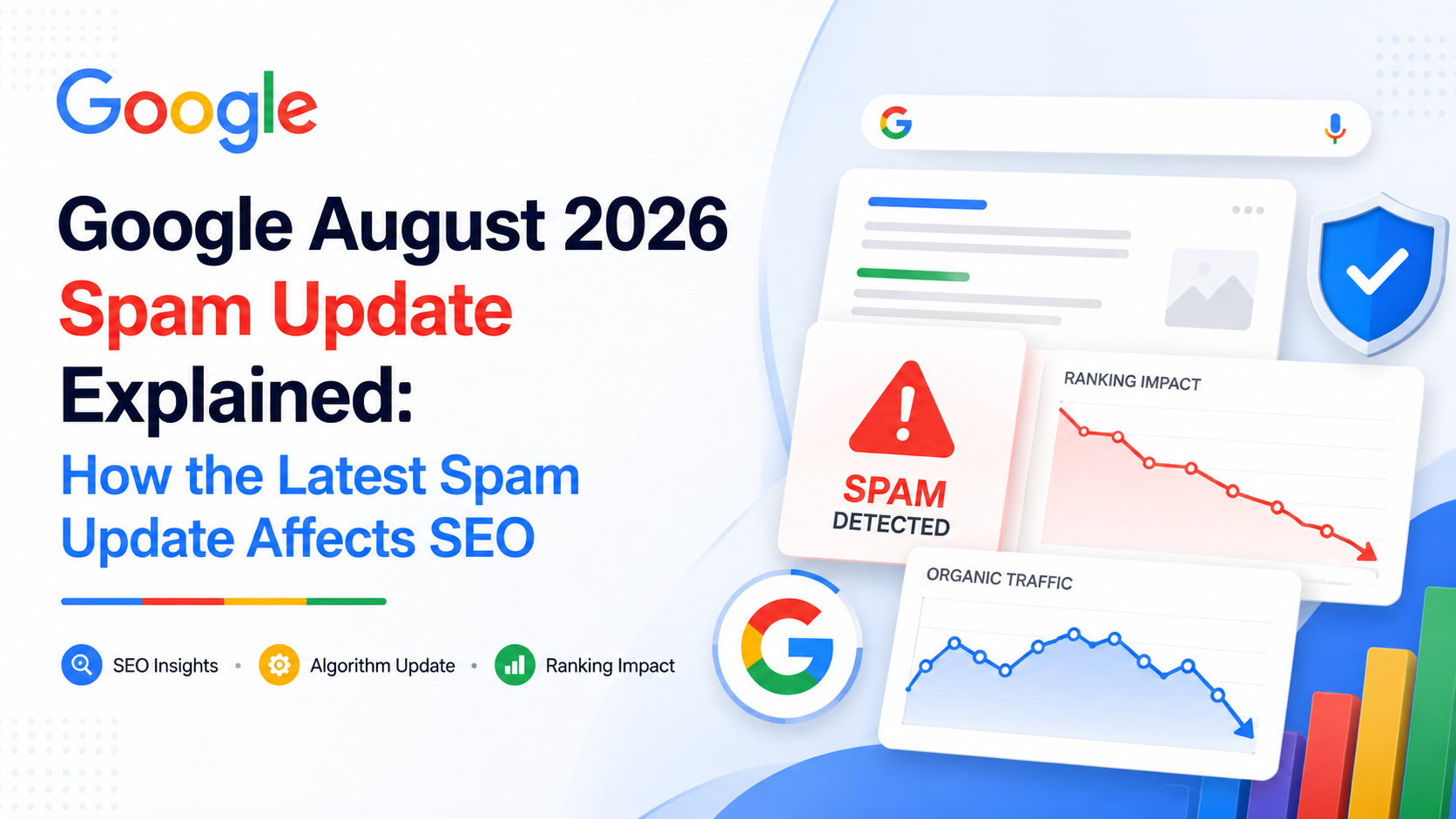
Google has released its August 2026 Spam Update — the third confirmed spam update of the year, following the March 2026 and June 2026 updates. If you’re a website owner, blogger, or SEO professional, this guide covers everything confirmed so far: when it started, what it targets, what it doesn’t target, the underlying spam policies at play, and exactly what you should check on your own site.
When Did the Update Start?
According to the Google Search Status Dashboard, the rollout began on August 18, 2026, at 9:27 AM Pacific Time, with the official release note posted a minute later at 9:28 AM PDT (4:28 PM UTC). Google Search Central confirmed the release on its official X (formerly Twitter) account the same day.
This is a global rollout — it applies to all regions and all languages, meaning websites in India, the US, the UK, Australia, and every other market could see ranking movement while the update processes. Google has said the rollout may take a few days to fully complete, and it will update its ranking release history page once it’s done.
What is Google’s August 2026 Spam Update?
It’s a search-ranking update aimed at improving Google’s ability to detect and act on spammy, manipulative SEO practices — as distinct from a “core update,” which broadly reassesses content relevance and quality. This one specifically targets techniques designed to game search rankings rather than genuinely help users.
What Actually Changed in This Update?
This is the most important question, and the short answer is: Google has not announced any new spam policy. No new category or rule was introduced with this update. Instead, Google is refining its automated spam-detection systems — commonly referred to as SpamBrain — to more effectively enforce its existing spam policies, which have remained unchanged since December 2025. There was also no companion blog article published alongside the dashboard note this time.
Here’s what’s confirmed about this update, based on Google’s own statements:
- Rollout time: A few days to fully complete.
- Target: Websites that violate Google’s existing spam policies.
- Does NOT target: This update does not target link spam, nor the site reputation abuse policy (also known as parasite SEO).
- Scope: Global — all regions and all languages.
- No new policy list: No new spam tactics were named specifically for this rollout.
Why is Google Updating Its Spam Systems Again?
Search has changed dramatically in the last couple of years. The web now contains huge volumes of automatically generated content, AI-assisted articles published at scale, manipulated backlink networks, doorway pages, and other tactics built primarily to win search visibility rather than serve users. Google’s spam policies exist specifically to catch practices that try to manipulate its ranking systems instead of genuinely helping searchers. Sites that violate these policies can see lower rankings or, in more serious cases, be excluded from search results altogether.
Google has also previously clarified (in May 2026) that its spam policies extend to attempts to manipulate generative AI responses in Search, including AI Overviews and AI Mode — a sign that spam enforcement is expanding alongside AI-powered search. Google hasn’t confirmed whether the August 2026 update specifically targets this kind of behavior.
In short: Google wants websites to create value for people first, and optimize for search engines second.
The Spam Policies Behind This Update
Since no new policy was introduced, the existing spam policies remain exactly what your site is being measured against — you can review Google’s full, official list on its Spam Policies for Google Search page. Here’s a full breakdown of the practices to watch out for:
1. Low-Quality / Thin Content
Avoid content created purely to target keywords, very short pages with little substance, or repetitive text that doesn’t add real value for the reader. Pages should exist to genuinely help someone, not just to occupy a search results slot.
2. AI-Generated Content
Using AI isn’t automatically a problem — Google’s guidance is clear that generative AI can be a useful tool for researching topics and structuring original content. The issue arises when AI or automation is used to mass-produce large volumes of low-value pages without real originality, expertise, or usefulness. This falls under what Google calls “scaled content abuse” — creating content at scale primarily to manipulate rankings, regardless of whether a human or an AI wrote it.
So instead of asking “Can I use AI for SEO content?”, a better question is: “Does this content genuinely help the person searching for it?” If the answer is yes, you’re on the right track.
3. Keyword Stuffing
Repeating the same keyword again and again doesn’t make a page more relevant — it just makes the content unnatural. For example, writing something like “Best SEO agency in Delhi, SEO agency Delhi, Delhi SEO company, best SEO services Delhi…” repeatedly without adding useful information can cross into keyword stuffing. Keywords should appear naturally, in service of answering the user’s actual search intent.
4. Spammy / Link Spam
Backlinks still matter in SEO, but not all backlinks help you. Google considers links created primarily to manipulate rankings to be link spam — this includes buying links, excessive link exchanges, automated link-building services, and low-quality directory or bookmark links. This is especially relevant for sites that have built large numbers of backlinks through automated SEO packages. More links doesn’t mean better SEO — relevant, natural, and useful links matter far more than raw backlink counts. (Note: this particular August update does not specifically target link spam, but it remains a core spam policy to watch generally.)
5. Duplicate / Doorway-Type Pages
This is what Google calls “doorway abuse” — publishing dozens of nearly identical pages that target different cities or slight keyword variations (e.g., “SEO Company Delhi,” “SEO Company Noida,” “SEO Company Gurgaon,” etc.) with only the location name changed and little else. If these pages exist mainly to capture search traffic rather than provide genuine local value, they’re at risk. Location or service pages should include real, distinct information — not just a swapped city name over the same boilerplate content.
6. Scraped or Rewritten Content
Copying content from other websites and lightly rewording it isn’t a sustainable strategy. Google’s spam policies directly address scraping and republishing content without adding substantial original value. A page should ideally contribute something new — original research, expert insight, first-hand experience, examples, data, comparisons, or simply a clearer explanation than what already exists.
7. Website Quality & Trust Signals
On the positive side, strengthening trust signals is genuinely beneficial regardless of any specific update. This includes:
- Clear author information and bios
- Genuine company/business details
- Accurate product or service information
- Original images and real examples (not just stock photos)
- Helpful FAQs
- Overall useful, well-organized information
These signals help demonstrate that a site is credible, accountable, and worth ranking — they’re part of what Google broadly calls E-E-A-T (Experience, Expertise, Authoritativeness, Trustworthiness).
8. Site Reputation Abuse (Parasite SEO)
This is when a trusted, high-authority domain hosts low-quality third-party content just to exploit its existing ranking strength (e.g., a well-known news site renting out sections of its domain to unrelated advertisers or content mills). Important: this specific August 2026 update explicitly does not target this policy, but it remains a standing rule for other updates.
Comparing This Update to Previous 2026 Spam Updates
To put the August update in context, here’s how it compares with earlier updates this year:
| Update | Rollout Duration | What It Targeted |
|---|---|---|
| March 2026 Spam Update | ~19.5 hours (fastest ever recorded) | General spam policies; excluded link spam and site reputation abuse |
| June 2026 Spam Update | ~2 days 1 hour | Normal spam update; same exclusions |
| August 2026 Spam Update | Still rolling out | Details not fully confirmed; excludes link spam and site reputation abuse |
For further historical context: the March 2026 update was the fastest rollout ever recorded on the Google Search Status Dashboard, according to reporting from Search Engine Journal. By contrast, the August 2025 spam update took almost 27 days (August 26 to September 22) — the longest rollout on record for a spam update. This variability is exactly why judging an update based on its first day or two of data can be misleading. You can track the full history of past updates on Ahrefs’ Google Algorithm Updates timeline.
How This Update Could Affect Your SEO
If your site genuinely doesn’t violate spam policies — no link spam, no cloaking, no mass-produced low-quality AI content — you likely have nothing to worry about. In Google’s own words, spam updates “target exclusively websites that violate Google’s spam policies.” If you don’t use manipulative techniques, there’s no reason for concern.
A few important things to keep in mind:
- Only negative impact for violators: Spam updates only hurt sites that violate policies — they don’t hand out ranking “bonuses.” If your traffic goes up, it’s likely because a spammy competitor lost visibility, not because you gained a reward.
- No manual penalty notice: This is a fully automated update, so there’s no manual action or penalty message inside Search Console.
- Recovery is possible: If you are affected, recovery can happen after fixing the underlying cause — though it can take weeks or months, and it doesn’t depend on the next core update.
- Link spam recovery works differently: If a future update specifically targets link spam and hits your site, Google has stated that rankings gained from spammy links won’t return even after cleanup, since that boost was never legitimate to begin with. This doesn’t apply to the current August update, since it excludes link spam.
How to Check If Your Website Is Affected
Don’t judge your site based on a single keyword’s movement — look at overall organic performance instead.
Check Google Search Console
Log into Google Search Console and compare, focusing on data from around August 18, 2026 onward:
- Clicks
- Impressions
- Average position
- Click-through rate (CTR)
- Top-performing pages
- Top-performing queries
Check Your Important Landing Pages
Identify whether specific categories of pages have lost visibility — for example, blog pages, product pages, service pages, location pages, or programmatically generated pages. If an entire page type drops simultaneously, investigate the content and SEO strategy behind that group specifically.
Review Your Backlink Profile
Look for sudden backlink spikes, links from irrelevant websites, automated link patterns, paid links, excessive anchor-text optimization, low-quality directories, and unnatural link exchanges. A backlink audit can help you spot risks before they compound into bigger ranking problems.
What Should You Do During the August Spam Update?
The smartest strategy right now is not to overreact.
- Don’t change everything at once. If rankings fluctuate for a few days, wait for the rollout to progress before making major changes — Google has said this update may take several days to complete. Changing too many things at once also makes it impossible to isolate what actually caused any shift.
- Audit your content honestly. Ask yourself: Is this content original? Does it actually answer the search query? Is it written for people, not just search engines? Are keywords used naturally? Are multiple pages targeting the exact same intent? Are there large numbers of low-value pages on the site?
- Review your off-page SEO activities. If your backlink strategy depends heavily on automated submissions, excessive directory links, unnatural link exchanges, or low-quality paid links, this is a good time to rethink that approach.
- Improve existing content rather than publishing more. Instead of putting out 20 weak articles, focus on strengthening 5 important ones — add original insights, real statistics, examples, FAQs, expert commentary, relevant internal links, and helpful visuals. Quality over quantity should be the guiding principle.
- Monitor the Search Status Dashboard. Wait for Google to confirm the rollout is complete before drawing firm conclusions about your site’s performance.
What Does This Update Mean for SEO Going Forward?
The direction is increasingly clear: SEO is moving away from “how many keywords can we add?” and toward “how much genuine value can we provide?” Google’s Search Essentials guidance already emphasizes creating helpful, reliable, people-first content, alongside solid technical accessibility and appropriate on-page SEO practices.
This doesn’t mean traditional SEO is dead — technical SEO, keyword research, internal linking, structured data, and quality backlinks still matter. But they need to support a website that genuinely deserves to rank, not substitute for one.
A Simple SEO Checklist After the August 2026 Spam Update
Before making major changes to your site, run through these questions:
- Is our content original and genuinely useful?
- Are we publishing pages primarily for users, rather than purely for rankings?
- Are our keywords used naturally, without stuffing?
- Do our backlinks come from legitimate, relevant sources?
- Are we buying or exchanging links purely for ranking purposes?
- Do our location/service pages provide unique local value, or are they duplicated with minor swaps?
- Are we publishing large volumes of AI-generated content without meaningful human input or originality?
- Do our pages actually answer the search intent they’re targeting?
- Are there duplicate or near-duplicate pages on the site?
- Do we have clear author information, company details, and genuine trust signals in place?
- Are we monitoring Google Search Console regularly during the rollout?
If most of your answers are positive, there’s no reason to panic.
Conclusion
The August 2026 Spam Update isn’t a new rulebook — it’s a refresh of Google’s existing spam-fighting infrastructure, SpamBrain, aimed at better enforcing policies that have been standing since December 2025. Link spam and site reputation abuse are explicitly excluded from this particular rollout. The update reinforces a message Google has been sending for years: sites relying on thin content, keyword stuffing, mass-produced AI content without real value, spammy backlinks, or duplicate doorway pages are the ones at risk — while sites investing in original, people-first content and genuine trust signals have little reason for concern.
If your site genuinely publishes quality content and avoids manipulative tactics, the best approach is to stay patient, keep monitoring your Search Console data, and continue building a website that people actually want to find.
For the latest official information, you can track the rollout on the Google Search Status Dashboard and review Google’s official Spam Policies for Google Search.
This post is based on Google’s official Search Status Dashboard announcements and reporting from reliable SEO news sources, including Search Engine Journal, Search Engine Land, and Search Engine Roundtable. The rollout is still ongoing, so check Google Search Central’s official channels for the latest updates on this topic.