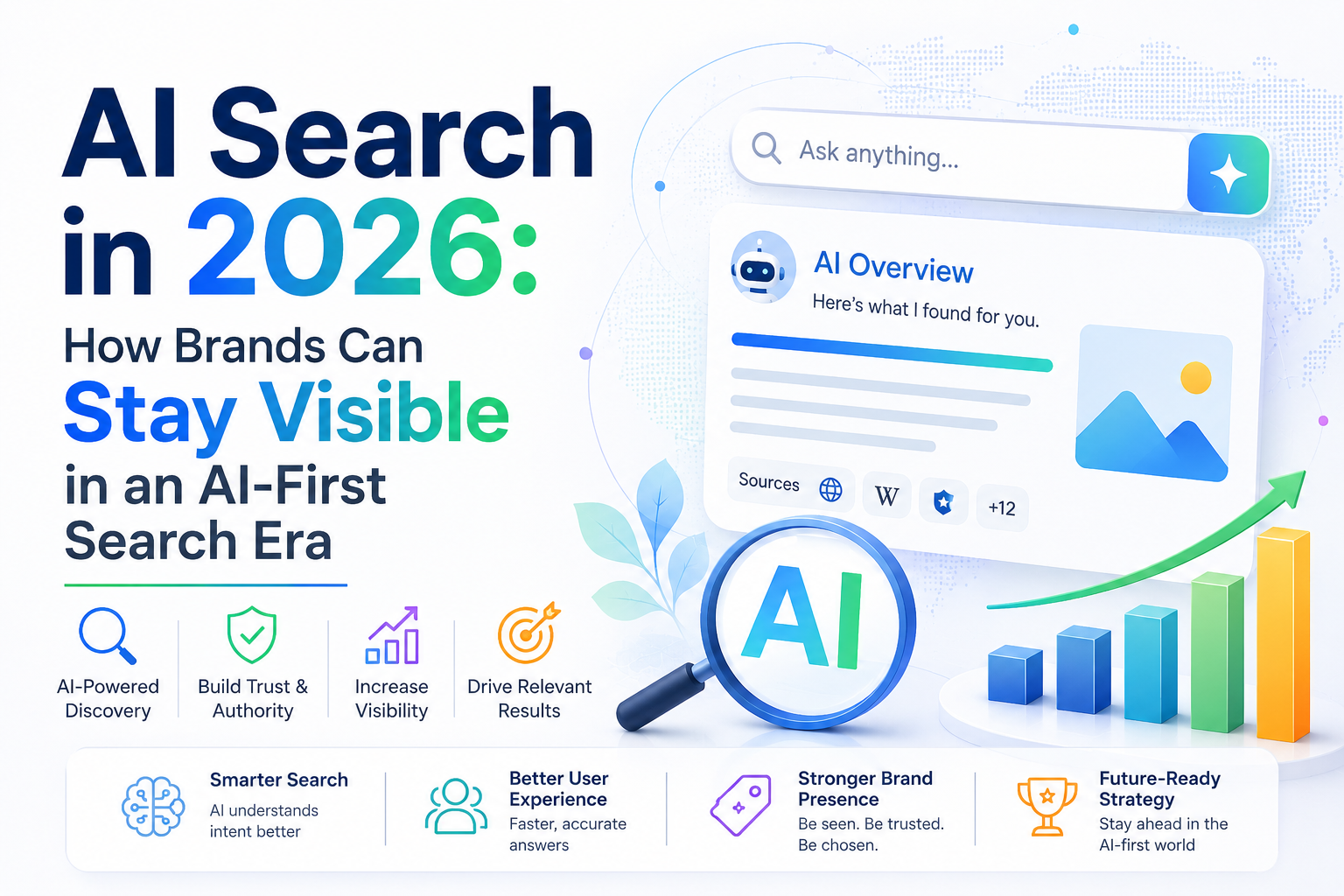
AI search is changing how users discover information online. Instead of displaying a list of links, AI-powered search engines provide direct answers, summaries, and recommendations. To remain visible in 2026, brands must focus on authoritative content, structured data, topical expertise, user experience, and optimization for AI-driven search platforms such as ChatGPT, Gemini, Perplexity, and Google AI Overviews.
Introduction
Search has undergone one of the biggest transformations since the rise of Google. In 2026, artificial intelligence is no longer just supporting search engines, it is becoming the search experience itself.
Users are increasingly turning to AI-powered platforms to ask questions, compare products, research services, and make purchasing decisions. Instead of scrolling through pages of search results, they receive conversational answers generated from multiple sources.
For businesses, this shift creates both opportunities and challenges. Traditional SEO remains important, but visibility now depends on how effectively your content can be understood, trusted, and cited by AI systems.
Understanding how AI search works and adapting your digital strategy accordingly is essential for long-term online success.
What is AI Search?
AI search refers to search experiences powered by large language models and machine learning technologies that generate direct responses to user queries.
Examples include:
- Google AI Overviews
- ChatGPT Search
- Gemini
- Perplexity AI
- Microsoft Copilot
- AI-powered voice assistants
Rather than simply ranking websites, these systems analyze information from multiple sources and provide synthesized answers.
This means brands are no longer competing only for rankings. They are competing for inclusion in AI-generated responses.
Why Traditional SEO Alone is No Longer Enough
For years, SEO focused on ranking pages for specific keywords.
Typical strategies included:
- Keyword optimization
- Backlink building
- Meta tags
- Technical SEO
- Content publishing
While these practices still matter, AI systems evaluate content differently.
They prioritize:
- Trustworthiness
- Expertise
- Context
- Content depth
- Entity recognition
- User intent satisfaction
A page ranking on the first page of Google does not automatically guarantee visibility in AI-generated answers.
Brands must now optimize for both search engines and AI models.
The Rise of Answer Engines
The search industry is shifting from search engines to answer engines.
Instead of asking:
“Best CRM software for small businesses”
Users now ask:
“What is the best CRM software for a growing business with a limited budget?”
AI systems analyze intent and generate customized answers.
This change means brands need content that directly answers questions rather than simply targeting keywords.
Content should provide:
- Clear explanations
- Actionable insights
- Expert perspectives
- Detailed comparisons
- Frequently asked questions
The more useful and comprehensive your content is, the more likely AI systems are to reference it.
How AI Chooses Which Brands to Mention
Although AI platforms use different algorithms, several common factors influence brand visibility.
Authority
AI systems favor sources with strong credibility.
Authority signals include:
- Industry expertise
- High-quality backlinks
- Positive brand reputation
- Citations from trusted websites
Content Quality
Thin content struggles to perform in AI search.
Winning content typically includes:
- Original research
- Expert opinions
- Case studies
- Practical examples
- Updated information
Entity Recognition
Modern AI understands entities rather than just keywords.
Entities include:
- Brands
- Products
- Services
- People
- Locations
- Industries
Building a strong online presence around your brand entity increases recognition across AI platforms.
Structured Information
AI models process content more effectively when information is organized logically.
This includes:
- Headings
- Tables
- FAQs
- Bullet points
- Schema markup
Key Strategies for Staying Visible in AI Search
Create Content Around User Intent
Modern AI focuses heavily on intent.
Instead of targeting isolated keywords, build content that answers complete user questions.
For example:
Instead of:
“Digital Marketing Services”
Create content such as:
- How Digital Marketing Services Help Small Businesses Grow
- When Should a Company Invest in Digital Marketing?
- What Results Can Businesses Expect from Digital Marketing?
This approach aligns naturally with conversational AI queries.
Build Topical Authority
Publishing one article is no longer enough.
Brands should create content clusters covering an entire subject area.
For example, a digital marketing agency could publish content about:
- SEO
- PPC advertising
- Social media marketing
- Content marketing
- Local SEO
- AI marketing tools
This demonstrates expertise and improves AI trust signals.
Focus on E-E-A-T
Google’s E-E-A-T framework remains highly relevant.
It stands for:
- Experience
- Expertise
- Authoritativeness
- Trustworthiness
To strengthen E-E-A-T:
- Add author bios
- Include credentials
- Publish case studies
- Share customer success stories
- Keep content updated
AI systems increasingly use these signals to evaluate credibility.
Optimize for AI Overviews
Google AI Overviews summarize information from multiple sources.
To improve visibility:
- Use question-based headings
- Provide concise answers
- Add supporting details
- Use structured formatting
- Include FAQ sections
Content that clearly answers questions has a greater chance of being referenced.
Use Schema Markup
Structured data helps AI systems understand content context.
Useful schema types include:
- FAQ Schema
- Article Schema
- Organization Schema
- Product Schema
- Review Schema
- Local Business Schema
Schema improves machine readability and can increase search visibility.
Strengthen Brand Mentions Across the Web
AI models learn from widespread online signals.
Build visibility through:
- Industry publications
- Guest posts
- Press releases
- Podcasts
- Interviews
- Social media discussions
Consistent brand mentions improve authority and recognition.
The Role of GEO: Generative Engine Optimization
A growing concept in 2026 is Generative Engine Optimization (GEO).
GEO focuses on increasing brand visibility within AI-generated responses.
Key GEO practices include:
- Creating authoritative content
- Publishing original research
- Maintaining factual accuracy
- Building strong entity relationships
- Earning trusted citations
- Optimizing content for conversational queries
Unlike traditional SEO, GEO aims to help AI engines understand and trust your brand enough to reference it directly.
How Voice Search and AI Search Work Together
Voice assistants are becoming increasingly AI-powered.
Users now ask complex questions such as:
- Which software is best for remote teams?
- What are the benefits of solar energy for businesses?
- How can I improve my website traffic in 2026?
Brands that create natural, conversational content are more likely to appear in voice-driven AI responses.
This makes question-based content and FAQ optimization more valuable than ever.
Common Mistakes Brands Should Avoid
Publishing Generic AI Content
Mass-produced content without expertise often lacks value.
AI systems increasingly reward originality and usefulness.
Ignoring Brand Authority
Even excellent content may struggle if your brand lacks credibility.
Invest in reputation building and industry recognition.
Focusing Only on Keywords
Keywords matter, but user intent matters more.
Content should solve problems rather than simply target search phrases.
Neglecting Technical SEO
Fast loading speeds, mobile optimization, secure websites, and crawlability remain important.
AI search still depends on accessible and reliable content.
The Future of Search Beyond 2026
Search is becoming more personalized, conversational, and predictive.
Future AI systems will likely:
- Understand context more deeply
- Personalize answers for individual users
- Integrate text, voice, image, and video search
- Recommend brands based on trust and relevance
- Deliver increasingly accurate real-time responses
Brands that adapt today will be better positioned for tomorrow’s search environment.
Conclusion
AI search is redefining digital visibility in 2026. Success is no longer determined solely by rankings but by whether AI systems recognize, trust, and reference your brand.
Businesses that invest in authoritative content, topical expertise, structured data, E-E-A-T principles, and Generative Engine Optimization will have a significant advantage in the AI-first search era.
The brands that focus on delivering genuine value, answering user questions comprehensively, and building long-term credibility will continue to thrive as search evolves.
Call to Action
Want your business to stay visible in the age of AI search? Start by evaluating your content strategy, strengthening your brand authority, and optimizing for both traditional search engines and AI-powered answer engines. The future of search belongs to brands that can earn trust from both users and AI systems.
FAQs
1. What is AI search and how does it work?
AI search uses artificial intelligence to understand user intent and provide direct, conversational answers instead of simply displaying a list of web pages. It gathers information from multiple trusted sources to generate relevant responses.
2. How can brands improve their visibility in AI-powered search results?
Brands can improve visibility by creating authoritative content, demonstrating expertise, using structured data, building topical authority, and ensuring their information is accurate, helpful, and easy for AI systems to understand.
3. What is Generative Engine Optimization (GEO)?
Generative Engine Optimization (GEO) is the practice of optimizing content so that AI platforms like ChatGPT, Gemini, Perplexity, and Google AI Overviews can discover, understand, and reference your brand in their generated responses.
4. Is traditional SEO still important in an AI-first search era?
Yes. Traditional SEO remains essential, but it should be combined with AI-focused strategies such as conversational content creation, entity optimization, E-E-A-T principles, and answer-focused content formatting.
5. What are the biggest AI search trends businesses should watch in 2026?
Key trends include AI-generated search results, Google AI Overviews, voice search growth, entity-based SEO, personalized search experiences, and increasing importance of brand authority and trust signals.