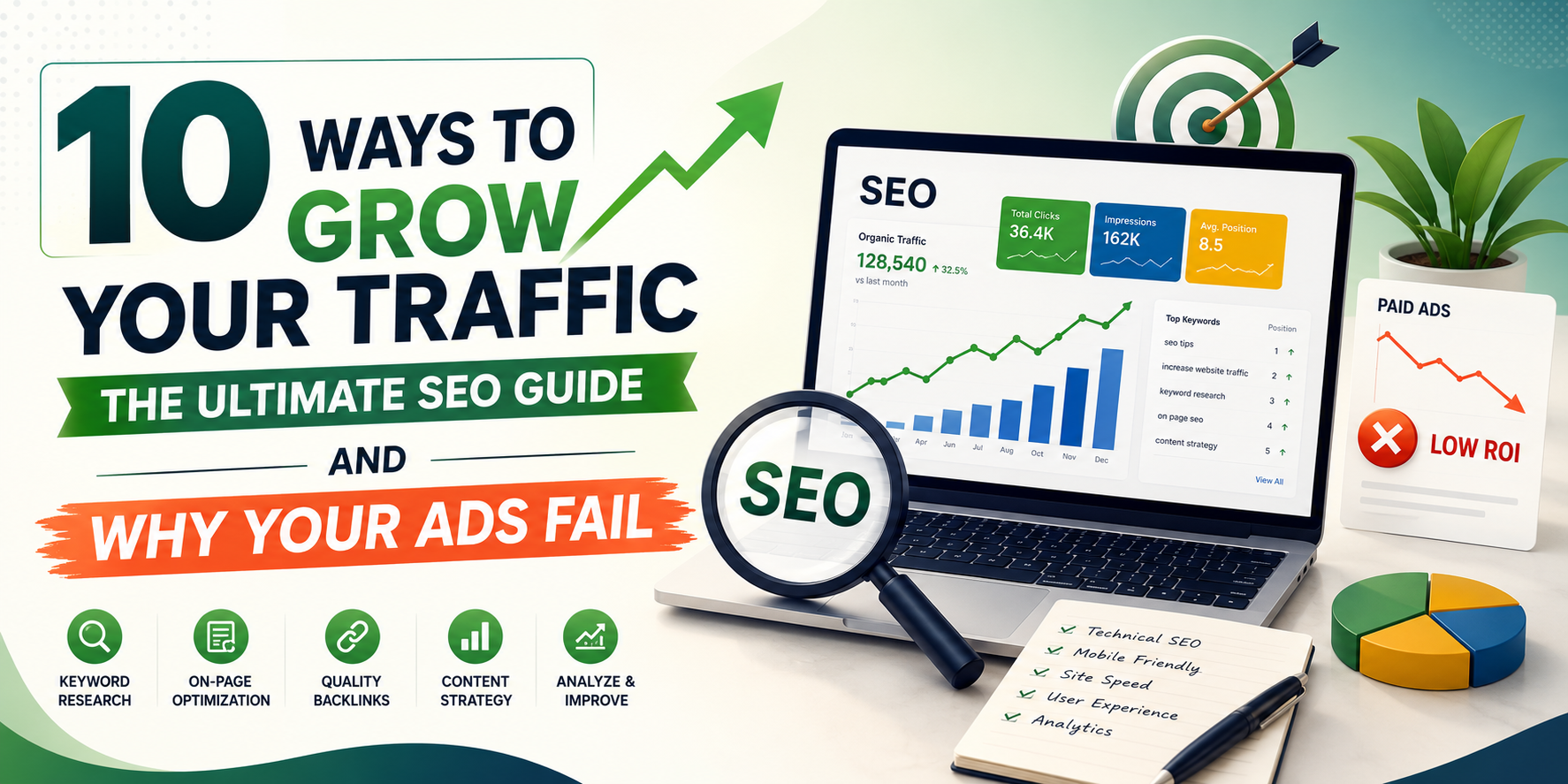
Every business owner has asked the same frustrated question at some point: “Why isn’t my website getting traffic, and why do my ads feel like they’re throwing money into a void?” The truth is, most traffic problems and most ad failures come from the same root cause — a lack of strategy connecting SEO, content, and paid promotion into one system. This guide walks through exactly how to fix that, combining proven traffic-growth tactics, a practical SEO framework, and an honest breakdown of why so many ad campaigns underperform.
What This Guide Covers
Most businesses treat organic traffic, SEO, and paid ads as three separate departments. In reality, they’re deeply connected. Your SEO foundation determines how much your ads cost. Your content determines whether traffic converts once it arrives. And your ad performance data can tell you exactly which keywords to prioritize organically. This guide brings all three together so you’re not fixing one channel while ignoring the two that support it.
Why Traffic Growth Is the Foundation of Everything
Traffic is often dismissed as a vanity metric, but it’s really the entry point to your entire revenue funnel. Without visitors, there are no leads. Without leads, there are no sales. It doesn’t matter how strong your product, pricing, or sales team is if nobody is finding your website in the first place.
What matters even more than raw traffic volume is traffic quality. A hundred visitors who are actively searching for your exact service will almost always outperform ten thousand visitors who landed on your site by accident. This is why organic search traffic, especially from long-tail and local keywords, tends to convert far better than generic display ad traffic — the person searching already has intent.
Growing traffic sustainably also protects your business from rising ad costs. Google Ads and social ad auctions get more expensive every year as competition increases. Businesses that rely solely on paid traffic are vulnerable to shrinking margins. Businesses that build organic traffic alongside ads have a buffer — and often a much lower blended cost per lead.
10 Proven Ways to Grow Your Website Traffic
1. Target Long-Tail Keywords First
Short, high-volume keywords like “SEO company” are extremely competitive and expensive to rank for. Long-tail keywords like “best SEO company in Noida for small business” have lower search volume but much higher intent and far less competition — meaning you can rank faster and convert better.
2. Fix Technical SEO Before Anything Else
No amount of great content will rank if your site loads slowly, isn’t mobile-friendly, or has crawl errors blocking search engines. Core Web Vitals, clean URL structures, proper indexing, and mobile responsiveness form the foundation everything else is built on.
3. Publish Genuinely Helpful, E-E-A-T-Aligned Content
Google’s Helpful Content guidelines reward content written by people with real experience and expertise, not thin, AI-generated filler. Content that answers a searcher’s actual question thoroughly, with clear structure and credible sourcing, consistently outperforms generic content over time.
4. Optimize for Featured Snippets
Structuring content with clear headers, concise definitions, numbered steps, and direct answers to common questions increases your chances of winning the “position zero” snippet — which often gets more clicks than the standard first organic result.
5. Strengthen Local SEO Signals
For service-based businesses, an optimized Google Business Profile, consistent local citations (name, address, phone number across directories), and location-specific keywords can drive some of the fastest traffic gains available, especially for “near me” and city-specific searches.
6. Earn Quality Backlinks, Not Just Many Backlinks
A handful of backlinks from relevant, authoritative sites will do more for your rankings than hundreds of low-quality directory links, as confirmed by Backlinko’s ranking factor studies. Focus on guest posts, partnerships, and content genuinely worth linking to — like original research or comprehensive guides.
7. Optimize for AI Search (AEO and GEO)
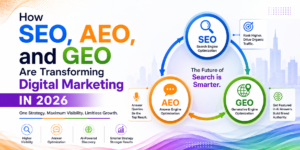
Answer Engine Optimization and Generative Engine Optimization are becoming essential as more searchers use ChatGPT, Perplexity, and Google AI Overviews instead of traditional search. Structuring content in clear question-and-answer formats increases your chances of being cited as a source inside AI-generated answers.
8. Repurpose Every Piece of Content Across Channels
One well-researched blog post can become five LinkedIn posts, a short video script, an email newsletter, and several social captions. This multiplies your reach without multiplying your content production time.
9. Improve On-Page User Experience
High bounce rates and short time-on-page signal to Google that your content isn’t satisfying the searcher’s intent. Clear navigation, fast load times, readable formatting, and relevant internal links keep visitors engaged and improve rankings indirectly.
10. Track Everything and Let Data Guide Decisions
Google Search Console and analytics tools reveal exactly which keywords are already bringing in impressions but low clicks — often the easiest wins available, since you’re already close to ranking and just need to optimize the existing page.
Why this matters: Traffic growth compounds over time. A well-optimized blog post published today can continue generating free, high-intent traffic for years — something no ad campaign can do once the budget runs out.
The Ultimate SEO Guide, In Practical Terms
Strip away the jargon, and SEO comes down to three core pillars working together. Neglecting any one of them weakens the other two.
| Pillar | What It Covers | Why It Matters |
|---|---|---|
| Technical SEO | Site speed, mobile UX, crawlability, structured data, secure hosting | Search engines can’t rank what they can’t properly access or index |
| On-Page SEO | Keyword-optimized titles, headers, meta tags, content depth, internal linking | Tells search engines and users exactly what the page is about |
| Off-Page SEO | Backlinks, brand mentions, social signals, reviews | Builds authority and trust signals beyond your own website |
When these three pillars are executed consistently, most businesses start seeing measurable ranking improvements within 3 to 6 months, with stronger compounding results between months 6 and 12, a timeline consistent with First Page Sage’s SEO timeline research. Highly competitive national keywords take longer; local and long-tail keywords often move faster.
One mistake many businesses make is expecting SEO to behave like a paid ad — instant, linear, and easily attributable to a single change. SEO is closer to compound interest. Small, consistent improvements across technical health, content quality, and authority-building accumulate into significant, durable traffic gains that don’t disappear the moment you stop actively working on them.
Why Your Ads Are Failing (And How to Fix It)
Paid advertising should, in theory, be predictable — you pay, you get traffic, some percentage converts. In practice, many campaigns bleed budget without delivering meaningful ROI. Here’s why:
Wrong Keyword Match Types
Broad match keywords often trigger ads for loosely related, low-intent searches, inflating click costs while attracting visitors who were never going to convert. Tightening match types and building strong negative keyword lists immediately improves ad efficiency.
Weak or Mismatched Landing Pages
Sending paid traffic to a generic homepage instead of a dedicated, offer-specific landing page is one of the most common and most costly mistakes. If the ad promises one thing and the landing page delivers something else, conversion rates collapse.
No Retargeting Strategy
The vast majority of visitors don’t convert on their first visit, regardless of channel. Without a retargeting campaign to bring them back, that initial ad spend is essentially wasted the moment the visitor leaves the site.
Ignoring Quality Score
Google Ads Quality Score rewards strong relevance between your keyword, ad copy, and landing page with a lower cost-per-click. Ignoring quality score means paying more for the same clicks that better-optimized competitors are getting cheaper.
Treating Ads as a Standalone Channel
Ads that run independently of any SEO or content strategy tend to get more expensive over time and stop performing the moment the budget is paused. Ads paired with strong organic content and landing pages consistently outperform ads running in isolation.
Benefits of Combining SEO and Smarter Ad Strategy
- Lower cost-per-click as organic authority and page relevance improve your Quality Score
- Traffic that persists even when ad spend is paused or reduced
- Higher conversion rates from organic visitors who arrive with clear search intent
- Stronger brand trust from appearing in both organic and paid results simultaneously
- More predictable long-term ROI compared to relying on ads alone
- Better data for both channels — ad keyword performance informs SEO priorities, and vice versa
Businesses that integrate SEO and paid strategy typically see their overall cost per lead decrease over time, even as ad platform costs rise industry-wide, because organic traffic absorbs more of the top-of-funnel load.
Want a traffic and SEO strategy built specifically for your business?Talk to Click Catcher
Frequently Asked Questions
1. How long does SEO take to show results?
Most businesses start seeing measurable movement within 3 to 6 months, with stronger, compounding results between 6 and 12 months. Local and long-tail keywords often move faster than highly competitive national terms.
2. Should I focus on SEO or paid ads first?
Ideally both, working together. If budget is limited, prioritize SEO for long-term, low-cost traffic, and layer in paid ads once your landing pages and technical SEO are solid enough to convert that traffic efficiently.
3. Why are my Google Ads expensive but not converting?
This usually comes down to broad keyword targeting, a weak or mismatched landing page, and a low Quality Score. Tightening keyword match types and aligning your landing page with the ad’s promise typically improves results quickly.
4. What’s the fastest way to grow website traffic?
Targeting long-tail, low-competition keywords with genuinely helpful content usually brings the fastest visible gains, especially when paired with fixing basic technical SEO issues like site speed and mobile usability.
5. Does AI search like ChatGPT and AI Overviews affect my SEO strategy?
Yes, increasingly so. Structuring content to directly and clearly answer specific questions (an approach known as AEO/GEO) improves your chances of being cited as a source inside AI-generated answers, not just ranked in traditional search results.