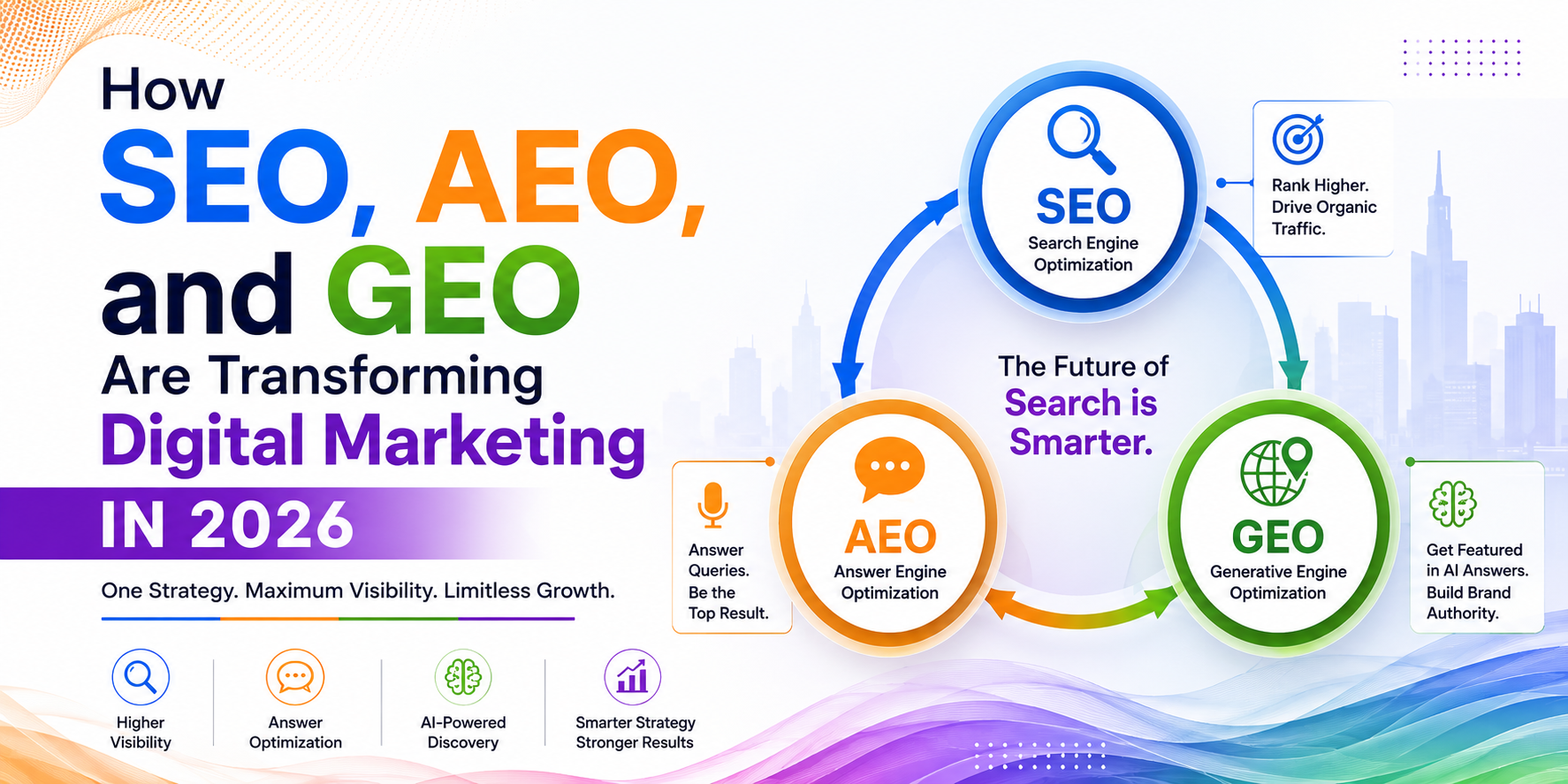
The digital marketing landscape is evolving rapidly, and businesses can no longer rely solely on traditional Search Engine Optimization (SEO) to gain visibility online. In 2026, Answer Engine Optimization (AEO) and Generative Engine Optimization (GEO) have become equally important for brands looking to connect with customers through search engines, AI-powered assistants, and generative search platforms.
As search behavior changes, businesses need a comprehensive strategy that combines SEO, AEO, and GEO to remain competitive. Understanding how these three approaches work together can help organizations improve visibility, increase traffic, and reach users across multiple digital channels.
Understanding SEO in 2026
Search Engine Optimization (SEO) remains the foundation of digital marketing. SEO focuses on improving a website’s visibility in search engine results pages (SERPs) by optimizing content, keywords, technical elements, and user experience.
Modern SEO strategies include:
- Keyword research and optimization
- Mobile-friendly website design
- Page speed improvements
- Quality content creation
- Internal linking
- Technical SEO enhancements
- Backlink building
While SEO continues to drive organic traffic, search engines have become more intelligent. They now prioritize user intent, content relevance, and overall experience rather than simple keyword matching.
What is Answer Engine Optimization (AEO)?
Answer Engine Optimization (AEO) focuses on helping content appear as direct answers to user queries. With the rise of voice search, AI assistants, and featured snippets, users increasingly expect immediate answers rather than lists of links.
AEO helps businesses optimize content for:
- Featured snippets
- Voice search results
- FAQ sections
- Knowledge panels
- AI-generated summaries
To succeed with AEO, businesses should structure content in a clear question-and-answer format, provide concise explanations, and use schema markup where appropriate.
For example, if a user asks, “What is AEO?” search engines and AI assistants can extract a direct answer from optimized content rather than requiring users to visit multiple websites.
What is Generative Engine Optimization (GEO)?
Generative Engine Optimization (GEO) is one of the fastest-growing digital marketing trends in 2026. GEO focuses on optimizing content for AI-powered search platforms and generative engines such as ChatGPT, Gemini, Copilot, and other AI-driven discovery systems.
Unlike traditional search engines, generative platforms summarize information from multiple sources and provide direct responses to users.
GEO strategies include:
- Publishing authoritative content
- Creating topic-focused content clusters
- Using clear and factual information
- Building brand credibility
- Demonstrating expertise and trustworthiness
- Maintaining consistent online mentions
When AI systems recognize a brand as a reliable source of information, they are more likely to reference or recommend that brand within generated responses.
Why SEO Alone is No Longer Enough
A few years ago, ranking on the first page of search results was the primary goal of digital marketing. Today, users interact with information differently.
People now:
- Ask AI assistants for recommendations
- Use voice search on mobile devices
- Expect instant answers
- Engage with AI-generated search experiences
- Seek localized and personalized results
As a result, businesses that focus only on SEO may miss opportunities to appear in AI responses and answer-based search results.
Combining SEO, AEO, and GEO creates a stronger digital presence across multiple platforms.
How SEO, AEO, and GEO Work Together
These three strategies are not competitors. Instead, they complement one another.
SEO Builds Visibility
SEO helps search engines discover, index, and rank your content.
AEO Delivers Direct Answers
AEO improves your chances of appearing in featured snippets, voice searches, and quick-answer sections.
GEO Expands AI Visibility
GEO increases the likelihood that AI-powered platforms will reference your brand and content when generating responses.
Together, they create a comprehensive digital marketing framework designed for modern search behavior.
Key Benefits of SEO, AEO, and GEO Integration
Improved Online Visibility
Businesses can appear across search engines, AI assistants, voice search results, and generative platforms.
Better User Experience
Well-structured content helps users quickly find the information they need.
Increased Organic Traffic
Optimized content attracts visitors from multiple discovery channels.
Enhanced Brand Authority
Consistent, trustworthy information helps establish credibility within your industry.
Future-Proof Marketing Strategy
As AI adoption grows, businesses with GEO-focused content will be better positioned for long-term success.
Best Practices for Businesses in 2026
To maximize results, businesses should:
- Create comprehensive and informative content.
- Use question-based headings and FAQs.
- Implement structured data and schema markup.
- Optimize for mobile devices and page speed.
- Build topical authority through content clusters.
- Focus on expertise, trustworthiness, and accuracy.
- Regularly update outdated information.
- Monitor AI search trends and user behavior.
These practices help improve performance across SEO, AEO, and GEO simultaneously.
The Future of Digital Marketing
Digital marketing is moving beyond traditional search engine rankings. Consumers now discover information through search engines, AI assistants, voice technologies, and generative platforms.
Businesses that adapt to these changes by embracing SEO, AEO, and GEO will be better equipped to attract customers, build trust, and maintain visibility in an increasingly AI-driven world.
Organizations that begin optimizing for all three today can gain a significant competitive advantage as digital search continues to evolve throughout 2026 and beyond.
Conclusion
SEO, AEO, and GEO are transforming the way businesses approach digital marketing in 2026. While SEO remains essential for search visibility, AEO helps brands provide direct answers, and GEO ensures relevance within AI-powered search experiences.
By combining these strategies, businesses can improve discoverability, strengthen brand authority, and reach audiences wherever they search for information. The future of digital marketing belongs to brands that understand how search engines, answer engines, and generative engines work together.
Frequently Asked Questions (FAQs)
1. What is the difference between SEO, AEO, and GEO?
SEO focuses on improving rankings in search engines, AEO focuses on providing direct answers for users, and GEO focuses on optimizing content for AI-powered generative search platforms.
2. Why is GEO important in 2026?
GEO is important because more users are relying on AI tools and generative search engines to find information, recommendations, and solutions.
3. Can businesses use SEO, AEO, and GEO together?
Yes. Combining SEO, AEO, and GEO creates a stronger digital marketing strategy that improves visibility across multiple search and AI platforms.
4. How does AEO improve search performance?
AEO helps content appear in featured snippets, voice search results, and direct answer sections, increasing visibility and user engagement.
5. What are the best GEO optimization techniques?
Publishing authoritative content, building topical expertise, maintaining factual accuracy, and establishing brand credibility are among the most effective GEO optimization techniques.