In today’s digital landscape, ranking on search engines is no longer optional for businesses that want consistent online growth. Whether you run an eCommerce store, service-based company, blog, or corporate website, search engine optimization helps bring targeted visitors directly to your website. The challenge is that SEO keeps evolving, and businesses that rely on outdated methods often struggle to generate results.
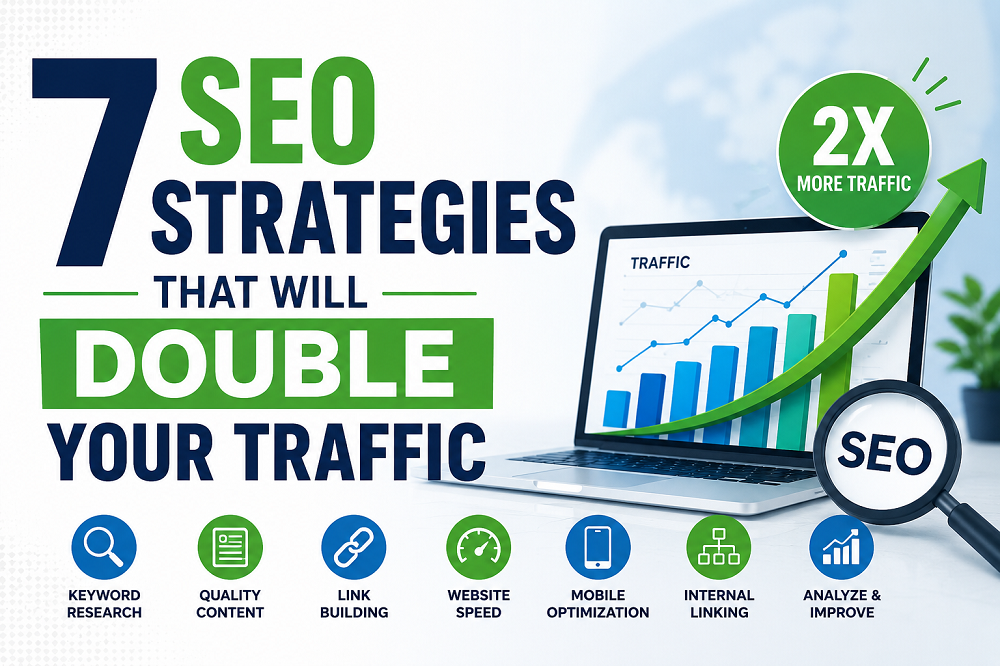
The good news is that improving your website traffic does not always require massive advertising budgets. By applying the right SEO strategies consistently, businesses can significantly increase visibility, improve rankings, and drive quality organic traffic. In this blog, we will explore seven proven SEO strategies that can help double your website traffic and improve long-term online performance.
1. Focus on Search Intent Instead of Just Keywords
Many websites still make the mistake of stuffing pages with keywords without understanding what users actually want. Modern SEO is centered around search intent. Google prioritizes pages that provide the most relevant and useful answers to users.
Search intent generally falls into four categories:
- Informational
- Navigational
- Transactional
- Commercial Investigation
For example, someone searching for “best laptops for graphic design” wants recommendations and comparisons, while a user searching “buy gaming laptop online” is ready to make a purchase.
To optimize for search intent:
- Understand what users expect from the query
- Analyze top-ranking pages
- Create detailed and relevant content
- Match your page format with user expectations
When your content aligns with user intent, visitors stay longer on your website, engagement improves, and rankings gradually increase.
2. Create High-Quality Long-Form Content
Content remains one of the strongest ranking factors in SEO. However, short and generic blogs no longer perform well in competitive industries. Google prefers detailed, informative, and value-driven content that thoroughly covers a topic.
Long-form content often performs better because it:
- Covers topics in depth
- Includes multiple related keywords naturally
- Increases user engagement
- Improves dwell time
- Attracts backlinks
A good SEO blog should include:
- Proper headings and subheadings
- Relevant keywords
- FAQs
- Internal links
- Actionable information
- Readable formatting
Instead of publishing multiple short blogs, focus on creating comprehensive content that solves user problems effectively.
3. Optimize Your Website Speed and Performance
Website speed directly affects both user experience and search engine rankings. Users expect websites to load quickly, and even a few seconds of delay can increase bounce rates significantly.
Google also considers Core Web Vitals as an important ranking signal. These metrics evaluate loading performance, visual stability, and responsiveness.
Ways to improve website speed include:
- Compressing images
- Using WebP image formats
- Minimizing CSS and JavaScript files
- Enabling browser caching
- Using a reliable hosting provider
- Implementing a CDN
- Removing unnecessary plugins
A faster website improves user satisfaction and helps search engines crawl your pages more efficiently.
Website Speed Test Tool – https://pagespeed.web.dev/
4. Build Strong Internal Linking Structure
Internal linking is one of the most underrated SEO strategies. A well-planned internal linking structure helps search engines understand your website hierarchy while guiding users to related content.
Benefits of internal linking include:
- Improved page authority distribution
- Better crawling and indexing
- Increased page views
- Reduced bounce rate
- Enhanced user navigation
For example, if you publish a blog about “digital marketing,” you can internally link it to pages related to SEO services, social media marketing, or content marketing.
Best practices for internal linking:
- Use descriptive anchor text
- Link relevant pages naturally
- Avoid excessive linking
- Regularly update old blogs with new links
Strong internal linking creates a connected website structure that benefits both users and search engines.
5. Optimize for Mobile Users
Mobile optimization is no longer optional because most internet users browse websites through smartphones. Google uses mobile-first indexing, meaning it primarily evaluates the mobile version of your website for rankings.
A poorly optimized mobile website can lead to:
- Higher bounce rates
- Lower rankings
- Poor user experience
- Reduced conversions
To improve mobile SEO:
- Use responsive web design
- Optimize font sizes
- Improve touch navigation
- Compress mobile images
- Avoid intrusive popups
- Ensure fast loading on mobile devices
A mobile-friendly website helps improve user engagement and boosts your visibility on search engines.
6. Earn High-Quality Backlinks
Backlinks continue to play a major role in SEO rankings. When reputable websites link to your content, search engines view your website as more trustworthy and authoritative.
However, quality matters more than quantity. A few strong backlinks from relevant websites can be more effective than hundreds of low-quality links.
Effective ways to build backlinks include:
- Guest blogging
- Publishing informative blogs
- Creating industry research
- Sharing infographics
- Building partnerships
- Listing your business on trusted directories
Avoid spammy link-building techniques because they can negatively affect your rankings.
The focus should always be on earning natural and relevant backlinks that improve your website authority over time.
7. Update and Refresh Old Content Regularly
Many businesses focus only on creating new content while ignoring existing pages. Updating old content can often generate faster SEO improvements than publishing brand-new blogs.
Search engines prefer fresh and updated information. Revisiting older content allows you to:
- Add updated statistics
- Improve keyword targeting
- Enhance readability
- Add internal links
- Optimize metadata
- Include new FAQs
For example, a blog published two years ago may still have ranking potential if updated properly with current information.
Regular content updates signal relevance to search engines and help maintain strong rankings.
Additional SEO Tips for Faster Growth
Apart from the major strategies above, businesses can further improve SEO performance by:
- Optimizing meta titles and descriptions
- Using schema markup
- Improving image SEO
- Creating location-based pages
- Targeting long-tail keywords
- Monitoring Google Search Console data
- Tracking user behavior with analytics tools
SEO is not a one-time process. Consistent optimization and continuous improvement are essential for long-term traffic growth.
Common SEO Mistakes to Avoid
While implementing SEO strategies, businesses should also avoid common mistakes such as:
- Keyword stuffing
- Duplicate content
- Broken links
- Ignoring technical SEO
- Slow-loading pages
- Poor mobile experience
- Low-quality backlinks
- Missing metadata
Even small technical issues can affect website rankings and user experience significantly.
Why Consistency Matters in SEO
One of the biggest misconceptions about SEO is expecting immediate results. SEO is a long-term strategy that requires patience and consistency.
Websites that regularly publish optimized content, improve technical performance, and provide value to users typically see stronger results over time.
Consistent SEO efforts lead to:
- Sustainable traffic growth
- Higher search rankings
- Better brand visibility
- Improved lead generation
- Increased customer trust
Businesses that stay committed to SEO often achieve long-lasting digital growth without depending entirely on paid advertising.
Conclusion
SEO continues to be one of the most effective digital marketing strategies for increasing website traffic and business visibility. By focusing on search intent, creating quality content, improving website performance, building backlinks, optimizing for mobile users, strengthening internal links, and updating existing content, businesses can significantly improve their search engine rankings.
The key to successful SEO lies in consistency, user-focused optimization, and adapting to changing search engine algorithms. While results may take time, the long-term benefits of SEO make it one of the most valuable investments for any business looking to grow online.
If implemented correctly, these seven SEO strategies can help your website attract more visitors, improve engagement, and build a stronger online presence over time.
FAQs
1. What is the fastest way to improve website traffic through SEO?
The fastest way to improve website traffic is by optimizing content for search intent, improving website speed, targeting relevant keywords, and publishing high-quality blogs consistently.
2. Why is long-form content important for SEO?
Long-form content helps cover topics in depth, improves keyword visibility, increases user engagement, and creates better opportunities for ranking on search engines.
3. How does internal linking help SEO?
Internal linking helps search engines understand website structure, improves page authority distribution, increases page views, and enhances user navigation.
4. Do backlinks still matter for SEO in 2026?
Yes, high-quality backlinks remain an important ranking factor because they help build website authority and trust in search engines.
5. How long does SEO take to show results?
SEO is a long-term strategy, and results usually begin appearing within a few months depending on competition, content quality, and website optimization efforts.
Follow Us on Social Media – Facebook, Instagram, LinkedIn, YouTube