Organic click-through rates are collapsing wherever AI Overviews appear. Here’s what the data actually shows, and the exact strategy shift that keeps businesses visible.
On this page
- What’s actually happening to your clicks
- The data: how bad is the click collapse, really
- Who’s getting hit hardest
- Cited vs. uncited: the gap that matters most
- The 2026 visibility playbook
- Mistakes still costing brands visibility
- FAQs
If your organic traffic has quietly slipped over the last year even though your rankings look fine on paper, you’re not imagining it. Google’s AI Overviews — the AI-generated summaries that now sit above traditional search results — are rewriting how people search, and they’re taking a large chunk of your clicks with them.
This isn’t a fringe problem affecting a handful of niche publishers. It’s a structural shift in how search works, and it’s hitting informational content, health and finance sites, and yes, small and mid-sized business websites across India and globally. The good news: visibility hasn’t disappeared, it’s just moved. This guide breaks down exactly what’s happening, backed by the latest 2026 data, and what to actually do about it.
What’s Actually Happening to Your Clicks
AI Overviews sit at the very top of the Google search results page and answer the user’s question directly, using information synthesized from multiple websites — often including yours, without sending you a visitor. Instead of scanning ten blue links, users read a two-paragraph AI-generated answer and, in a growing number of cases, never click through to any website at all.
Google frames this as a UX improvement. The company describes the underlying mechanism as “query fan-out,” where it generates parallel sub-queries to dig deeper into the web and surface the most relevant sites for a search. Whatever the framing, the effect on publisher and business traffic is measurable and significant.
Why this matters for your business
If your website depends on Google search for leads — and for most Delhi NCR businesses it still does — a drop in click-through rate means fewer people landing on your site even if your rankings haven’t moved. Ranking #1 no longer guarantees a visitor.
The Data: How Bad is the Click Collapse, Really?
Multiple independent studies from late 2025 into 2026 point in the same direction, even though they measure the impact slightly differently. Here’s what the numbers actually say.
58%CTR drop for the #1 ranking result when an AI Overview appears
68%of US Google searches now end without any click
48%of all queries now trigger an AI Overview
80-83%zero-click rate specifically on AI Overview queries
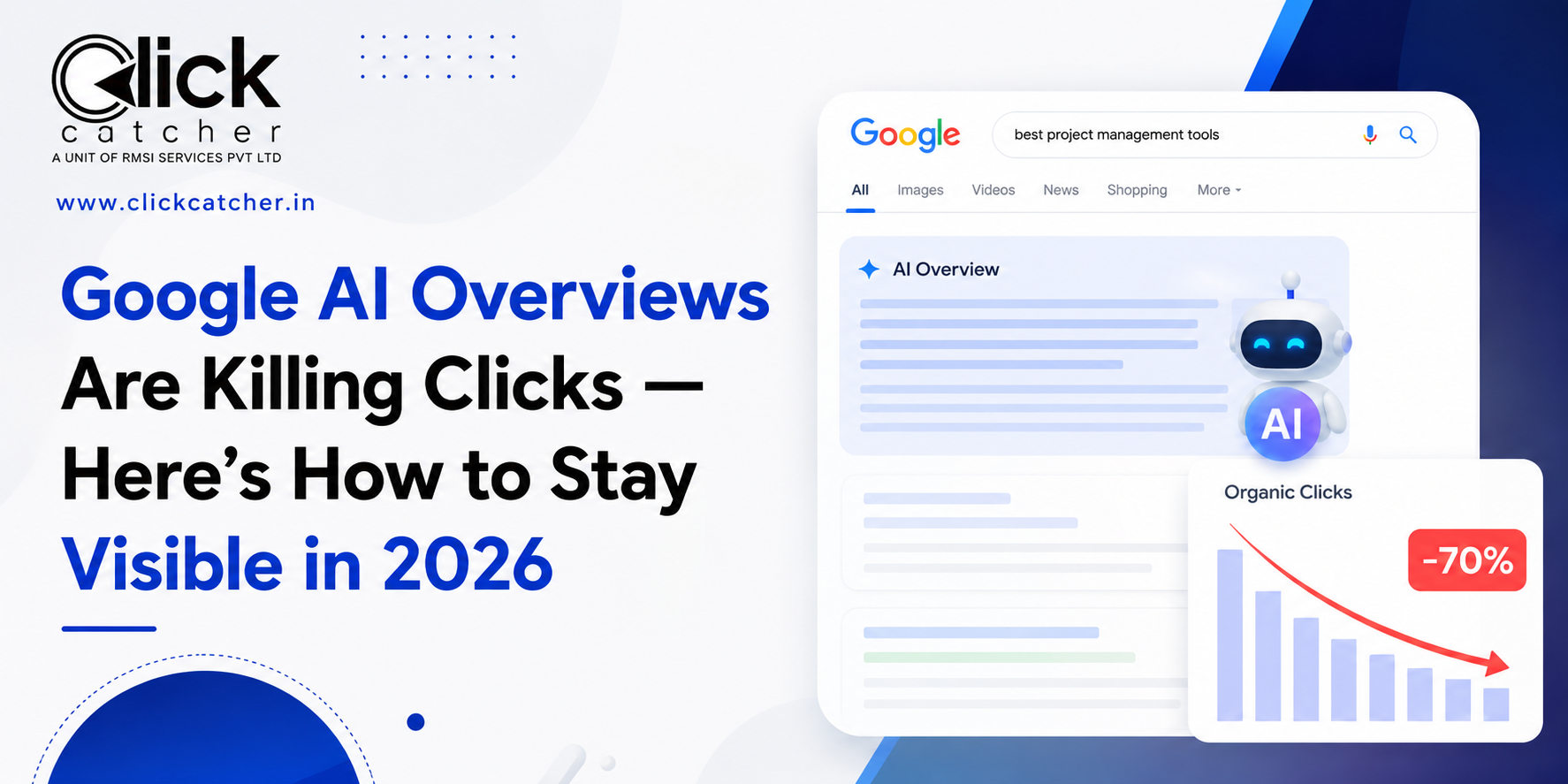
According to an Ahrefs study covering data through December 2025, the presence of an AI Overview on a search results page led to a 58% reduction in click-through rate for the top-ranking organic result. That’s a sharp acceleration — the same research showed only a 34.5% drop back in April 2025, meaning the erosion is speeding up, not levelling off.
The zero-click picture is just as stark. Research covered by Search Engine Land found that the share of Google searches ending in a click fell 9.51 percentage points between 2024 and 2026, roughly a 23% decline overall. Zero-click searches reached 68% of US queries by early 2026, up from about 60% just two years earlier.
Perhaps the most revealing figure comes from Pew Research’s browsing-behaviour study, which tracked actual user sessions rather than SERP-level estimates: when an AI Overview appears, only 8% of users click through to a traditional search result, compared to 15% when no overview is shown — a relative click-rate decline of roughly 47%. Even more telling: clicks on links placed inside the AI answer itself sit at just 1%, and 26% of sessions end entirely right after seeing an AI Overview, versus 16% for sessions without one.
Comparing the major studies
| Source | Metric measured | Reported decline |
|---|---|---|
| Ahrefs | CTR for #1 result when AI Overview appears | 58% |
| Pew Research | Actual click-through behaviour (browsing data) | ~47% relative decline |
| Seer Interactive | Organic CTR on AI Overview queries | Up to 61-65% |
| SparkToro | Zero-click search share (all queries) | 68% of searches (2026) |
These numbers use different methodologies and aren’t directly comparable one-to-one, but the direction of travel is unmistakable. As one 2026 industry analysis put it, these are not contradictory findings — they measure different things: user behaviour, keyword-level CTR, and overall search volume, and every angle points to fewer clicks reaching websites.
Who’s Getting Hit Hardest
Not every query type is affected equally. AI Overviews trigger far more often on some topics than others, and that determines how much traffic risk your business content actually carries.
- Healthcare and medical content: AI Overviews appear on roughly 88% of healthcare-related queries, the highest of any vertical.
- Educational content: Overviews trigger on about 83% of education queries.
- Informational “what is” and “how to” queries: These are hit hardest across the board, since AI Overviews are built to answer exactly this kind of question directly on the results page.
- Entertainment and transactional queries: Entertainment queries trigger overviews only about 37% of the time, giving these categories more breathing room.
For an agency-run blog, service pages, or a local business site, this means top-of-funnel “guide” and “explainer” style content is now the most exposed to click loss — even though it’s usually the content that drives the most search volume.
Cited vs. Uncited: The Gap That Matters Most Now
Here’s the part of the data that should change how you prioritize your content strategy: getting cited inside the AI Overview is dramatically better than not being cited at all, even if neither guarantees the click volume you used to get.
The citation gap
When an AI Overview cites a page, that page earns roughly 2.1% CTR. An uncited page on the same results page earns only about 0.9% — both trail the no-overview baseline of around 3.3%, but being cited still roughly doubles your odds of a click compared to being ignored.
This pattern holds beyond raw CTR too. Brands cited within AI Overviews see about 35% more organic clicks and 91% more paid clicks compared to brands that go uncited on the same query. The strategic implication is simple: the goal is no longer just ranking — it’s becoming the source the AI decides to cite.
There’s also a quality signal worth watching. Research has found that Google’s AI Overviews have relied heavily on YouTube for health-related queries, which raises real questions about how carefully AI systems are actually vetting source authority versus convenience. That’s a gap smaller, well-structured businesses can exploit if they build genuinely authoritative, well-cited content.
The 2026 Visibility Playbook
Chasing rankings alone is no longer enough. Here’s the strategy shift that’s actually working for businesses trying to stay visible through 2026.
1. Optimize to get cited, not just to rank
Structure content so it’s easy for an AI system to lift and cite directly: clear, direct answers near the top of the page, descriptive subheadings phrased as questions, and concise definitions before you go deep. Industry analysis on GEO trends notes that keyword density now matters less than extractability and clarity — content needs to be engineered to be “easy-to-cite,” with strong authority signals so AI systems see the site as a safe source to pull from.
2. Build topical authority, not one-off pages
AI models understand the world through entities and the relationships between them rather than keywords alone, which means an entity-first approach that covers a topic in genuine depth now outperforms shallow, generic content built purely to target a single keyword. For Click Catcher clients, this means clustering content — a pillar page on “digital marketing services” supported by deep-dive pages on SEO, GEO, SMO, and web development, all interlinked — rather than scattered standalone posts.
3. Don’t abandon traditional SEO fundamentals
It’s tempting to chase GEO tactics aggressively, but the data on doing so is mixed. One controlled study found that running a page through a typical GEO checklist — adding statistics, quotations, source citations, and an authoritative tone — actually resulted in a lower citation rate on GPT-4o-mini than leaving the page untouched. Core Web Vitals, mobile responsiveness, and page speed still matter enormously: Interaction to Next Paint (INP) is rolling out globally in 2026 as a central ranking signal, and fast, mobile-first, accessible websites continue to win with both users and AI systems alike.
4. Target queries less likely to trigger an overview
Since AI Overviews trigger far less often on transactional, local, and entertainment-style queries, shift more content investment toward bottom-of-funnel, high-intent, and locally specific searches — “best web development company in Noida” behaves very differently in the SERP than “what is web development.”
5. Diversify beyond Google
Searchers are increasingly asking multi-step, natural-language questions across multiple AI engines, and visibility can be high on one platform like Perplexity and low on Google’s AI layer, or vice versa. Track your brand’s presence across ChatGPT, Perplexity, and Google AI Overviews separately rather than assuming Google performance predicts everything else.
6. Measure differently
Raw click volume is increasingly the wrong single metric to obsess over. One case study found that a very small share of visitors arriving through AI referral traffic drove a disproportionate, 20x increase in AI-driven sales — meaning smaller AI-referred traffic can still convert exceptionally well. Track leads and conversions from AI-referred sessions specifically, not just session counts.
Mistakes Still Costing Brands Visibility
- Treating GEO as a bolt-on checklist: stuffing in citations and stats without genuine depth can backfire, as the GPT-4o-mini study above shows.
- Ignoring Core Web Vitals: a slow, non-mobile-friendly site loses on both traditional rankings and AI citation eligibility.
- Writing only for keywords, not for entities and intent: shallow, keyword-stuffed pages are exactly what AI systems now skip over.
- Measuring success by click volume alone: ignoring conversion quality from the (smaller) AI-referred audience means missing where the real value is showing up.
- Optimizing for Google only: skipping visibility tracking on ChatGPT and Perplexity leaves a growing share of AI-driven discovery unmanaged.
Don’t Let AI Overviews Erase Your Search Visibility
Click Catcher helps Delhi NCR businesses stay visible across Google, AI Overviews, and AI search platforms with GEO-ready content, technical SEO, and a strategy built for how search actually works in 2026.
Frequently Asked Questions
Do AI Overviews really reduce website traffic?
Yes. Multiple 2026 studies confirm it — Ahrefs found a 58% CTR drop for the top-ranking result when an AI Overview appears, and Pew Research’s browsing-behaviour data found click-through falls from around 15% to 8% when an overview is shown on the results page.
Can I stop my website from appearing in AI Overviews?
You can block Google-Extended and related crawlers via robots.txt, but this typically also affects your eligibility to be cited or ranked, which usually costs more visibility than it protects. Most businesses are better served by optimizing to get cited rather than opting out entirely.
Is GEO replacing traditional SEO?
No. Industry data still shows SEO traffic significantly outweighs GEO-driven traffic, and traditional ranking factors like Core Web Vitals, backlinks, and site structure remain central to both classic search rankings and AI citation eligibility. GEO is an addition to SEO, not a replacement for it.
Which types of content are most affected by AI Overviews?
Informational “what is” and “how to” style content is hit hardest, along with health, finance, and education queries where AI Overviews trigger most frequently. Transactional, local, and entertainment queries are affected less often.
How can a small business measure the real impact of AI Overviews on its site?
Track click-through rate and conversions specifically on queries where an AI Overview appears versus where it doesn’t, using Google Search Console’s query-level data alongside AI-referral traffic in analytics. Watch conversion quality, not just click volume, since AI-referred visitors often convert differently than traditional organic traffic.