Digital marketing has never had more channels, tools, or noise. New platforms launch every year, algorithms change every quarter, and AI is rewriting how people search. Yet the businesses that grow consistently are not chasing every trend. They are building on a small set of fundamentals that keep working.
At Click Catcher, a digital marketing agency in Noida serving businesses across Delhi NCR, we see the same pattern in every successful campaign: strong pillars, executed well, and connected to each other. This guide breaks down the five core pillars every marketer must know, what each one does, and how to measure it.
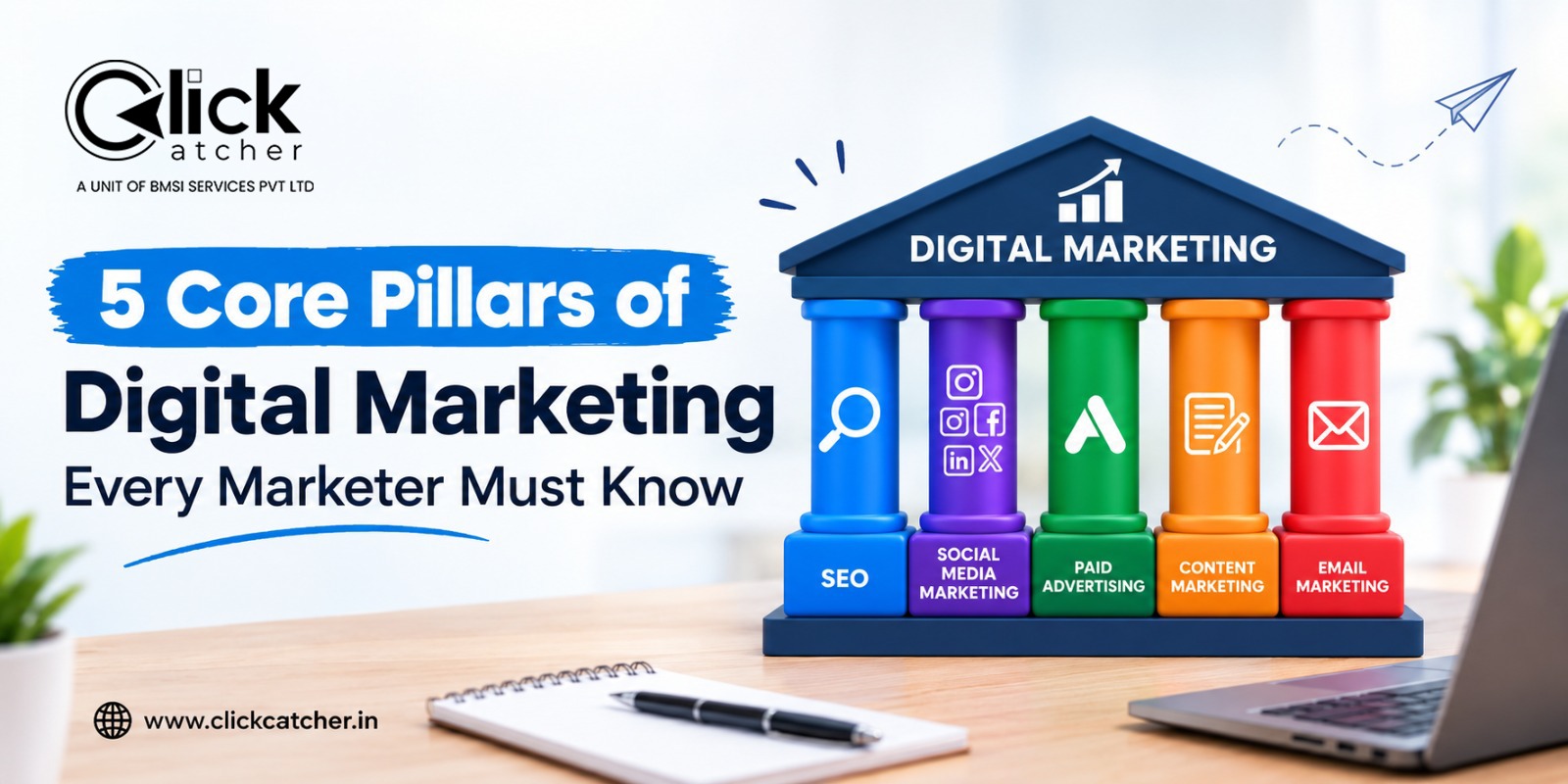
Quick Answer: The 5 core pillars of digital marketing are Search Engine Optimization (SEO), Content Marketing, Social Media Marketing, Paid Advertising (PPC), and Email Marketing, all supported by analytics and data-driven decisions.
Why Digital Marketing Needs a Pillar-Based Approach
Many businesses treat marketing as a set of disconnected tasks: a few social posts here, a boosted ad there, an occasional newsletter. This creates activity but not growth. A pillar-based approach gives every channel a clear role in the customer journey, from first discovery to repeat purchase.
Think of it as a building. SEO and content bring people in, social media builds familiarity, paid ads accelerate reach, and email turns interest into loyalty. Remove one pillar and the structure gets weaker. According to HubSpot’s marketing statistics, brands that combine multiple channels consistently outperform those that rely on a single one.
| Pillar | Main Role | Funnel Stage | Speed of Results |
| SEO | Organic visibility and trust | Awareness to Consideration | Slow, compounding |
| Content Marketing | Education and authority | Awareness to Decision | Medium |
| Social Media Marketing | Community and brand recall | Awareness to Engagement | Medium |
| Paid Advertising (PPC) | Instant traffic and leads | Consideration to Conversion | Fast |
| Email Marketing | Nurturing and retention | Decision to Loyalty | Fast to medium |
Pillar 1: Search Engine Optimization (SEO)
SEO is the practice of improving your website so it appears higher in search results for the queries your customers actually use. It remains the most cost-efficient long-term traffic source because rankings keep delivering visitors without paying per click.
What SEO Includes
- On-page SEO: titles, meta descriptions, headings, internal links, and keyword-focused content.
- Technical SEO: site speed, mobile-friendliness, crawlability, schema markup, and secure hosting.
- Off-page SEO: backlinks, brand mentions, and digital PR.
- Local SEO: Google Business Profile, local citations, and reviews, vital for city-focused businesses.
Google’s own SEO Starter Guide is an excellent baseline, and Moz’s Beginner’s Guide to SEO covers the fundamentals step by step.
2026 Insight: Search is no longer just ten blue links. AI Overviews and answer engines now summarize content directly, so modern SEO must also cover GEO (Generative Engine Optimization) and AEO (Answer Engine Optimization). Clear structure, direct answers, and strong E-E-A-T signals matter more than ever.
Key metrics: organic traffic, keyword rankings, click-through rate, and conversions from organic search.
Pillar 2: Content Marketing
Content is the fuel for every other pillar. Blogs, videos, guides, case studies, and infographics answer customer questions, build trust, and give search engines something to rank. Good content does not sell aggressively. It helps first, and the sale follows.
Content Formats That Work
| Format | Best For | Example |
| Blog posts | SEO and education | How-to guides, comparisons |
| Case studies | Building trust and proof | Client growth stories |
| Short videos | Reach and engagement | Reels, Shorts, explainers |
| Infographics | Shareability and backlinks | Data-led visuals |
| E-books and guides | Lead generation | Gated industry reports |
The Content Marketing Institute regularly publishes research showing that documented content strategies deliver better results than ad-hoc publishing. The rule is simple: publish consistently, match content to search intent, and refresh older posts regularly.
Key metrics: time on page, scroll depth, social shares, backlinks earned, and leads generated per piece.
Pillar 3: Social Media Marketing
Social media is where your audience spends a large part of their day. It works best as a relationship channel rather than a broadcast tool. Consistent, valuable posting builds recognition, so when a customer is ready to buy, your brand is already familiar.
Choosing the Right Platform
| Platform | Audience | Best Use |
| Consumers, lifestyle, D2C | Reels, visuals, stories | |
| Professionals, B2B | Thought leadership, lead generation | |
| Broad, local communities | Groups, local ads, events | |
| YouTube | Learners and researchers | Tutorials, long-form video |
| X (Twitter) | News, tech, trends | Real-time engagement |
You do not need to be everywhere. Pick two or three platforms where your customers are active and do them well. Meta’s Business Hub and LinkedIn Business offer free resources to get started.
Key metrics: engagement rate, reach, follower growth, saves, shares, and referral traffic.
Pillar 4: Paid Advertising (PPC)
Paid advertising puts your offer in front of the right audience immediately. Unlike SEO, you pay for visibility, but you get precise targeting, fast testing, and measurable return. It is ideal for product launches, seasonal offers, and businesses that need leads now.
Common Paid Channels
- Google Ads: captures high-intent searches through search, shopping, and display campaigns.
- Meta Ads: targets by interests, behavior, and lookalike audiences on Facebook and Instagram.
- LinkedIn Ads: reaches decision-makers by job title and industry.
- Retargeting: brings back visitors who did not convert the first time.
Start with Google Ads for intent-based demand and test small budgets before scaling. Pair every campaign with a dedicated landing page that matches the ad message.
Pro Tip: Paid and organic work best together. Use ad data to discover which keywords and messages convert, then build SEO content around them.
Key metrics: cost per click, cost per lead, conversion rate, and return on ad spend (ROAS).
Pillar 5: Email Marketing
Email is the one channel you fully own. There is no algorithm between you and your subscriber. It consistently delivers some of the highest returns in digital marketing because the audience has already shown interest.
Email Types Every Business Should Use
| Email Type | Purpose | Trigger |
| Welcome series | Introduce your brand and set expectations | New subscriber |
| Newsletter | Stay top of mind with useful content | Weekly or monthly |
| Abandoned cart | Recover lost sales | Cart left without checkout |
| Re-engagement | Win back inactive contacts | No opens for 60 to 90 days |
| Promotional | Drive offers and sales | Campaign or season |
Segment your list, personalize subject lines, and keep each email focused on one action. Platforms like Mailchimp make automation accessible even for small teams.
Key metrics: open rate, click-through rate, conversion rate, unsubscribe rate, and revenue per email.
The Glue: Analytics and Data
The five pillars only work if you measure them. Set up Google Analytics 4 and Google Search Console from day one, define conversion goals, and review performance monthly. Data tells you which pillar deserves more budget and which needs fixing.
How the Five Pillars Work Together
Here is a simple example. A blog post (content) ranks on Google (SEO), gets shared on LinkedIn and Instagram (social), is promoted through a retargeting campaign (paid), and feeds a lead magnet that starts an email sequence (email). One asset, five pillars, one connected customer journey.
| Business Stage | Priority Pillars |
| New business (0 to 6 months) | PPC, Social Media, Local SEO |
| Growing business (6 to 18 months) | SEO, Content, Email |
| Established brand (18+ months) | All five plus advanced analytics and automation |
Common Mistakes to Avoid
- Spreading budget across every channel instead of mastering a few.
- Publishing content with no keyword or intent research.
- Running ads without optimized landing pages.
- Ignoring email because it feels “old school.”
- Skipping tracking, then guessing what works.
Frequently Asked Questions
What are the 5 pillars of digital marketing?
SEO, content marketing, social media marketing, paid advertising (PPC), and email marketing, supported by analytics.
Which pillar should a small business start with?
Most local businesses see the fastest early results from Google Business Profile optimization, local SEO, and a small paid campaign, then add content and email as they grow.
How long does digital marketing take to show results?
Paid ads can generate leads within days. SEO and content typically take 3 to 6 months to build meaningful momentum.
Is SEO still relevant with AI search?
Yes. AI answer engines pull from well-optimized, authoritative content, so SEO, GEO, and AEO now work together.
Should I hire a digital marketing agency?
If you lack time, expertise, or tools, an agency brings a full team across all five pillars at lower cost than building one in-house.
Conclusion
Digital marketing succeeds when strategy is built on solid pillars rather than scattered tactics. SEO builds lasting visibility, content earns trust, social media creates community, paid ads deliver speed, and email drives loyalty. Together, measured through analytics, they create growth that compounds.
Ready to Build Your Digital Marketing Foundation?
Click Catcher helps businesses across Noida and Delhi NCR grow with SEO, GEO, AEO, social media marketing, web development, graphic design, and branding.