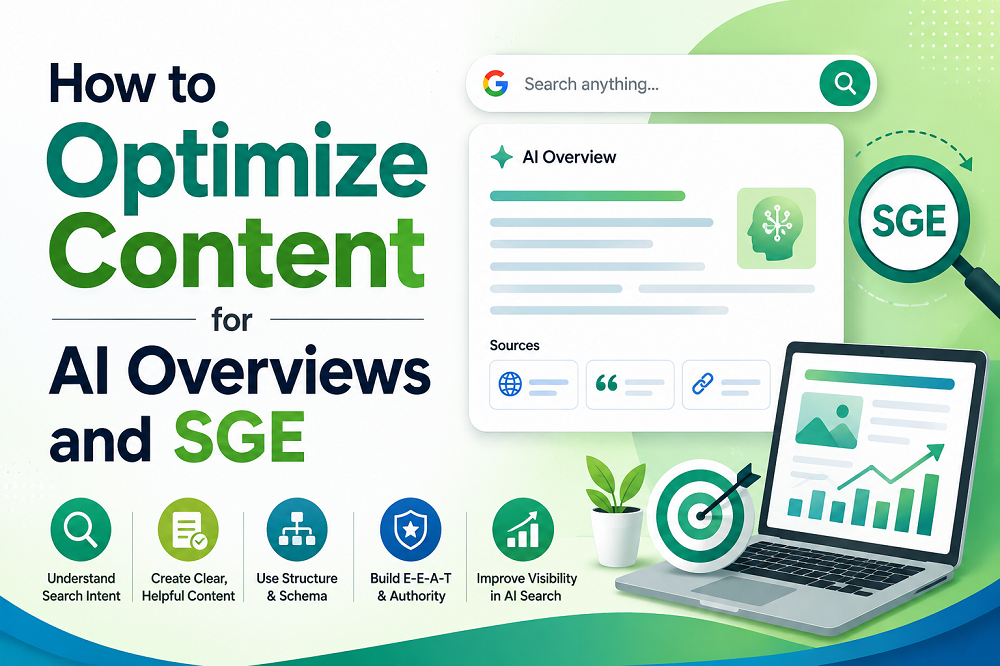
Search is changing rapidly. With the introduction of AI-powered experiences like Google’s Search Generative Experience (SGE) and AI Overviews, users are now getting direct answers inside search results without always clicking on websites. This shift is changing how businesses, bloggers, and marketers approach SEO content strategy.
Traditional SEO focused heavily on rankings and keywords. Now, content also needs to be structured in a way that AI systems can understand, summarize, and present to users. Websites that adapt early to AI-driven search can improve visibility, authority, and organic traffic over time.
In this blog, we will explain how to optimize content for AI Overviews and SGE while maintaining strong SEO performance.
What Are AI Overviews and SGE?
AI Overviews are AI-generated summaries shown directly in Google Search results. These summaries combine information from multiple sources to provide users with quick answers.
Search Generative Experience (SGE) is Google’s AI-powered search system designed to deliver conversational, context-rich search results. Instead of only showing blue links, SGE generates detailed responses with supporting website references.
For example, if someone searches for “best SEO strategies for small businesses,” Google may generate a detailed AI summary that includes tips, comparisons, and recommendations gathered from different websites.
This means your content is no longer competing only for rankings. It is also competing to become part of AI-generated answers.
Why AI Optimization Matters
AI-driven search affects user behavior in several ways:
- Users receive faster answers directly on Google
- Search results are becoming more conversational
- Websites with structured and reliable information are favored
- Topical authority is becoming more important
- Content quality matters more than keyword stuffing
Optimizing for AI Overviews helps your content stay visible even when users do not click traditional search listings immediately.
Focus on Search Intent First
AI systems prioritize content that clearly solves user problems. Before writing, understand what users actually want.
There are generally four major types of search intent:
Informational Intent
Users want to learn something.
Example:
- What is SGE?
- How does AI SEO work?
Navigational Intent
Users want to visit a specific brand or website.
Example:
- Google Search Console login
Commercial Intent
Users are comparing products or services.
Example:
- Best AI SEO tools
Transactional Intent
Users are ready to take action.
Example:
- Buy SEO software
Your content should directly address the user’s intent within the first few paragraphs.
Write Clear and Direct Answers
AI Overviews prefer content that is easy to summarize.
To improve visibility:
- Answer questions directly
- Use simple language
- Avoid unnecessary filler
- Add concise explanations
- Include step-by-step guidance where relevant
For example, instead of writing:
“Many experts in digital marketing often discuss several approaches businesses may consider while trying to improve their online visibility.”
Write:
“Businesses can improve online visibility by optimizing content, improving page speed, and targeting user search intent.”
Clear answers increase the chances of AI systems selecting your content.
Use Structured Headings Properly
Content structure is extremely important for AI readability.
Use:
- H1 for the main title
- H2 for major sections
- H3 for supporting subtopics
Well-structured content helps AI systems understand topic hierarchy.
Example structure:
- H1: How to Optimize Content for AI Overviews and SGE
- H2: What Is SGE?
- H2: Why AI SEO Matters
- H2: Best Optimization Strategies
- H3: Improve Readability
- H3: Use Structured Data
This improves both SEO and user experience.
Create Topic-Focused Content
AI systems prefer websites with topical authority.
Instead of publishing random articles, create clusters of related content.
Example for an SEO website:
- AI SEO Guide
- Voice Search Optimization
- Technical SEO Basics
- E-E-A-T SEO Strategy
- Content Optimization for SGE
Internal linking between related articles helps Google understand your expertise.
Optimize for Conversational Queries
AI search is more conversational than traditional search.
Users now search like this:
- “How can I optimize my website for AI search?”
- “What are the best strategies for SGE optimization?”
To optimize:
- Include natural language phrases
- Add FAQ sections
- Use question-based headings
- Write in a conversational tone
This helps your content align with AI-generated search experiences.
Add FAQ Sections
FAQs improve your chances of appearing in AI summaries because they provide direct answers to common questions.
Example:
What is AI Overview in Google?
AI Overview is a Google Search feature that generates AI-powered summaries directly in search results.
Does SGE affect SEO?
Yes, SGE changes how users interact with search results and increases the importance of high-quality, structured content.
FAQ sections also improve long-tail keyword targeting.
Improve E-E-A-T Signals
Google values E-E-A-T:
- Experience
- Expertise
- Authoritativeness
- Trustworthiness
To improve E-E-A-T:
- Use credible sources
- Add author information
- Include real examples
- Keep content updated
- Use accurate facts and statistics
AI systems are more likely to reference trustworthy content.
Use Schema Markup
Structured data helps search engines understand your content better.
Useful schema types include:
- FAQ Schema
- Article Schema
- HowTo Schema
- Product Schema
- Review Schema
Schema markup improves content visibility in AI-powered search environments.
Optimize Readability
Readable content performs better for both users and AI systems.
Best practices:
- Use short paragraphs
- Add bullet points
- Avoid overly technical wording
- Use transition words
- Keep sentences concise
Readable content improves engagement and comprehension.
Add Original Insights and Examples
AI systems increasingly value original and unique information.
Avoid publishing generic rewritten content.
Instead:
- Share practical examples
- Add case studies
- Include expert opinions
- Use industry-specific insights
Original content increases authority and differentiation.
Keep Content Updated Regularly
AI systems prefer fresh and accurate information.
Regularly update:
- Statistics
- Trends
- SEO strategies
- AI-related developments
- Tool recommendations
Updating old content can improve search visibility significantly.
Optimize Technical SEO
Strong technical SEO supports AI discoverability.
Focus on:
- Fast loading speed
- Mobile responsiveness
- HTTPS security
- Crawlability
- Clean site structure
Technical issues can limit AI systems from properly accessing your content.
Use Multimedia Content
Images, videos, infographics, and charts improve engagement and help AI understand context better.
Best practices:
- Use descriptive alt text
- Optimize image sizes
- Add captions
- Include relevant visuals
Visual content also improves user retention.
Build Strong Internal Linking
Internal linking helps AI systems understand content relationships.
Example:
A blog about “AI SEO” can link to:
- Technical SEO Guide
- Keyword Research Tips
- Voice Search Optimization
- Content Marketing Strategies
This strengthens topical relevance.
Measure Performance Continuously
Track performance using tools like:
- Google Search Console
- Google Analytics
- PageSpeed Insights
- SEO tracking tools
Monitor:
- Organic traffic
- Click-through rate
- User engagement
- Keyword visibility
- Indexed pages
AI search optimization is an ongoing process.
Conclusion
AI Overviews and SGE are transforming the future of search. Businesses that focus on structured, user-focused, and authoritative content will have a stronger chance of maintaining visibility in AI-driven search results.
The key is not to replace traditional SEO, but to enhance it with AI-friendly strategies. Clear answers, topical authority, conversational content, and strong technical SEO will continue to play an important role in search success.
As AI search evolves, websites that prioritize helpful, trustworthy, and well-structured content will remain competitive in the changing digital landscape.
FAQs
What is SGE in SEO?
SGE stands for Search Generative Experience, Google’s AI-powered search feature that generates conversational search results.
How do AI Overviews affect website traffic?
AI Overviews may reduce some clicks for informational queries, but optimized websites can still gain visibility and authority through AI citations.
Is keyword optimization still important for AI SEO?
Yes, keywords still matter, but content quality, intent matching, and structure are becoming equally important.
What type of content performs best in AI search?
Content that is clear, trustworthy, well-structured, and directly answers user questions performs best.
How can I improve my chances of appearing in AI Overviews?
Focus on topical authority, structured formatting, FAQ sections, schema markup, and high-quality original content.