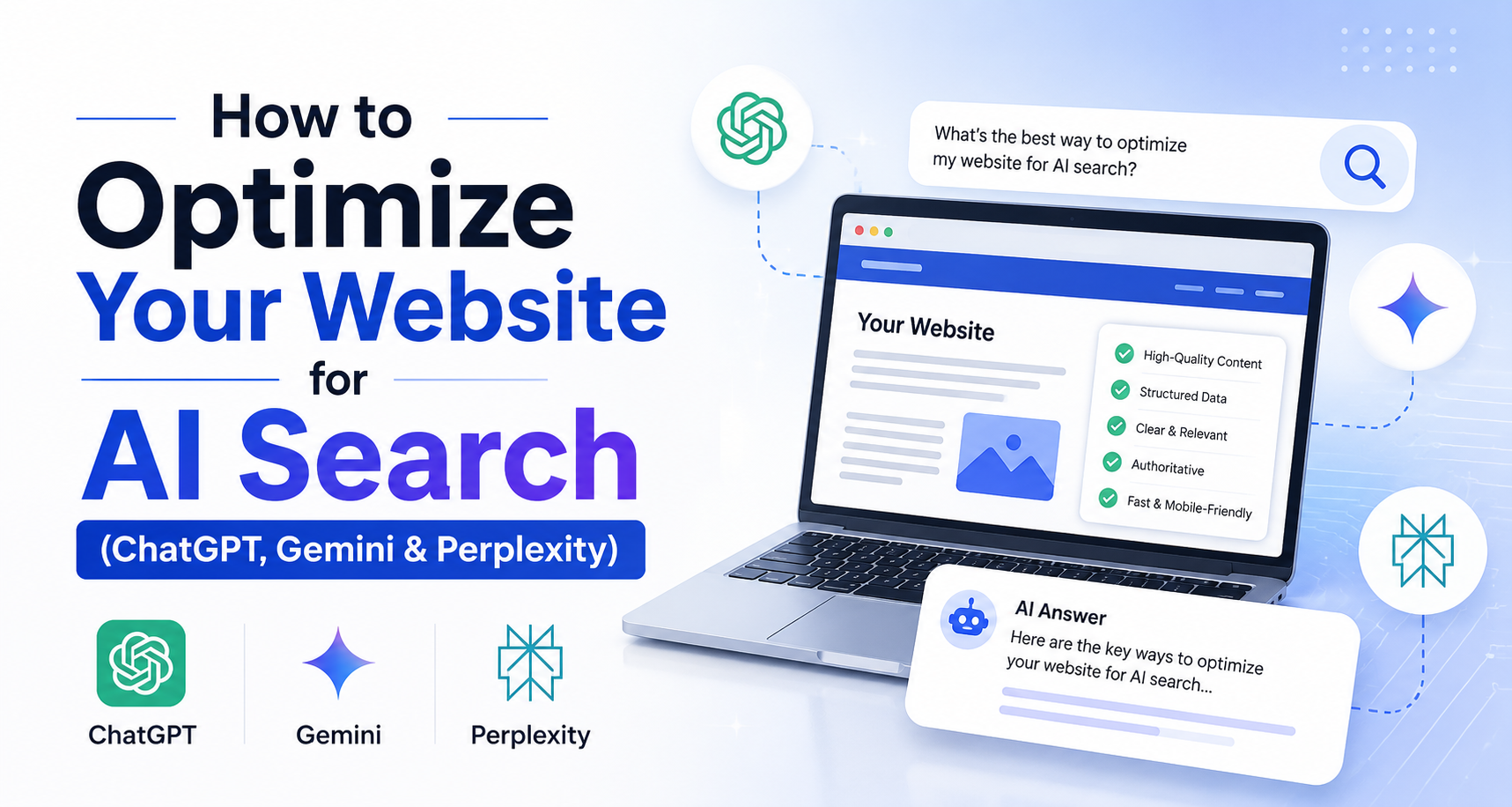
Search behavior is shifting fast. Millions of people now ask ChatGPT, Google Gemini, and Perplexity questions instead of typing them into a search bar — and the businesses that show up inside those AI-generated answers are the ones winning attention, trust, and traffic. This guide breaks down exactly what AI search optimization is, why it matters, and how to get your website ready for it.
What is AI Search Optimization?
AI search optimization — commonly known as GEO (Generative Engine Optimization) and closely related to AEO (Answer Engine Optimization) — is the practice of structuring your website’s content so AI-powered platforms can easily read, understand, extract, and cite it when generating answers for users.
Traditional SEO was built around a simple goal: rank in the top 10 blue links on a search engine results page. AI search flips that model. Tools like ChatGPT, Gemini, and Perplexity don’t return a list of links — they return a synthesized answer, usually pulling from just two to seven sources they consider trustworthy enough to cite. GEO is about becoming one of those chosen few sources.
Instead of optimizing purely for keywords and backlinks, GEO focuses on things like factual density, clear question-and-answer structure, verifiable data, and technical accessibility — all signals that help large language models retrieve and trust your content during the answer-generation process.
Why AI Search Optimization Matters Right Now
AI-driven search is no longer a future trend — it’s already reshaping how people discover brands, products, and services. ChatGPT alone now serves hundreds of millions of weekly active users, many of whom use it as a substitute for traditional search. Google has also woven AI Overviews directly into its results pages, showing an AI-generated summary with source citations above the standard organic listings.
This shift matters for one simple reason: visibility in traditional search no longer guarantees visibility in AI search. Industry research has found that the overlap between top-ranking Google pages and the sources AI tools actually cite has dropped sharply — in some studies, below 20%. In other words, a page that ranks #1 on Google might not get mentioned by ChatGPT or Perplexity at all, because these engines are evaluating content through a different lens: how easily can this passage be lifted, verified, and trusted?
Why this matters for your business: If your content isn’t structured for AI retrieval, you risk becoming invisible in a discovery channel that’s growing every month — even while your traditional rankings stay strong.
There’s also a growing gap in “answer engine” behavior itself. Analysts estimate a significant share of B2B research queries will soon be satisfied entirely within an AI answer, without the user ever clicking through to a website. That makes it even more important to be the source that gets cited, quoted, or recommended — because for a growing number of searches, that citation is the only interaction you’ll get with a potential customer.
Key Benefits of Optimizing for AI Search
- Early-mover advantage: GEO is still an emerging discipline. Brands that invest now can lock in citation authority before the space becomes as competitive as traditional SEO.
- Higher-intent traffic: Users who click through from an AI-generated answer have often already had their initial questions addressed, meaning they arrive further along in the decision-making journey and tend to convert at a noticeably higher rate.
- Stronger brand credibility: Being cited by name inside a ChatGPT or Perplexity response acts as a implicit third-party endorsement, positioning your brand as a trustworthy, authoritative source in your industry.
- Expanded reach beyond Google: GEO helps you show up across a growing ecosystem of AI tools — ChatGPT, Gemini, Perplexity, Copilot, and more — rather than depending on a single search engine.
- Future-proofing your visibility: As AI adoption continues to climb, businesses that build GEO into their content strategy today will be far better positioned than those scrambling to catch up later.
- Complementary, not competing, with SEO: Most GEO techniques — clean structure, authoritative sourcing, technical accessibility — also strengthen traditional rankings, so the investment pays off on both fronts.
How to Optimize Your Website for AI Search
1. Confirm AI Crawlers Can Actually Access Your Site
Before anything else, make sure your site isn’t accidentally blocking the bots that power AI search. Check your robots.txt file for disallow rules affecting crawlers like GPTBot (OpenAI), Google-Extended (Gemini), and PerplexityBot. This is one of the most common — and most overlooked — issues, especially for sites using Cloudflare, which has changed its default settings to block AI bots automatically in some configurations. Also confirm your key pages are server-side rendered rather than hidden behind JavaScript that crawlers can’t easily parse.
2. Structure Content Around Real Questions
AI engines are built to answer prompts, not match keywords. That means your content should mirror how real users actually phrase their questions. Use question-based headers (H2s and H3s), followed immediately by a clear, direct answer in the first sentence or two, before expanding with supporting detail. This “answer-first” structure makes it far easier for an AI model to lift a clean, usable passage.
3. Add Structured Data and Schema Markup
FAQ schema, Article schema, and Organization schema all help AI systems parse your page’s structure and meaning more accurately. Structured data acts as a translation layer between your content and the machine reading it, reducing the chance of misinterpretation.
4. Build for E-E-A-T: Experience, Expertise, Authoritativeness, Trust
AI models are trained to favor content that demonstrates real, verifiable authority. Include author bylines with credentials, cite original data and statistics, quote subject-matter experts, and back up claims with links to primary sources. Generic, thin content rarely gets cited — specific, evidence-backed content does.
5. Keep Content Fresh and Accurate
Update your published and “last modified” dates whenever you meaningfully revise a page, and make sure your schema markup’s dateModified field matches. AI systems tend to favor recently updated, verifiably accurate content over stale pages, and freshness is one of the more actionable levers you can pull consistently.
6. Write for Extraction, Not Just Reading
Break content into short, self-contained passages that answer one specific question each. Use numbered lists, comparison tables, and clearly labeled sections. AI tools often pull isolated snippets rather than entire articles, so every section should be able to stand on its own and still make complete sense.
7. Earn Mentions Beyond Your Own Website
GEO isn’t limited to on-site optimization. AI models also weigh signals from across the web — reviews, forum discussions, PR coverage, and social mentions all feed into how these tools perceive your brand’s authority. A cross-functional approach involving SEO, content, PR, and social media teams tends to produce stronger AI visibility than content efforts alone.
SEO vs AEO vs GEO: What’s the Difference?
| Approach | Focus | Goal |
|---|---|---|
| SEO | Keywords, backlinks, technical site health, page experience | Rank higher in traditional search results |
| AEO | FAQs, structured direct answers, concise definitions | Win featured snippets and voice search results |
| GEO | Citability, factual density, authority signals, AI-crawler accessibility | Get cited or recommended inside AI-generated answers |
Bottom line: GEO doesn’t replace SEO — it builds directly on top of it. The strongest AI search strategies combine solid technical SEO foundations, AEO-style answer formatting, and citation-worthy, well-sourced content, all working together rather than in isolation.
A Simple AI Search Optimization Checklist
- Audit robots.txt and server logs to confirm AI crawlers can access your site
- Rewrite key headers as questions your audience is actually asking
- Add FAQ, Article, and Organization schema to priority pages
- Include original statistics, expert quotes, and cited sources
- Refresh dates and content on evergreen pages every few months
- Break long content into short, extractable, self-contained sections
- Build brand mentions through PR, reviews, and social channels
Frequently Asked Questions
Does AI search optimization replace traditional SEO?
No. GEO builds on core SEO fundamentals like site speed, proper indexing, and quality backlinks, while adding techniques specifically aimed at getting cited inside AI-generated answers. The two work best together, not as substitutes for one another.
How long does it take to see results from GEO?
Many brands see their first AI citations within days of publishing well-structured, freshly updated content. However, consistent and meaningful visibility across multiple AI platforms typically takes a few months of sustained, ongoing effort.
Which AI platforms should I prioritize optimizing for?
ChatGPT, Google Gemini (including AI Overviews), and Perplexity currently handle the largest share of AI-driven search queries, making them the top priorities. Copilot and other emerging assistants are worth monitoring as their usage grows.
Do I need to create entirely separate content for AI search versus Google search?
Not necessarily separate content, but you do need additional formatting layered onto your existing SEO content — clear question-and-answer structure, schema markup, and citation-worthy facts that make passages easy for AI systems to extract and trust.
Can small businesses realistically compete in AI search results?
Yes. Because GEO rewards clear, well-structured, and genuinely authoritative content over sheer domain age or advertising budget, smaller and newer sites have a real opportunity to earn citations that would be much harder to win in traditional search rankings.
Helpful External Resources
- Search Engine Land: Mastering Generative Engine Optimization in 2026
- Google Search Central: AI Features and Your Website
- LLMrefs: The 2026 Guide to AI Search Visibility
Want Your Website Cited by AI Search Engines?
Click Catcher helps businesses in Noida and beyond optimize for SEO, AEO, and GEO — so you stay visible wherever your customers are searching, from Google to ChatGPT.