
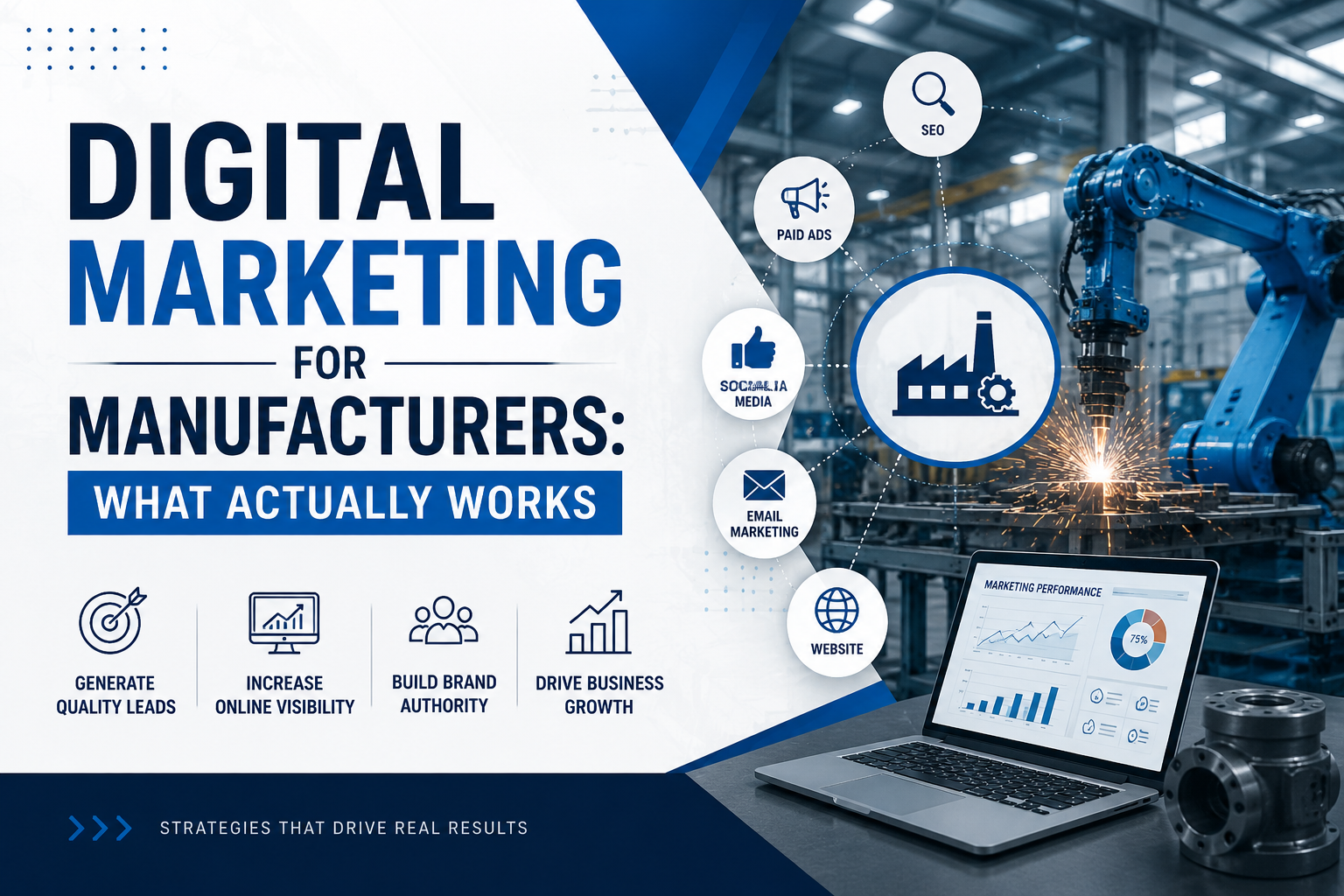
Manufacturing marketing has quietly gone through a complete overhaul. The old playbook — a trade show booth, a print catalog, and an occasional cold call — no longer generates the pipeline it used to. Buyers have changed, and if your strategy hasn’t changed with them, you’re losing deals to competitors before you even know they exist.
Here’s what’s actually driving results for manufacturers right now, and how to apply it without wasting budget on tactics built for a different industry entirely.
The Buyer Has Already Changed — Has Your Strategy?
Most digital marketing advice online is written by and for SaaS or consumer brands. It doesn’t translate well to manufacturing, where sales cycles stretch 12–18 months, deals can run into six or seven figures, and the buying committee includes engineers, procurement, quality, and leadership — each with different priorities and none of them making a decision on impulse.
What hasn’t changed is this: your buyers are researching online long before they ever contact you. Industry research consistently shows that a large majority of B2B buyers complete most of their research — often 60–70% of the buying journey — before reaching out to a supplier at all. If your company isn’t visible during that research phase, you’re not being rejected. You simply never make the shortlist.
That’s the core shift manufacturers need to internalize: marketing isn’t a brochure anymore. It’s the mechanism by which you get considered in the first place.
What Actually Works
1. Technical, Search-Driven SEO
Generic industry keywords don’t convert in manufacturing. Buyers search using part numbers, materials, tolerances, and specific processes — not vague phrases like “innovative engineering solutions.” Effective industrial SEO means building content around the exact terms your buyers type into Google: capability pages, spec-driven product pages, and technical blog content that answers real engineering and procurement questions.
This also means fixing the fundamentals: fast load times, mobile-friendly design, clean site structure, and pages that clearly lay out specs, certifications, materials, and tolerances rather than marketing fluff.
2. A Website Built Around Buyer Personas, Not Org Charts
Many manufacturing websites are still structured around internal departments instead of what a visitor actually needs. A single product can matter to five different personas — engineering, procurement, maintenance, quality, and management — and each wants something different: engineers want technical specs, procurement wants certifications and lead times, and leadership wants case studies and ROI proof.
The manufacturers winning right now treat their website as a strategic asset structured around these buyer journeys, not a static digital brochure.
3. Deep, Technical Content in Multiple Formats
Content is where manufacturers can build real authority — but it has to go beyond a blog post. High-performing content mixes downloadable spec sheets, product comparison guides, sizing or ROI calculators, technical white papers, and video walkthroughs. It should bridge technical capability with business outcomes, because purchasing decisions in manufacturing are rarely made on specs alone — leadership still wants to see the ROI case.
Done well, strong content shortens sales cycles significantly, because prospects arrive at your sales team already informed and closer to a decision.
4. LinkedIn and Paid Search — Used for Different Jobs
LinkedIn and Google Ads solve different problems, and manufacturers get the best results when they use both intentionally rather than picking one:
- LinkedIn lets you target by job title, company size, and industry — ideal for reaching specific decision-makers directly.
- Google Ads captures buyers mid-research, when they’re actively searching for a solution or comparing suppliers.
The mistake most manufacturers make is running broad awareness campaigns instead of targeting high-intent moments — someone searching for a supplier, comparing specs, or evaluating alternatives. Precision matters far more than reach in industrial B2B.
5. Email, Hyper-Segmented by Role and Region
Generic email blasts underperform badly in manufacturing. The same product might interest a maintenance engineer in one country and a logistics buyer in another — but their needs, timing, and language differ completely. Segmenting email by industry, application, geography, and buyer type (technical vs. purchasing) consistently improves open rates, click-throughs, and conversions.
Progressive, automated content flows work well here — for example, sequencing a product comparison, a technical testimonial, an implementation checklist, and finally an ROI calculator as a lead moves through the funnel.
6. Marketing Automation and First-Party Data
As third-party tracking becomes less reliable, manufacturers are shifting toward first-party data: gated technical content, webinars, ROI calculators, and diagnostic tools that capture direct buyer intent. Pairing this with CRM and marketing automation platforms (like HubSpot or ActiveCampaign) allows manufacturers to score leads, personalize outreach, and hand sales teams warmer, better-qualified prospects — rather than generic form-fill leads.
7. AI-Driven Personalization and Intent Data
AI tools are increasingly used to identify in-market buyers before they ever fill out a form, by blending firmographic, technographic, and intent data. For manufacturers with long sales cycles and complex buying committees, this kind of predictive signal is valuable — it helps sales and marketing prioritize accounts that are actually ready to engage, instead of spreading effort evenly across a broad target list.
What Doesn’t Work Anymore
It’s worth being direct about what’s fallen off: sporadic campaigns, a one-off Google Ads push, and awareness-only content no longer move the needle the way they did a few years ago. Competition has caught up, and buyers are more self-directed and more skeptical than before. A large share of manufacturing marketers still rate their own strategy as only moderately effective — not because they’re underspending, but because budget is going toward disconnected tactics instead of a coordinated strategy tied to actual revenue outcomes.
The manufacturers seeing real growth aren’t necessarily spending more. They’re spending with more discipline — fewer channels, clearer targeting, and consistent measurement tied to qualified leads and closed revenue, not vanity traffic metrics.
How to Get Started Without Overhauling Everything at Once
You don’t need to launch SEO, paid media, email automation, and AI personalization simultaneously. The manufacturers who succeed typically:
- Start with one channel — usually SEO or paid search, since both capture existing demand rather than trying to create it.
- Fix the website fundamentals so it can actually convert the traffic you’re already getting.
- Build a small set of high-value content assets (spec sheets, comparison guides, an ROI calculator) tied directly to your top buyer personas.
- Layer in segmented email and automation once you have enough first-party data to make it worthwhile.
- Measure against qualified leads and revenue, not just traffic or impressions, so you know what’s actually working.
Meaningful improvement in a competitive category typically takes four to six months of consistent effort — longer for highly contested niches, faster for less competitive ones. This is a compounding game: the manufacturers who started building content and search visibility years ago are the ones dominating search results now.
FAQs
How is digital marketing for manufacturers different from other B2B industries?
Manufacturing sales cycles are longer (often 12–18 months), involve larger buying committees with technical decision-makers, and require detailed proof of specifications and capabilities that go far beyond what typical software or service buyers expect.
Which channel should manufacturers start with?
SEO and paid search are usually the best starting point because they capture buyers who are already searching for a solution, rather than trying to generate demand from scratch.
How long does it take to see results?
Meaningful improvement generally takes four to six months in competitive categories, though less contested niches can show results sooner. SEO and content marketing tend to compound over time, so early movers hold an increasing advantage.
Is trade show marketing still worth it?
Yes, but it works best as part of a broader strategy rather than the primary channel. Many manufacturers now pair relationship-driven channels like trade shows with digital demand capture (SEO, PPC) and nurture sequences (email, content) to keep leads warm between events.
What content actually converts for manufacturers?
Technical, specific content performs best — spec sheets, product comparisons, ROI calculators, case studies, and application-specific guides. Generic, feature-focused content rarely resonates with engineering and procurement buyers.
Do manufacturers need to be active on social media?
LinkedIn is the most valuable platform for manufacturers, since it allows precise targeting of decision-makers by job title, company, and industry. Broader consumer platforms are typically lower priority unless there’s a specific brand-awareness goal.
What’s the biggest mistake manufacturers make with digital marketing?
Running broad, awareness-style campaigns instead of targeting high-intent moments, and setting vague goals like “more traffic” instead of measurable objectives tied to qualified leads and revenue.