Introduction
The way people search for information online is changing rapidly. Instead of typing a few keywords into a search engine and browsing through multiple websites, users are increasingly asking AI-powered tools direct questions and receiving immediate answers.
At the heart of this transformation are Large Language Models (LLMs). These powerful AI systems have become the foundation of modern search experiences, virtual assistants, content generation tools, and business automation platforms.
As search evolves from traditional rankings to AI-generated answers, businesses need to understand how LLMs influence digital visibility. The brands that adapt early will be better positioned to stay discoverable, trusted, and relevant in the years ahead.
What Are Large Language Models (LLMs)?
Large Language Models are artificial intelligence models trained on massive datasets containing books, articles, websites, research papers, and other forms of written content.
Their purpose is to understand patterns in language and generate human-like responses.
LLMs can:
- Answer questions
- Summarize content
- Translate languages
- Generate text
- Write code
- Analyze information
- Assist with research
- Support customer service
Unlike traditional software that follows predefined rules, LLMs learn language patterns through training and can respond to a wide range of queries.
Popular Examples of Large Language Models
Several well-known AI platforms rely on LLM technology:
ChatGPT
Developed by OpenAI, ChatGPT helps users with research, writing, coding, customer support, and information discovery.
Gemini
Google’s Gemini powers many AI-enhanced search experiences and productivity tools.
Claude
Claude focuses on natural conversations, reasoning, and content generation.
Perplexity AI
Perplexity combines AI-generated answers with source citations, creating a unique search experience.
Microsoft Copilot
Integrated into Microsoft products, Copilot helps users complete tasks using AI-powered assistance.
These platforms are reshaping how users interact with information online.
How LLMs Are Changing Search
Traditional search engines displayed a list of websites ranked by relevance.
Today, AI-powered search systems can:
- Understand complex questions
- Analyze intent
- Summarize information
- Provide direct answers
- Recommend products and services
- Generate personalized responses
For example, instead of searching:
“Best CRM software”
Users now ask:
“What is the best CRM software for a growing business with remote teams?”
The AI system interprets the intent and generates a customized response.
This shift is changing how brands compete for visibility online.
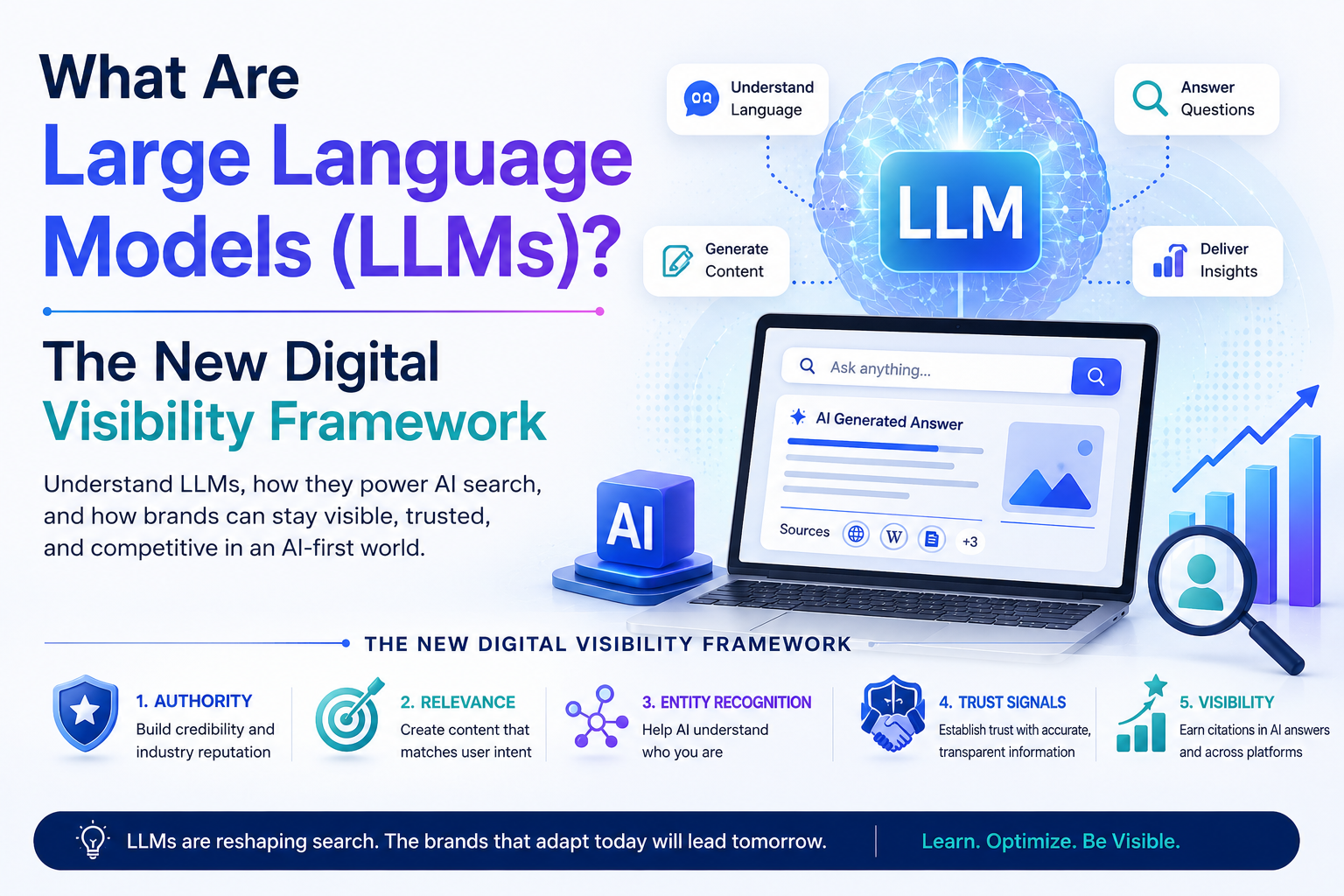
The New Digital Visibility Framework
The rise of LLMs has introduced a new visibility framework that goes beyond traditional SEO.
Success now depends on how effectively AI systems can understand, trust, and reference your content.
1. Authority
AI systems prioritize information from trusted sources.
Authority signals include:
- Industry expertise
- Quality backlinks
- Brand mentions
- Published research
- Customer trust
The stronger your authority, the more likely AI systems are to recognize your content.
2. Relevance
LLMs analyze content context rather than relying solely on keywords.
Content should answer real user questions and provide useful insights.
Brands that focus on solving problems gain greater visibility.
3. Entity Recognition
Modern AI understands entities such as:
- Brands
- Products
- Services
- Organizations
- People
Creating consistent information across websites, social platforms, and directories strengthens entity recognition.
4. Trust Signals
Trust is becoming one of the most important ranking factors in AI-powered environments.
Important trust indicators include:
- Accurate information
- Updated content
- Expert authors
- Transparent sourcing
- Positive reputation
Why Businesses Need to Understand LLMs
Businesses that ignore AI search risk losing visibility as user behavior changes.
Understanding LLMs helps organizations:
- Improve content strategies
- Increase online visibility
- Adapt to AI search trends
- Build stronger authority
- Improve customer engagement
Companies that align their content with how AI systems process information will gain a competitive advantage.
LLMs and SEO: A New Relationship
SEO is not disappearing. Instead, it is evolving.
Traditional SEO focused on:
- Keywords
- Rankings
- Backlinks
- Technical optimization
The AI era adds new priorities:
- Context
- Expertise
- User intent
- Structured information
- Brand authority
Businesses must optimize for both search engines and AI models.
The Rise of Generative Engine Optimization (GEO)
Generative Engine Optimization (GEO) is emerging as a key strategy for the AI-first era.
GEO focuses on increasing visibility within AI-generated answers.
Effective GEO includes:
- Publishing expert content
- Creating comprehensive topic clusters
- Building entity authority
- Using structured data
- Maintaining factual accuracy
- Earning trusted citations
The goal is not only to rank but also to become a trusted source for AI systems.
Best Practices for AI Visibility in 2026
Create Helpful Content
Content should provide clear answers and practical value.
Build Topical Authority
Cover entire subject areas rather than isolated keywords.
Use Structured Data
Schema markup helps AI systems understand content context.
Strengthen Your Brand Presence
Consistent branding across multiple channels improves entity recognition.
Update Content Regularly
Fresh and accurate information increases trustworthiness.
Focus on E-E-A-T
Experience, Expertise, Authoritativeness, and Trustworthiness remain essential signals for both search engines and AI systems.
The Future of LLMs and Search
Large Language Models will continue to influence how information is discovered and consumed.
Future developments may include:
- More personalized search experiences
- Better contextual understanding
- Voice-first interactions
- Real-time information retrieval
- Multimodal search combining text, images, audio, and video
As these capabilities expand, businesses will need to continuously adapt their digital strategies.
Conclusion
Large Language Models are transforming the internet and redefining digital visibility. They power the AI tools that millions of people now use to discover information, evaluate products, and make decisions.
For businesses, understanding LLMs is no longer optional. It is a critical part of remaining visible in an AI-driven world.
By focusing on authority, trust, relevance, entity recognition, and Generative Engine Optimization, brands can position themselves for success in the new digital visibility framework and stay competitive as AI-powered search continues to evolve.
Frequently Asked Questions (FAQs)
1. What is a Large Language Model (LLM)?
A Large Language Model (LLM) is an AI system trained on massive amounts of text data to understand, generate, and respond to human language. Examples include ChatGPT, Gemini, Claude, and Perplexity.
2. How do LLMs influence AI-powered search?
LLMs help AI search engines understand user intent, analyze information from multiple sources, and generate direct answers instead of simply displaying a list of website links.
3. Why are LLMs important for digital visibility in 2026?
As more users rely on AI-generated answers, businesses need content that AI systems can understand, trust, and reference. This makes LLM optimization an important part of modern digital visibility.
4. How can businesses optimize their content for LLMs?
Businesses can improve visibility by creating authoritative content, answering user questions clearly, building topical expertise, using structured data, and maintaining strong E-E-A-T signals.
5. What is the connection between LLMs, SEO, and GEO?
Traditional SEO helps websites rank in search engines, while Generative Engine Optimization (GEO) focuses on making content discoverable and reference-worthy for AI systems powered by Large Language Models.