If you’ve watched your traffic dip after a core update, or you’re just trying to figure out where to focus your SEO effort this year, you’ve probably asked the same question everyone in search marketing is asking right now: what actually moves the needle in Google rankings today?
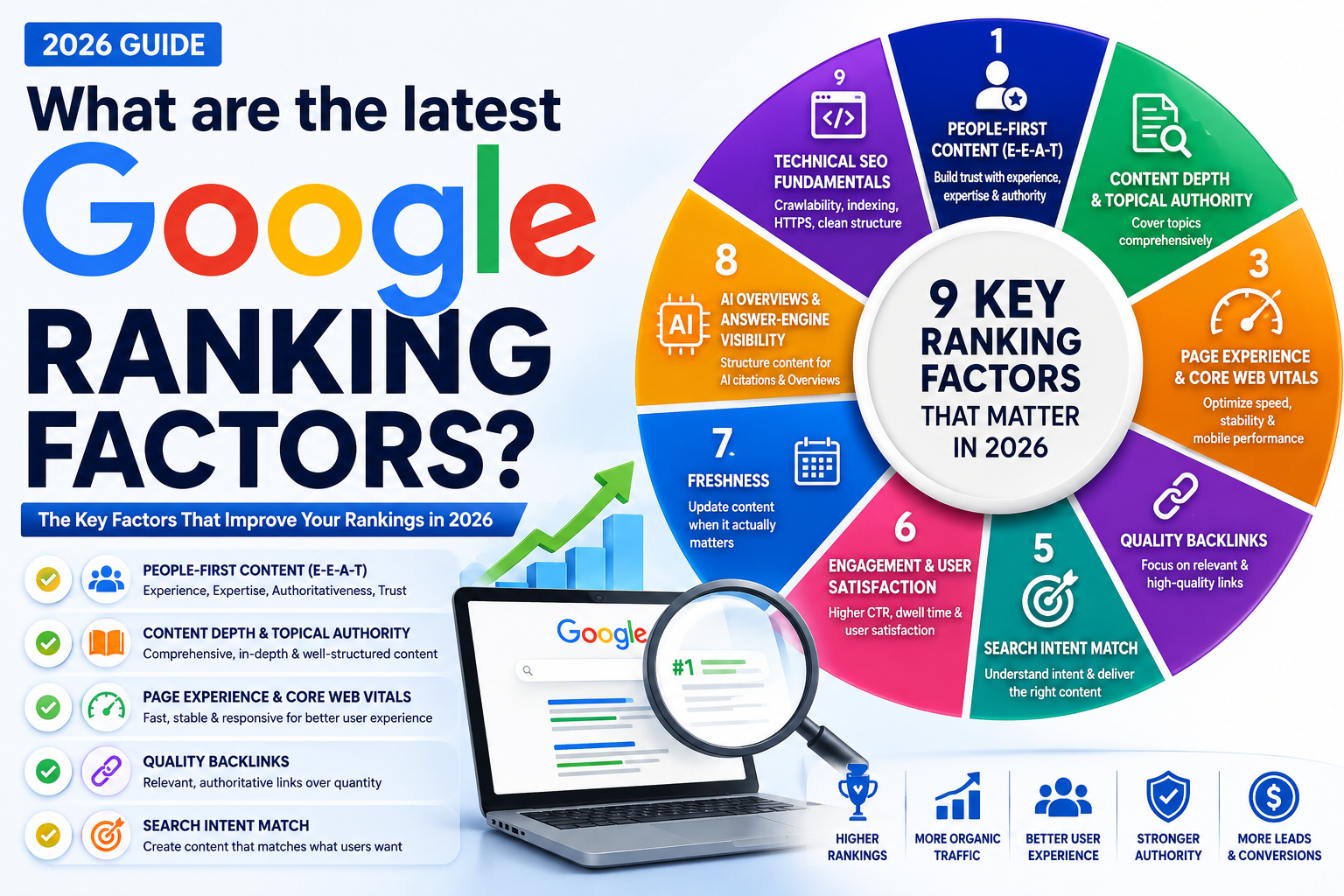
The honest answer is that Google doesn’t publish a numbered checklist. It uses layered ranking systems — relevance scoring, quality evaluation, spam detection, and personalization — that work together rather than as 200 independent switches you can flip on and off. But across Google’s own documentation and the data coming out of the 2025–2026 core updates, a clear set of priorities has emerged. This guide breaks them down.
1. Helpful, People-First Content (and Why E-E-A-T Isn’t a “Score”)
Google has been explicit that its automated systems are built to surface content created to genuinely help people, not content engineered purely to rank. To judge that, Google’s systems look at a cluster of signals tied to E-E-A-T: Experience, Expertise, Authoritativeness, and Trust, as laid out in Google’s own guidance on creating helpful, reliable, people-first content.
A subtlety worth understanding: Google has said directly that E-E-A-T itself isn’t a single ranking factor you can optimize for like page speed. It’s closer to a quality philosophy that Google’s systems try to approximate through many smaller, measurable signals — author transparency, demonstrated firsthand experience, citations and credentials, and accuracy over time. Google gives this even more weight on “Your Money or Your Life” (YMYL) topics — content that could affect someone’s health, finances, or safety.
What changed in 2025–2026: Google’s quality rater guidelines were significantly revised, expanding guidance on evaluating AI-generated content and adding new criteria for how raters assess AI Overviews themselves. The practical shift for writers is that firsthand experience — original data, documented processes, real examples, named outcomes — now carries more weight than broad, generic coverage of a topic.
What to do: Show your work. Add author bios with real credentials, cite primary sources, include original photos, data, or case studies, and avoid publishing content that just repackages what’s already ranking.
2. Content Depth and Topical Authority
Google’s systems increasingly reward sites that cover a subject comprehensively rather than chasing single keywords in isolation. This is sometimes called “topical authority” — building a cluster of genuinely useful content around a subject so Google’s models recognize your site as a credible source on that topic, not just a single page that happens to match a query.
This matters more now because of how Google retrieves and re-ranks pages: it first pulls a pool of relevant candidates based on classic relevance signals (words, entities, topic match), then applies deeper quality and authority layers on top. A page on a site with strong topical depth has an advantage at that second stage.
What to do: Build content around clusters of related questions and subtopics, not isolated posts. Link them together internally so both users and crawlers can see the relationship.
3. Page Experience and Core Web Vitals
Technical performance is still a real ranking input, and it’s gotten more demanding. Google’s Core Web Vitals measure how a page actually feels to use: loading speed, visual stability, and responsiveness. Interaction to Next Paint (INP) replaced First Input Delay as the responsiveness metric in March 2024, raising the bar for how snappy a page needs to feel when users interact with it — not just how fast it initially loads.
Mobile performance specifically carries outsized weight, since Google has used mobile-first indexing since 2019: the mobile version of your page is the primary one Google evaluates, regardless of how much desktop traffic you get.
What to do: Run your key pages through PageSpeed Insights and fix what it flags, prioritizing mobile load time and interaction responsiveness over desktop polish.
4. Backlinks — Fewer, But More Relevant
Backlinks remain part of how Google assesses authority, but their relative importance has dropped compared to a decade ago, as content quality and topical signals have grown in influence. Industry analyses tracking algorithm weight over time, such as the research published by First Page Sage, have noted backlinks accounting for a meaningfully smaller share of overall ranking weight than they used to, while topical authority and content depth have grown.
What hasn’t changed is the quality bar. Google’s systems are better than ever at distinguishing a link earned because a real publication found your content useful from a link bought, swapped, or planted purely to manipulate rankings. A handful of links from sites with genuine topical relevance and trust will outperform a large pile of low-quality, irrelevant links.
What to do: Earn links through original research, data, or genuinely citable resources rather than outreach campaigns built around link volume.
5. Search Intent Match
Google’s natural-language models — including BERT and RankBrain — exist specifically to understand what a searcher actually means, not just which words they typed. A page can be technically optimized and still underperform if it doesn’t match what the searcher is trying to accomplish.
There are generally four flavors of intent: informational (“how does X work”), navigational (“brand name”), commercial (“best X for Y”), and transactional (“buy X”). Ranking well starts with writing content that matches the intent behind a query, not just the keyword string.
What to do: Before writing, check what’s currently ranking for your target query. If the top results are comparison listicles and yours is a single-product sales page, you’re mismatched with intent — no amount of on-page tweaking will fix that gap.
6. Engagement and User Satisfaction Signals
Google has long used aggregated, anonymized click and engagement patterns — through systems generally referred to as NavBoost — to refine rankings based on how real users respond to results over time. Signals like click-through rate, how long someone stays before bouncing back to search results, and whether they refine their query all feed into this feedback loop.
This is one of the harder factors to “optimize” directly, because it’s a downstream effect of actually satisfying the searcher rather than a checklist item. The practical implication is that a compelling title and meta description that earns a click, paired with content that actually delivers on that promise, will outperform clickbait that disappoints once someone lands on the page.
7. Freshness (Where It Actually Matters)
Google’s freshness systems boost newer content for queries where recency genuinely matters — breaking news, “best tools in [current year]” roundups, or anything tied to a fast-moving topic like algorithm updates. It does not mean every page needs to be republished monthly; evergreen, foundational content doesn’t benefit from artificial date-stamping if nothing substantive has changed.
What to do: Reserve update effort for content where the underlying facts genuinely shift, and make real, visible improvements (not just a changed timestamp) when you do.
8. AI Overviews and Answer-Engine Visibility
This is the newest and fastest-moving piece of the puzzle. AI Overviews now appear on a substantial share of Google searches, and being cited inside that AI-generated answer box has become its own visibility goal, separate from (but related to) traditional ranking. Google has discussed how its AI Overview features pull from a wide pool of sources rather than just the top organic result, which means a strong page lower in the traditional rankings can still be cited if it answers the question clearly.
To be cited, content generally needs to: directly answer the core question early and unambiguously, use clear heading structure that an AI system can parse, and carry strong entity and authorship signals (consistent author identity, organization markup, and structured data) that help automated systems verify who’s behind the information.
What to do: Structure key pages so the direct answer appears in the first sentence or two beneath a clear heading, then expand with supporting detail. Use schema markup (Author, Organization, FAQ, Review) where genuinely applicable.
9. Technical SEO Fundamentals
None of the above matters if Google can’t crawl, render, and index your page in the first place. Crawlability, a clean site structure, HTTPS, and avoiding duplicate or thin content are table-stakes rather than competitive advantages — but they’re still disqualifying when missing. Google’s own Search Essentials documentation is the most reliable baseline for what’s required versus optional.
A Quick, Honest Note on the “200+ Factors” Claim
You’ll see a lot of SEO content promising a definitive list of Google’s “200 ranking factors” or even “48 confirmed factors.” Google has never published such a list, and most of what circulates is industry inference, patent analysis, and leaked-document speculation rather than confirmed fact. Google’s own guide to its ranking systems is the closest thing to an official source, and it deliberately describes systems and signal clusters rather than a fixed, countable list. Treat any “complete list” you read elsewhere as a useful mental model, not gospel.
Putting It Together: A Practical Priority Order for 2026
- Write for the reader first. Demonstrate real experience and expertise; don’t just describe a topic, show you’ve engaged with it.
- Go deep, not just frequent. A smaller number of comprehensive, well-linked pieces beats a high volume of thin posts.
- Fix your Core Web Vitals, especially on mobile, where most searches now happen.
- Earn a handful of genuinely relevant links rather than chasing volume.
- Match search intent exactly before worrying about keyword density.
- Structure content for both humans and AI Overviews — clear answers up front, solid heading hierarchy, structured data.
- Keep the technical basics clean: crawlable, indexable, secure, fast.
Google’s ranking systems will keep evolving, and the next core update will inevitably shuffle the relative weight of each of these factors. But the underlying direction has been consistent for years now: the sites that win are the ones that make Google’s job easier by being unambiguously useful to the person on the other end of the search.
Here are 5 FAQs for the blog:
1. What are the most important Google ranking factors in 2026?
The biggest ones are E-E-A-T (experience, expertise, authority, trust), content depth and topical authority, Core Web Vitals, search intent match, and relevant backlinks. No single factor guarantees rankings — Google blends all of them together.
2. Is E-E-A-T an actual Google ranking factor?
Not directly. Google has stated E-E-A-T itself isn’t a specific factor it scores — it’s a quality concept that its systems approximate through other measurable signals like author credentials, citations, and demonstrated firsthand experience.
3. Do backlinks still matter for SEO in 2026?
Yes, but less than they used to. Backlink volume has dropped in relative importance compared to content quality and topical authority. A few links from genuinely relevant, trusted sources outperform a large number of low-quality links.
4. How do I rank in Google’s AI Overviews?
Answer the core question clearly within the first sentence or two, use a clean heading structure, and add structured data (Author, Organization, FAQ schema) so Google’s AI systems can easily parse who wrote the content and verify its credibility.
5. How often does Google update its ranking algorithm?
Constantly — Google rolls out thousands of small changes a year, plus a handful of named core updates that can meaningfully reshuffle rankings. There’s no single static algorithm to solve once and forget.
Follow us on – Facebook, Instagram, Youtube, Linkedin
Visit Our Business Profile Page – https://share.google/U1wx87BrzOn2rUOyr