Google has already rolled out four major search updates in 2026 — and each one has reshaped how rankings behave. If your traffic has been jumping around this year, you’re not imagining it. Here’s a clear, no-fluff breakdown of what changed, why it matters, and what you should actually do about it.
What Are Google’s 2026 SEO Updates?
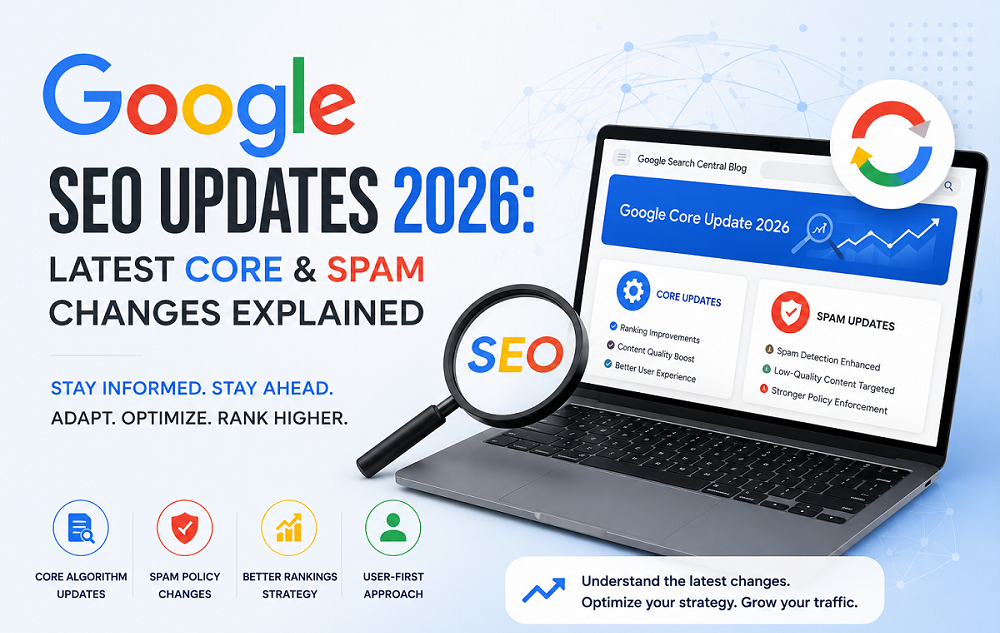
Google runs two very different types of algorithm updates: core updates, which broadly recalibrate how ranking systems judge content quality and relevance, and spam updates, which specifically target sites violating Google’s webmaster guidelines. 2026 has been an unusually active year for both.
So far this year, Google has confirmed a February 2026 Discover Core Update, a March 2026 Core Update (paired with a March 2026 Spam Update), a May 2026 Core Update, and a June 2026 Spam Update. Core updates involve large changes to Google’s algorithm aimed at making results better, and are designed to surface relevant, satisfying content for searchers from all types of sites. That’s four confirmed rollouts in six months — a noticeably faster cadence than in previous years.
Quick Definition: A core update changes how Google evaluates content quality overall — nobody is “penalized,” some sites are simply outranked by pages that now satisfy quality signals better. A spam update, on the other hand, is targeted enforcement against sites actually breaking specific rules like cloaking, scraped content, or keyword stuffing.
Timeline: Google’s Confirmed 2026 Updates
| Update | Type | Rollout Window | Key Focus |
|---|---|---|---|
| February 2026 Discover Core Update | Core (Discover) | Feb 5 – Feb 27 | Local relevance, less clickbait, topical expertise |
| March 2026 Core Update | Core | Mar 10 – Apr 8 | Information Gain, E-E-A-T, original research |
| March 2026 Spam Update | Spam | Mar 24 – Mar 25 | Content-level violations, SpamBrain tuning |
| May 2026 Core Update | Core | May 21 – Jun 2 | Broad, high-volatility quality recalibration |
| June 2026 Spam Update | Spam | Jun 24 – Jun 26 | Scaled content abuse, cloaking (excludes link spam) |
The March 2026 Core Update: Information Gain Takes Center Stage
The March update introduced a concept the SEO community had been watching for a while. It re-weighted what’s known as Information Gain — a ranking signal that measures how much genuinely new knowledge a piece of content adds relative to what’s already ranking for that query. In simple terms: rewriting the same ten articles that already rank on page one no longer cuts it.
This update rewards original research, proprietary data, first-hand testing, real client case studies, and analysis that requires expertise the average reader doesn’t already have. It also leans harder into Google’s E-E-A-T framework — content attributed to authors with verifiable credentials and a consistent publishing history now performs noticeably better than anonymous or generic-author content, regardless of how well-written that content is.
May 2026 Core Update: The Biggest Shake-Up of the Year
The May 2026 core update was the fourth confirmed search-related update Google listed on its Search Status Dashboard in 2026, and the second core update of the year. Unlike the relatively quiet March update, this one hit hard. Industry analysts described it as “much more like a typical core update,” with significant weekend ranking swings well after the official rollout was marked complete.
The rollout started on May 21, 2026 and took about 12 days to complete, finishing on June 2, 2026. If your rankings moved sharply during late May, this is almost certainly why.
June 2026 Spam Update: What It Did (and Didn’t) Target
Google released the June 2026 spam update on June 24, 2026, with the rollout completing globally across all languages just two days later on June 26. What makes this update interesting is what Google explicitly ruled out.
Google confirmed to industry press that the June 2026 spam update does not target link spam and does not target the site reputation abuse policy — pointing enforcement instead toward content-level tactics such as cloaking, doorway abuse, expired domain abuse, hacked content, hidden text, keyword stuffing, and scaled content abuse.
Worth Noting: On May 15, 2026, Google updated its spam policies to explicitly cover attempts to manipulate generative AI responses, including AI Overviews and AI Mode
— a clear signal that AEO and GEO manipulation is now formally in Google’s enforcement crosshairs, not just a grey area.
Why These Updates Matter for Your Business
Every update this year points in the same direction: Google is getting sharper at separating genuinely useful, expert-backed content from content built purely to rank. For businesses in Noida and across India relying on organic search for leads, this means a few things:
- Thin, templated content is riskier than ever — scaled content abuse enforcement is actively hunting it down.
- Author credibility now carries ranking weight — anonymous blog posts lose ground to content with real bylines and expertise.
- Original data beats rewritten summaries — case studies, in-house research, and first-hand results are publishable ranking assets.
- AI Overviews are now a spam battleground — gaming AI-generated answers carries the same risk as gaming classic rankings.
Benefits of Staying Ahead of These Updates
Businesses that adapt early to each update cycle tend to see compounding advantages rather than one-time wins:
- More stable rankings — sites built on genuine expertise see less volatility during future core updates.
- Better AI visibility — content structured for E-E-A-T and Information Gain performs better in AI Overviews and AI Mode too, not just traditional blue links.
- Lower recovery risk — Google itself notes there aren’t specific actions to “recover” from a core update since a ranking drop doesn’t necessarily mean something is wrong — but sites already meeting quality signals rarely see negative impact in the first place.
- Stronger long-term authority — investing in original research and credentialed authorship builds topical authority that survives multiple update cycles.
What To Do If a 2026 Update Hit Your Rankings
Google has repeatedly said there’s nothing new or special that creators need to do for a core update as long as they’ve been making satisfying, people-first content. Practically, that translates to:
- Audit your top pages for genuine Information Gain — are you adding anything the current top 10 results don’t already say?
- Add verifiable author bios with real credentials and publishing history.
- Remove or consolidate thin, auto-generated, or scaled content clusters.
- Wait for a clean comparison window in Search Console before making major changes — Google’s own guidance points to comparing data after a rollout fully completes, since single-day movement during volatile rollouts can be misleading.
- Check whether the drop aligns with a spam policy category rather than a core update — the fixes are very different.
Click Catcher Insight: Most “recovery” panic we see from Noida businesses after an update is actually a competitor simply doing E-E-A-T better — not a technical penalty. Before chasing fixes, benchmark your top pages against what’s currently ranking for the same query.
Frequently Asked Questions
1. How many Google updates have happened in 2026 so far?
Google has confirmed four major updates through mid-2026: the February 2026 Discover Core Update, the March 2026 Core Update (alongside a March 2026 Spam Update), the May 2026 Core Update, and the June 2026 Spam Update.
2. What is the difference between a core update and a spam update?
A core update recalibrates how Google’s systems judge overall content quality and relevance — it doesn’t target rule-breaking specifically. A spam update is targeted enforcement against sites actively violating documented spam policies, like cloaking or scaled content abuse.
3. Did the June 2026 spam update target backlinks?
No. Google confirmed to industry reporters that the June 2026 spam update excluded both link spam and the site reputation abuse policy, focusing instead on content-level violations.
4. What is “Information Gain” in the March 2026 core update?
Information Gain is a ranking signal measuring how much new, non-redundant value a page adds compared to content already ranking for the same query. Pages that simply rephrase existing top results score poorly on this signal.
5. How long should I wait before reacting to a core update?
Google recommends waiting until a rollout is fully complete before drawing conclusions, since rankings can fluctuate significantly during the rollout window itself. Comparing Search Console data from before the update to a stable period after completion gives the most reliable read.
External Resources
For official guidance, refer to Google’s official Search Central Blog on the February 2026 Discover Core Update, Search Engine Land’s coverage of the May 2026 Core Update, and Search Engine Journal’s analysis of the May update’s volatility.
Need Help Navigating Google’s 2026 Algorithm Changes?
Click Catcher’s SEO team tracks every core and spam update as it rolls out — so your rankings don’t have to guess. Talk to Our SEO Experts →