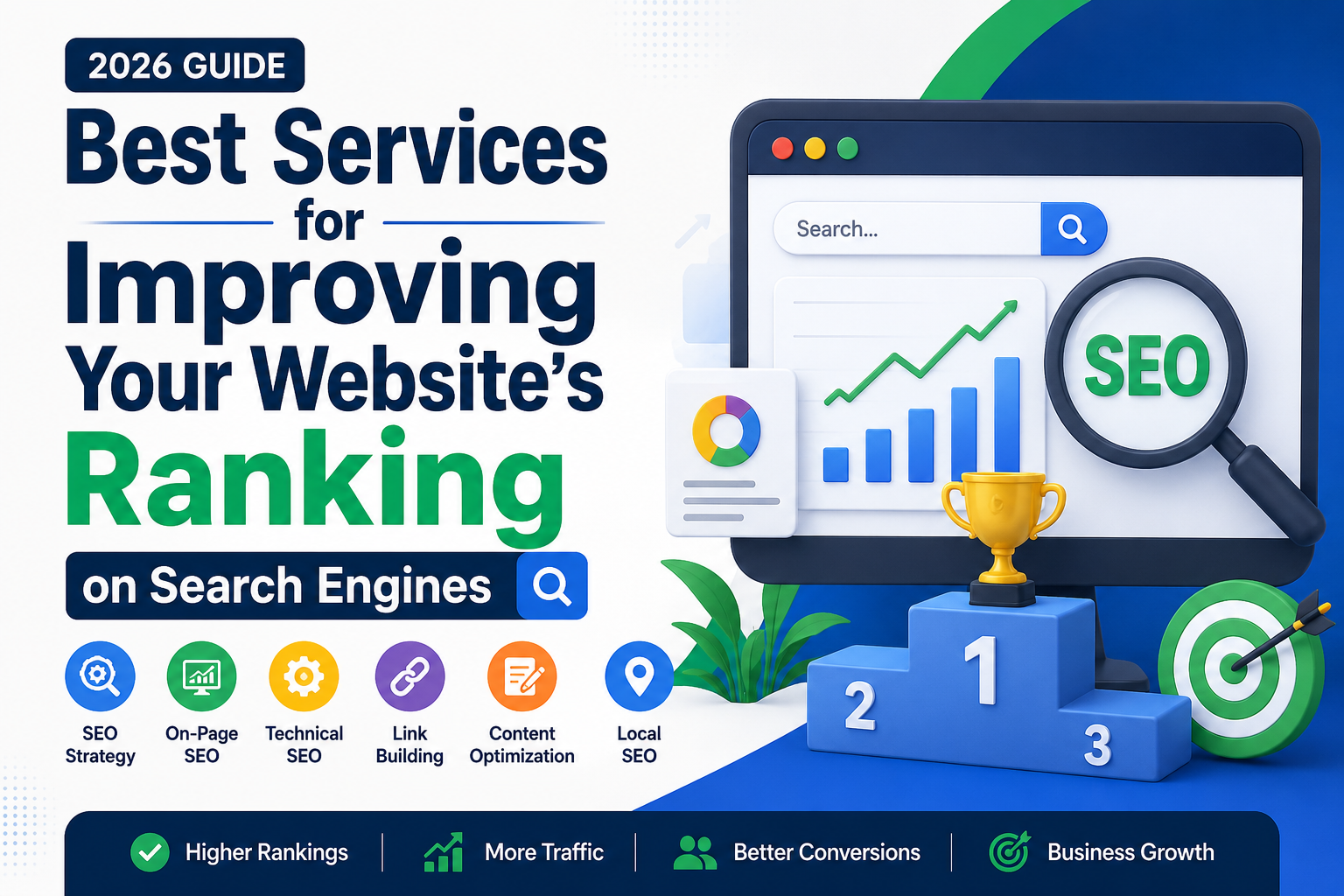
Ranking on Google in 2026 means more than chasing keywords — it means being visible across traditional search results, AI Overviews, and answer engines like ChatGPT and Perplexity. This guide breaks down the SEO services that actually move rankings, what each one costs, and how to choose the right mix for your business.
If you’ve ever typed “why isn’t my website ranking?” into Google, you’re not alone. Thousands of businesses struggle with the same problem every month — decent traffic potential, a reasonable product or service, but a website that’s nowhere to be found past page three of the search results. The fix usually isn’t one single tactic. It’s a combination of services working together: technical fixes, content strategy, authority building, and increasingly, optimization for AI-driven search.
This guide walks through the services that genuinely impact rankings in 2026, based on Google’s own Search Central documentation and current industry practice — not outdated tactics that stopped working years ago.
1. Technical SEO Audits and Fixes
Before any content or link-building effort pays off, your site has to be crawlable and indexable. Technical SEO covers site speed, mobile usability, crawl errors, broken links, XML sitemaps, canonical tags, and Core Web Vitals. Google has been explicit that crawling and indexing are the first stage of ranking — if Google’s bots can’t reach or understand your pages, nothing else matters.
A good technical audit typically checks:
- Site speed and Core Web Vitals (LCP, INP, CLS)
- Mobile responsiveness and usability
- Crawl budget issues and orphaned pages
- Broken internal/external links (404s)
- Duplicate content and canonicalization
- HTTPS security and site architecture
2. Keyword Research and Content Strategy
Keyword research has shifted from volume-chasing to intent-mapping. Rather than targeting the highest-volume keyword, effective strategies now map content to what Google classifies as informational, navigational, commercial, or transactional intent, and build topic clusters around a central pillar page. This structure signals topical authority and strengthens internal linking — both of which matter for rankings and for AI Overview eligibility.
3. On-Page SEO and Content Optimization
On-page SEO is about making each individual page as clear and useful as possible — for both users and crawlers. This includes optimized title tags, meta descriptions, header structure (H1–H3), internal linking, image alt text, and schema markup. It’s also where E-E-A-T (Experience, Expertise, Authoritativeness, Trustworthiness) comes into play most directly, since Google evaluates whether content demonstrates real expertise rather than generic, recycled information.
4. Off-Page SEO and Link Building
Backlinks remain a strong trust signal, but the strategy has changed. Mass guest posting and link swaps carry real risk today. The safer, more durable approach is digital PR — creating content genuinely worth citing (original research, data studies, expert commentary) and getting it placed in relevant industry publications, rather than buying links at scale.
5. Local SEO Services
For businesses serving a specific city or region, local SEO is often the highest-ROI service available. This includes Google Business Profile optimization, local citations, review management, and location-specific landing pages. It’s especially critical now that Google is expanding AI-driven local discovery features.
6. AEO and GEO (AI Search Optimization)
This is the newest and fastest-growing category. In May 2026, Google published its first consolidated guide on optimizing for generative AI features in Search, directly addressing the AEO and GEO terminology that had proliferated across the industry. The core message: content needs to be genuinely unique and non-commodity to be selected for AI Overviews and AI Mode — restating what every other site already says won’t get picked up. Structured content (tables, FAQs, clear headers) also makes it easier for AI systems to extract and present your content as an answer.
Key takeaway: Google has confirmed that no special AI-specific files or schema are required to appear in AI features. What matters is the same foundation that’s mattered for years — crawlable pages, internal linking, strong page experience, and content backed by real expertise.
7. SEO Analytics and Reporting
None of the above works without measurement. Ongoing services should include monthly Search Console reviews, ranking tracking, conversion tracking (not just traffic), and regular content refreshes — outdated information is treated as a negative quality signal by Google’s ranking systems.
Comparing the Main Types of SEO Services
| Service Type | Primary Goal | Typical Timeline | Best For |
|---|---|---|---|
| Technical SEO Audit | Fix crawlability, speed, and indexing issues | 2–4 weeks | Sites with stagnant or declining traffic |
| Content & Keyword Strategy | Build topical authority and target intent | Ongoing, 3–6 months to show results | New or low-authority websites |
| On-Page Optimization | Improve individual page relevance and CTR | 1–2 weeks per batch | Existing pages with impressions but low clicks |
| Link Building / Digital PR | Build domain authority and trust signals | Ongoing, 3–12 months | Competitive industries and keywords |
| Local SEO | Rank in local map packs and “near me” searches | 1–3 months | Location-based businesses |
| AEO / GEO Optimization | Get cited in AI Overviews and AI chat answers | Ongoing | Brands wanting AI search visibility |
How to Choose the Right SEO Service Provider
Not every business needs every service listed above. A newer website usually gets the most value from technical fixes and content strategy first, while an established site with decent traffic but weak local visibility may only need a focused local SEO push. When evaluating providers, look for:
- Transparent reporting tied to Search Console data, not vanity metrics
- A clear content and E-E-A-T strategy, not just link packages
- Case studies or references relevant to your industry
- Realistic timelines — anyone promising page-one rankings in days is a red flag
- Familiarity with both traditional SEO and emerging AEO/GEO practices
Reality check: Most new sites need 3–6 months to see meaningful organic traffic growth, even with strong execution. SEO is a compounding investment, not a quick-fix channel.
Frequently Asked Questions
What is the best SEO service for a small business?
For most small businesses, a combination of local SEO and on-page optimization delivers the fastest, most measurable ROI, especially for businesses that rely on nearby customers finding them through Google Search and Maps.
How long does it take to improve search engine rankings?
Most sites start seeing measurable ranking improvements within 3–6 months, depending on competition level, current domain authority, and how consistently content and technical fixes are implemented.
Do I need separate services for AI search optimization?
Not entirely separate — Google has confirmed that strong traditional SEO fundamentals (crawlability, structured content, genuine expertise) are also what drive AI Overview visibility. AEO/GEO builds on the same foundation rather than replacing it.
Is link building still worth investing in?
Yes, but the approach matters. Digital PR and earned citations from relevant industry sources are far more durable than bulk-purchased links, which carry increasing risk of penalties.
How do I know if an SEO service is actually working?
Track organic conversions and engagement, not just traffic or rankings alone. Google Search Console should be the primary source of truth for impressions, clicks, and indexing status.
Want a Ranking Strategy Built Around Your Business?
Click Catcher builds technical, content, and AI-search strategies tailored to your website’s current gaps — not generic packages.