Quick Answer
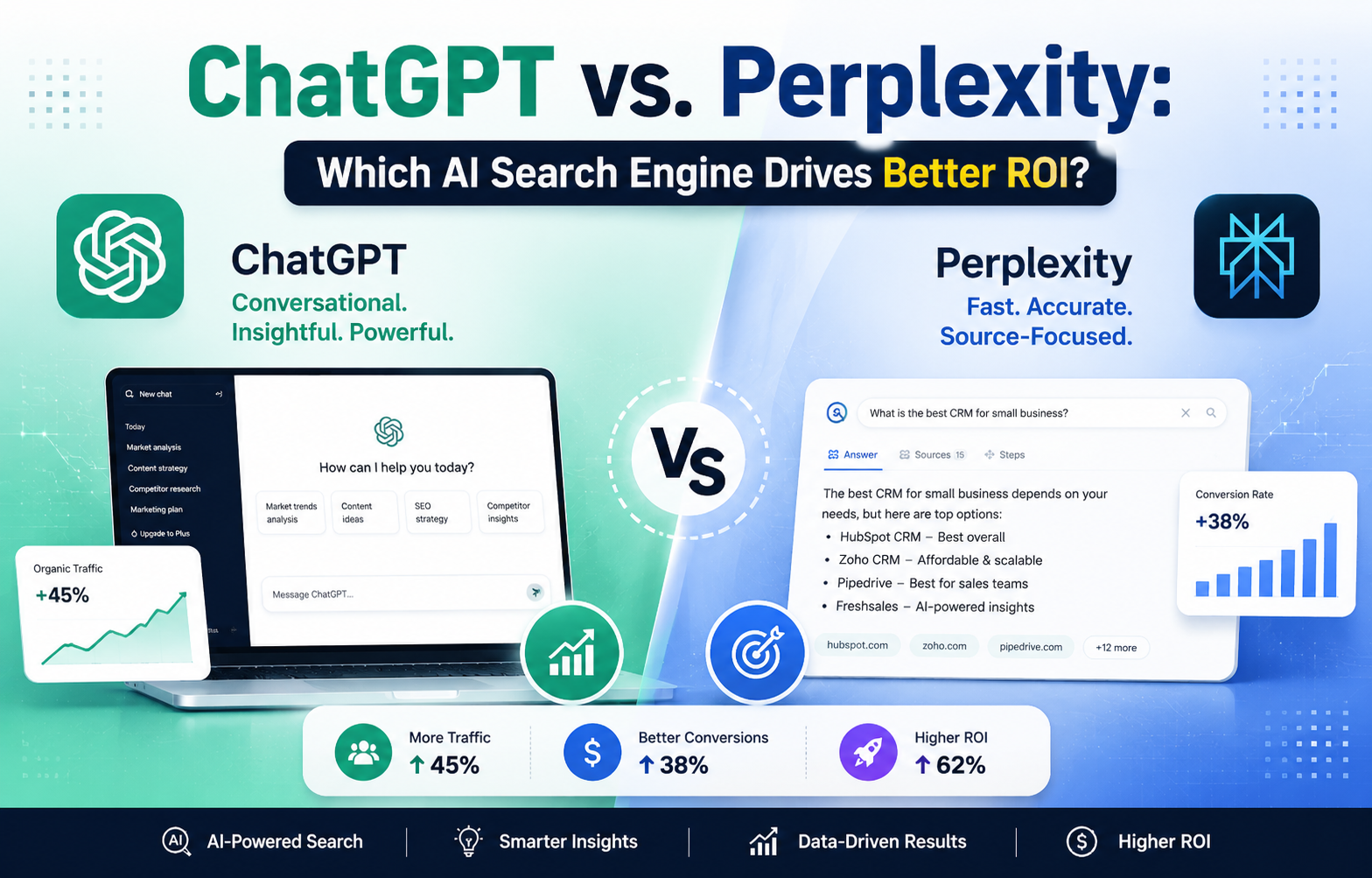
ChatGPT drives significantly more volume — it typically accounts for 60–80% of all AI referral traffic to websites. Perplexity sends far fewer visits but its users are usually further along the research journey, so its traffic often converts at a comparable or higher rate. In short: ChatGPT wins on reach, Perplexity often wins on intent quality. The best ROI comes from optimizing for both, not choosing one over the other, because the two platforms cite almost entirely different sets of websites.
If you’ve been tracking your Google Search Console numbers and wondering why “AI search” keeps coming up in every marketing meeting, you’re not imagining it. AI search vs traditional search is no longer a future debate — it’s already reshaping how buyers discover, compare, and choose brands. And for businesses trying to decide where to invest content and SEO effort, the ChatGPT vs Perplexity question is one of the most practical decisions you’ll make this year.
At Click Catcher, we build content marketing strategy and SEO programs for brands across Noida and India, and this exact question comes up in almost every client conversation now. Here’s what the data actually says.
AI Search vs Traditional Search: What’s Actually Different?
Before comparing ChatGPT and Perplexity directly, it helps to understand the bigger shift happening. Traditional search (think classic Google) works on a “ten blue links” model — you type a query, and you get a ranked list of pages to click through. You do the reading. You do the comparison. You decide.
AI search engines flip that model. Instead of handing you links, they read multiple sources, synthesize the information, and give you a direct answer — often with citations, sometimes without. The user barely has to click anywhere unless they want to dig deeper. This is the heart of what’s called a “zero-click” search experience, and it’s reshaping how content marketers think about visibility.
AI Search vs Traditional Search
| Aspect | Traditional Search (Google) | AI Search Engines |
| Result Format | List of ranked links | Direct synthesized answer |
| User Behavior | Clicks multiple pages to compare | Reads one answer, may not click at all |
| Ranking Signal | Backlinks, keywords, domain authority | Content clarity, structure, citations, freshness |
| Visibility Goal | Rank on page 1 | Get quoted or cited in the answer |
| Best Optimization Approach | SEO | AEO (Answer Engine Optimization) + GEO (Generative Engine Optimization) |
ChatGPT vs Perplexity: How Each One Actually Works
Both tools use large language models to answer questions, but their approach to sourcing information is quite different — and that difference matters a lot for marketers thinking about ROI.
ChatGPT, especially with browsing enabled, can search the web and pull in real-time information, but its core strength has always been conversational reasoning — explaining, drafting, brainstorming, and answering based on a blend of trained knowledge and live search when needed. Perplexity, on the other hand, was built from the ground up as a search-first product. Every answer it gives is typically backed by visible citations, almost like a research assistant that shows its homework.
This distinction is the reason content teams can’t treat them identically. A brand that gets cited often on Perplexity might be nearly invisible on ChatGPT, and vice versa, depending on how discoverable and well-structured its content is.
Perplexity vs ChatGPT: Core Comparison
| Feature | ChatGPT | Perplexity |
| Primary Use Case | Conversational assistant, content generation, reasoning | Research-focused, citation-driven search |
| Source Citations | Sometimes shown, depends on mode | Almost always shown clearly |
| Real-Time Web Access | Yes, with browsing enabled | Yes, by default |
| User Intent | Broad — tasks, ideas, chat, search | Narrow — fact-finding, comparisons, research |
| Content Discovery Style | Blended answer, less transparent sourcing | Answer plus visible source list |
| Best For Marketers | Being part of general knowledge answers | Being cited as a direct, trusted source |
Which One Actually Drives Better ROI?
There’s no universal winner — it depends on your funnel stage and industry:
- E-commerce and impulse categories: ChatGPT’s scale usually wins on raw revenue, even if individual sessions convert modestly.
- B2B, SaaS, finance, and professional services: Perplexity (and increasingly Claude) often deliver higher-intent visits because these platforms are used for serious comparison research rather than quick answers.
- Local and service businesses: Both matter less than Google’s AI Overviews and local search right now, but early visibility still compounds — the brands that get cited first tend to stay cited.
What Google Itself Says About AI Search
It’s worth pausing on this because a lot of “AI SEO” advice contradicts it: Google’s own Search Central documentation states there are no special technical requirements, no separate “AI index,” and no unique markup needed to appear in AI Overviews or AI Mode. The same E-E-A-T principles — Experience, Expertise, Authoritativeness, and Trustworthiness — that govern classic organic rankings also determine what gets surfaced and cited in Google’s generative AI features. Google has also confirmed that clicks originating from AI Overviews tend to be higher quality, with users spending more time on the destination site once they do click through.
The practical implication for ChatGPT vs Perplexity, and for AI search more broadly, is the same: these platforms don’t reward “AI-flavored” writing tricks. They reward genuinely helpful, well-organized, technically accessible content — the same content Google has recommended for years.
| Google’s Official AI Search Guidance | What It Means for Your Content |
| No special AI Overviews markup or separate index required | Focus on strong core SEO instead of chasing “GEO hacks” |
| Content is judged on E-E-A-T, same as classic Search | Show real authorship, credentials, and firsthand expertise |
| Pages must be indexed and crawlable to be cited | Check robots.txt and Search Console for crawl errors first |
| AI Overview clicks are typically higher quality/longer visits | Optimize for engagement and conversion, not just impressions |
| Helpful, people-first content outperforms AI-generated filler | Prioritize original insight over generic, templated answers |
How to Optimize for Both AI Search Engines and ROI
- Publish original data and expert insight. AI engines favor content that adds something new — statistics, case studies, and clearly attributed expertise — over generic rewrites.
- Structure content for extraction. Use clear H2/H3 headings, short paragraphs, bullet points, and a “quick answer” near the top so both AI models and Google’s Featured Snippets can lift it cleanly.
- Build topical authority, not just keyword rankings. Cover a topic in depth across multiple linked pages instead of one thin post.
- Earn third-party mentions. Reviews, industry publications, and community discussion (like Reddit and niche forums) heavily influence what both ChatGPT and Perplexity choose to cite.
- Add schema markup and FAQs. Structured data helps AI systems and Google AI Overviews understand exactly what your page answers.
- Check your robots.txt. Confirm you’re not accidentally blocking GPTBot, ChatGPT-User, or PerplexityBot — a surprisingly common and easily fixed mistake.
- Track AI referral traffic separately. Segment ChatGPT, Perplexity, and Gemini sessions in your analytics so you can see which platform is actually driving qualified leads, not just visits.
For a deeper look at how zero-click search behavior affects lead generation, see our related guide: Zero-Click Searches Are Growing: How to Still Get More Leads.
FAQs
1. Is ChatGPT better than Perplexity for SEO?
Not exactly — they optimize for different outcomes. ChatGPT typically sends more overall traffic, while Perplexity often sends smaller but higher-intent traffic. A strong AEO/GEO strategy targets both rather than picking one.
2. Does AI search replace traditional SEO?
No. AI search vs traditional search isn’t an either/or choice. Google still drives the majority of organic traffic, and AI engines frequently pull their answers from well-ranked, authoritative web pages — so solid SEO fundamentals remain the foundation.
3. How do I know if AI search engines are sending traffic to my site?
Check your Google Analytics referral sources for domains like chatgpt.com, perplexity.ai, and gemini.google.com. Many businesses discover this traffic is already happening, just uncategorized as “direct.”
4. What content works best for AI Overviews and AI search engines?
Clear, well-structured content that directly answers a specific question in the first few sentences — supported by credible sources, data, and simple formatting — performs best across ChatGPT, Perplexity, and Google AI Overviews alike. According to Google’s own AI features documentation, there’s no special markup needed; the same helpful, people-first content that ranks well in classic Search is what gets surfaced in AI Overviews and AI Mode.
5. Can small businesses realistically compete for AI search visibility?
Yes. AI systems favor depth and clarity over domain size. A focused local or niche business with well-structured, genuinely useful content can be cited ahead of a much larger competitor with thin pages.
Conclusion
ChatGPT and Perplexity aren’t competing for the same job — one delivers scale, the other delivers intent. Winning ROI in 2026 means showing up credibly on both, backed by content that’s structured for AI extraction and grounded in real expertise, not keyword stuffing.
If you’re not sure where your brand currently stands across AI search engines and traditional Google rankings, that’s exactly the gap Click Catcher helps close — combining SEO, GEO, and content marketing strategy under one roof.
Ready to find out where your brand stands in AI search?
Book a free consultation with Click Catcher and get a clear picture of your visibility across Google, ChatGPT, and Perplexity.