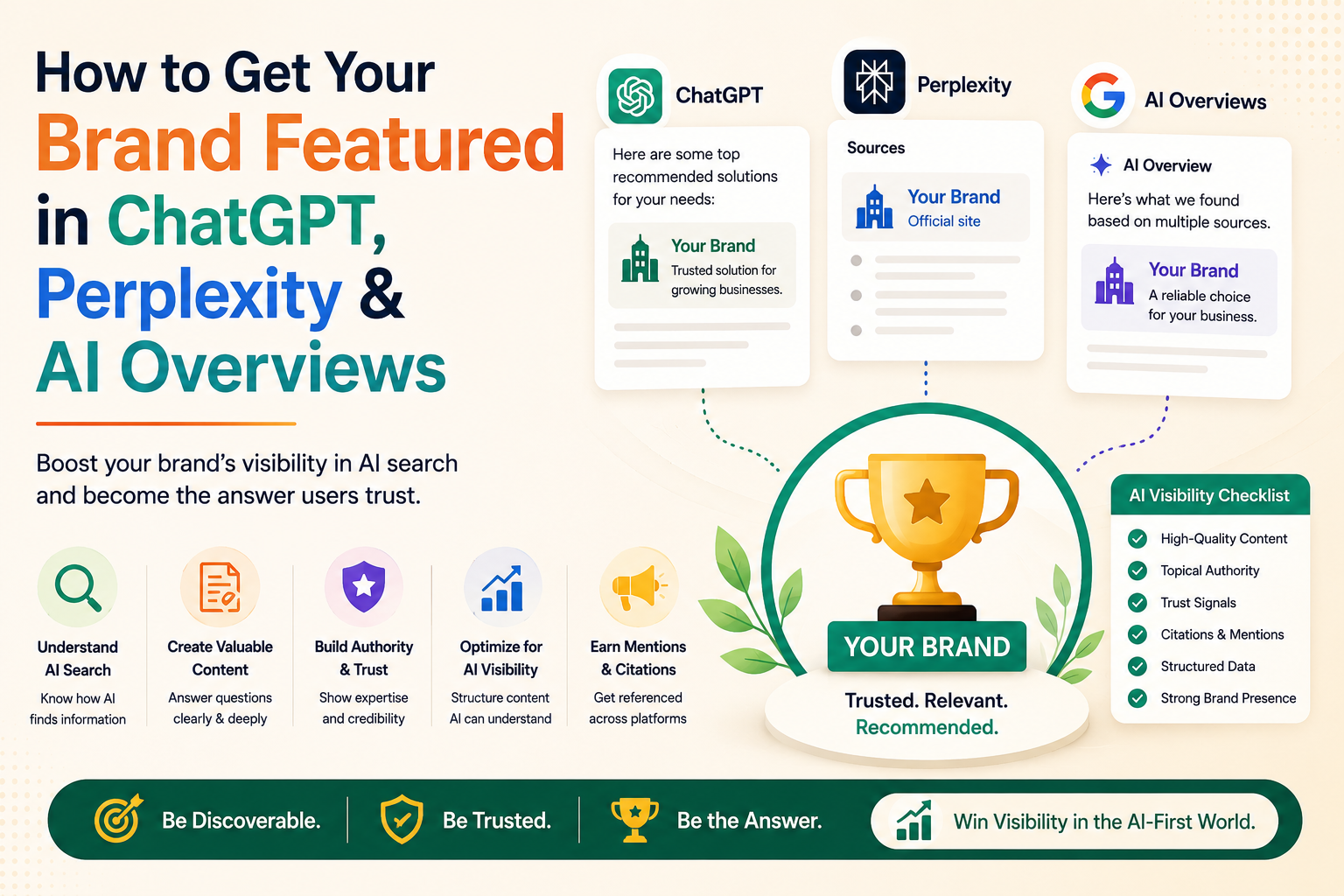
Imagine a potential customer types a question into ChatGPT or Perplexity — and your brand shows up as the recommended solution. No paid ads. No bidding wars. Just pure authority.
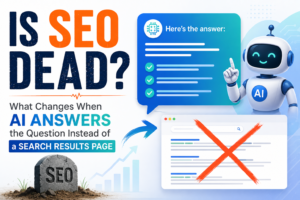
That’s the new frontier of digital marketing in 2026. Search has fundamentally transformed. Users are no longer just Googling — they’re asking AI assistants, and those AI assistants are deciding which brands get mentioned. Traditional SEO alone won’t get you there.
This guide breaks down exactly how to get your brand featured in ChatGPT, Perplexity, Google AI Overviews, and other AI-driven search platforms — with actionable strategies your digital marketing agency can implement starting today.
| KEY INSIGHT Over 60% of search queries in 2026 are answered directly by AI without the user clicking a website. Brands not optimized for AI visibility are invisible to more than half their potential audience. |
1. Understanding How AI Platforms Choose Brands
Before you can get featured, you need to understand the logic behind AI recommendations. Platforms like ChatGPT, Perplexity, and Google’s AI Overviews don’t rank pages — they synthesize authoritative information from trusted sources. They look for:
- Entities: Named brands, products, and experts recognized across multiple authoritative sources
- Topical Depth: Content that thoroughly covers a subject, not just surface-level keywords
- Structured Data: Properly tagged content that machines can easily parse and understand
- Trust Signals: Reviews, citations, mentions in reputable publications, and consistent NAP data
- E-E-A-T: Experience, Expertise, Authoritativeness, and Trustworthiness across your digital presence
The fundamental shift: AI doesn’t reward who pays the most. It rewards who knows the most and proves it consistently.
2. Build a Knowledge Graph Presence for Your Brand
Google’s Knowledge Graph and similar entity databases are the backbone of AI understanding. When AI models describe your brand, they pull from these entity-rich sources. Here’s how to establish your brand as a recognized entity:
Claim and Optimize Your Google Business Profile
Ensure your business name, description, category, and services are accurate and keyword-rich. AI Overviews frequently pull business information directly from GBP. Add detailed service descriptions, update your Q&A section, and post regularly to signal an active, authoritative presence. → Set up Google Business Profile
Create a Wikipedia or Wikidata Entry
For established brands, a Wikipedia page or Wikidata entry dramatically increases AI recognition. AI language models are heavily trained on Wikipedia. If your brand isn’t there, you’re at a significant disadvantage. Smaller brands can focus on Wikidata, which has a lower notability threshold.
Use Schema Markup (Structured Data)
Structured data is how you speak the language of machines. Read our complete Schema Markup Guide and implement the following Schema types on your website (schema.org reference):
- Organization Schema — your brand’s name, logo, founding date, and social profiles
- LocalBusiness Schema — address, hours, phone, geo coordinates
- FAQPage Schema — question-and-answer format that AI loves to cite
- HowTo Schema — step-by-step guides that position you as the explainer
- Article Schema — author credentials, publish dates, and content type classifications
3. Create Content That AI Wants to Cite
AI models are trained on and continually index content that is direct, factual, and structured for comprehension. To become a brand that AI cites, your content strategy must shift from keyword-stuffing to authority-building.
Write Answer-First Content
Structure every blog post, landing page, and service page to answer the user’s question in the first 100 words. AI Overviews and Perplexity scan for the fastest, clearest answer. If your content buries the answer under long introductions, AI will skip it.
Build Topic Clusters, Not Isolated Posts
Create a central “pillar page” on a broad topic (e.g., “Complete Guide to Digital Marketing in 2026”) and support it with 10–20 in-depth subtopic articles. Interlink them tightly. This signals topical authority — one of the most powerful signals for AI recommendation systems.
Publish Original Research and Data
AI platforms prioritize original, citable data. Conduct surveys, publish case studies with real numbers, and produce annual industry reports. When other authoritative sites cite your data, AI models learn that your brand is a primary source — not just a content aggregator.
| PRO TIP Use the “Inverted Pyramid” structure in your content: lead with the conclusion, then provide supporting evidence, then offer deep-dive detail. This matches how AI systems extract answers — they take the top of the pyramid and cite it. |
4. Master Generative Engine Optimization (GEO)
GEO — Generative Engine Optimization — is the new SEO. While traditional SEO optimizes for search engine rankings, GEO optimizes for AI engine citations. Here’s your GEO checklist:
- Use conversational, question-based headings (e.g., “What is the best way to…?”)
- Include direct, concise definitions for key terms in your industry
- Add statistics with source attribution in every major piece of content
- Create comparison pages: “Brand A vs Brand B” — AI loves to surface these for decision-stage queries
- Optimize your About page to clearly describe who you are, what you do, and who you serve
- Ensure your content is available for indexing by Perplexity and Bing (since Perplexity uses Bing’s index)
- Build topical authority in ONE niche before expanding — depth beats breadth for AI citations
5. Earn Mentions Across Authoritative Platforms
AI models learn brand credibility from how frequently and positively a brand is mentioned across trusted sources. This is sometimes called “digital PR for AI visibility.” Key strategies include:
Get Featured in Industry Publications
Write guest posts for Forbes, Entrepreneur, HubSpot, Search Engine Journal, and niche trade publications in your industry. Authoritative backlinks remain important, but unlinked brand mentions in trusted publications now carry strong AI visibility signals.
Build a Podcast and YouTube Presence
AI models are increasingly indexing podcast transcripts and YouTube video descriptions. A consistent video or podcast presence, with keyword-rich transcripts and show notes, positions your brand as a voice of authority that AI platforms recognize across multiple media formats.
Encourage and Respond to Reviews
Google reviews, Trustpilot, G2, Clutch, and Yelp reviews are data sources AI models scan when evaluating brand trustworthiness. Proactively collect reviews, respond professionally to all feedback, and ensure review sentiment is overwhelmingly positive.
6. Optimize for Perplexity Specifically
Perplexity AI is rapidly becoming one of the most-used AI search platforms, especially among professionals and researchers. Unlike ChatGPT, Perplexity actively cites its sources — meaning getting featured directly drives traffic back to your website.
- Ensure your site is indexed by Bing (Perplexity uses Bing’s crawler — submit your sitemap to Bing Webmaster Tools)
- Write content that directly answers specific, long-tail questions your audience asks
- Use clear, factual language with minimal fluff — Perplexity favors content that gets to the point fast
- Include dates and “as of [year]” qualifiers in time-sensitive content to signal freshness
7. Monitor and Measure Your AI Visibility
What gets measured gets improved. Use these methods to track your AI search presence:
| Tool / Method | What It Tracks | Frequency |
| Google Search Console | AI Overview appearances & impressions | Weekly |
| Brand mention monitoring (e.g. Brand24) | Unlinked brand mentions across the web | Daily |
| Manual AI Queries | Search your brand + keywords in ChatGPT, Perplexity, Gemini | Monthly |
| Referral Traffic Analysis | Track traffic from Perplexity and AI-based referrers | Weekly |
| Schema Validator (Google) | Ensure structured data is correctly read | After updates |
8. The Long Game: Build an AI-First Brand
Getting featured in AI platforms isn’t a one-time campaign. It’s the result of sustained, deliberate brand building. Here’s the mindset shift your digital marketing agency needs to make:
- Think like an encyclopedia, not a sales brochure — AI cites information, not promotions
- Prioritize depth over volume — 10 deeply researched articles beats 100 thin ones
- Be consistent — AI trust is built through repeated positive signals over time
- Invest in your brand’s credibility offline too — speaking at conferences, awards, and partnerships all contribute to your AI visibility
- Update your content regularly — stale content is deprioritized by AI systems that favor freshness
FAQ
1: What is the difference between SEO and GEO (Generative Engine Optimization)?
Traditional SEO focuses on ranking your web pages higher in Google’s search results through keywords, backlinks, and technical optimization. GEO, on the other hand, optimizes your brand to be cited and recommended by AI platforms like ChatGPT, Perplexity, and Google AI Overviews. While SEO drives clicks to your website, GEO ensures your brand appears as a trusted answer within AI-generated responses — even before a user visits any website.
2: How long does it take to get featured in ChatGPT or Perplexity?
There’s no fixed timeline, as AI models are trained and updated on different schedules. However, brands that consistently publish authoritative, structured content, earn mentions in reputable publications, and maintain strong entity signals (like a Google Business Profile and Schema markup) typically begin seeing AI citations within 3 to 6 months. The key is consistency — AI trust is built over time, not overnight.
3: Do I need to stop investing in traditional SEO to focus on AI visibility?
Not at all. Traditional SEO and AI visibility go hand in hand. In fact, most GEO best practices — quality content, structured data, authoritative backlinks, and E-E-A-T signals — directly strengthen your traditional SEO as well. Think of GEO as an evolution of SEO, not a replacement. A strong SEO foundation makes it significantly easier for AI platforms to recognize and recommend your brand.
4: Does paid advertising help get my brand featured in AI Overviews or ChatGPT?
No. AI platforms like ChatGPT and Perplexity do not accept paid placements within their AI-generated responses. Google AI Overviews are also organic and cannot be directly bought. This is actually great news for smaller brands and digital marketing agencies — AI visibility is a level playing field where authority, trust, and content quality win over budget size.
5: What type of content is most likely to be cited by AI platforms?
AI platforms favor content that is direct, factual, well-structured, and authoritative. The formats that perform best include FAQ pages (with FAQPage Schema), How-To guides, original research with statistics, comparison articles, and comprehensive pillar pages. Content that answers a specific question clearly within the first 100 words has the highest chance of being pulled into AI-generated summaries. Avoiding fluff, using clear headings, and citing credible sources also significantly boosts your chances.
Final Thoughts
The brands that will dominate the next decade aren’t the ones spending the most on ads — they’re the ones that AI systems trust the most. ChatGPT, Perplexity, Google AI Overviews, and every future AI platform will choose to feature brands that have done the work: built topical authority, earned trust signals, structured their data properly, and published genuinely helpful content.
Start now. The window to establish AI visibility before your competitors do is open — but it won’t be for long.
Need help building your brand’s AI search visibility? Get in touch with our digital marketing team today.