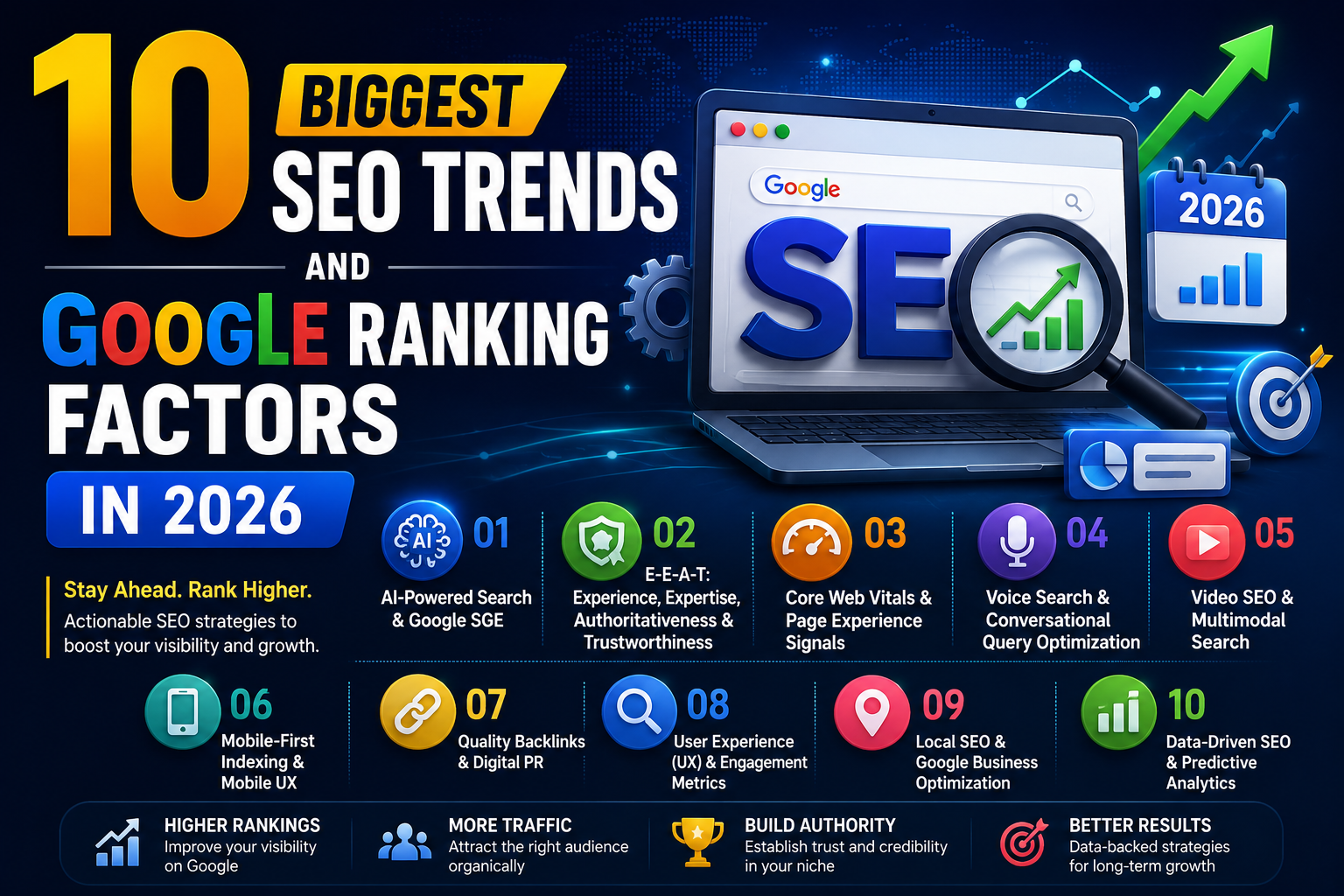
The world of search engine optimization is shifting faster than ever. With Google rolling out major algorithm changes, AI-powered search results, and entirely new ranking signals, digital marketers and website owners must adapt or risk losing their hard-earned traffic. In this comprehensive guide, we cover the 10 biggest SEO trends and Google ranking factors defining 2026 — backed by industry data, expert insights, and actionable strategies you can implement today.
Whether you are a seasoned SEO professional or a business owner just getting started, understanding these trends will help you stay ahead of the curve. For the foundational principles of search, we recommend reviewing Google’s official Search Central documentation alongside this guide.
Trend #1: AI-Powered Search & Google’s Search Generative Experience (SGE)
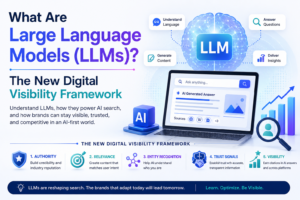
Artificial intelligence is no longer a peripheral feature — it is the engine driving modern search. Google’s Search Generative Experience, now deeply integrated into results globally, generates AI-powered summaries at the top of the page, often absorbing clicks that previously went to organic results. To thrive, your content must be authoritative, structured, and rich enough to be cited by Google’s AI as a trusted source.
The key to winning SGE visibility is Answer Engine Optimization (AEO). This means writing content that directly and succinctly answers user questions, using clear headings, structured data markup, and factual accuracy. Sites that regularly appear in AI-generated summaries report dramatically higher brand visibility even when traditional click-through rates shift.
For a deep dive into adapting your strategy, explore Search Engine Land’s SGE optimization guide.
- Optimize for featured snippets and AI Overview citations
- Use FAQ and HowTo schema markup on all key pages
- Write concise, factual, well-sourced content AI can confidently reference
- Structure articles with clear H2/H3 hierarchies answering specific questions
Trend #2: E-E-A-T: Experience, Expertise, Authoritativeness & Trustworthiness
Google’s E-E-A-T framework — Experience, Expertise, Authoritativeness, and Trustworthiness — has evolved from a quality guideline into a de facto ranking signal in 2026. The extra ‘E’ for Experience underscores Google’s emphasis on first-hand, lived knowledge over generic AI-generated content.
Brands and creators demonstrating real-world expertise through author bios, credentials, original research, and transparent sourcing consistently outrank competitors publishing thin content. This is especially critical in YMYL (Your Money or Your Life) niches such as health, finance, and legal topics.
Review Moz’s comprehensive breakdown of E-E-A-T and how it affects rankings for detailed implementation advice.
- Add detailed author bios with credentials, social links, and photos
- Cite reputable, authoritative external sources throughout your content
- Publish original data, case studies, and first-person research
- Display trust signals: SSL, privacy policy, contact page, and business address
Trend #3: Core Web Vitals & Page Experience Signals
Page experience is now a permanent and increasingly weighted ranking factor. Google’s Core Web Vitals — Largest Contentful Paint (LCP), Interaction to Next Paint (INP), and Cumulative Layout Shift (CLS) — measure how fast, responsive, and visually stable your pages are. In 2026, Google tightened thresholds, particularly for INP, which replaced First Input Delay as the interactivity metric.
Sites consistently scoring ‘Good’ across all Core Web Vitals enjoy measurable ranking advantages, especially on mobile. Investing in performance optimization — image compression, lazy loading, efficient JavaScript, and server-side rendering — is no longer optional; it is table stakes for competitive keywords.
Use Google PageSpeed Insights to audit your site and identify specific bottlenecks impacting your scores.
- Target LCP under 2.5 seconds, INP under 200ms, CLS under 0.1
- Serve images in WebP/AVIF format with explicit dimensions declared
- Minimize render-blocking JavaScript and unused CSS stylesheets
- Use a CDN and enable browser caching for all static assets
Trend #4: Voice Search & Conversational Query Optimization
With smart speakers in over 40% of households and voice assistants integrated into virtually every smartphone, voice search optimization is now a mainstream necessity. Voice queries are longer, more conversational, and almost always phrased as complete questions — fundamentally different from typed searches.
Long-tail keywords and question-based content structures (Who, What, When, Where, Why, How) are the cornerstones of effective voice search SEO. Local voice searches (‘near me’ queries) dominate, making Google Business Profile optimization critical for businesses targeting voice users.
Learn how to structure conversational content from Ahrefs’ guide to voice search SEO.
- Target question-based long-tail keywords (e.g., ‘What is the best…’)
- Use concise 30–40 word answers for featured snippet eligibility
- Optimize Google Business Profile for local voice search queries
- Implement speakable schema markup for audio-compatible content
Trend #5: Video SEO & Multimodal Search
Google’s search results pages in 2026 are increasingly multimodal — mixing text, images, video clips, and AI-generated content. YouTube, as a Google property, receives preferential treatment in results, and short-form video clips from YouTube Shorts and other platforms now regularly appear above traditional links for how-to and informational queries.
Creating video content optimized for search — keyword-rich titles, detailed descriptions, chapters, captions, and transcripts — dramatically increases your content’s surface area across both traditional and AI-driven search. Embedding relevant videos on web pages also increases dwell time, a positive behavioral signal.
For detailed tactics, visit Backlinko’s YouTube SEO guide.
- Upload videos to YouTube with exact-match keyword-rich titles
- Add full transcripts to video descriptions for improved indexability
- Use video schema markup to earn rich result eligibility in Google Search
- Embed videos on corresponding blog posts to boost engagement metrics
Trend #6: Link Building Quality Over Quantity
Backlink building remains one of Google’s strongest ranking signals, but the emphasis has completely shifted from quantity to quality and relevance. In 2026, a single link from a highly authoritative, topically relevant website carries more weight than dozens of low-authority links. Google’s SpamBrain algorithm effectively detects and discounts link manipulation.
The most sustainable strategies center on digital PR, original research publications, resource page outreach, and genuine relationship building. Creating linkable assets — comprehensive guides, original data studies, free tools — naturally attracts high-quality editorial links at scale.
Explore Semrush’s advanced link building strategies for 2026 for campaign ideas and outreach templates.
- Conduct original research or surveys to attract natural editorial links
- Pursue digital PR campaigns to earn links from news and media outlets
- Audit existing backlinks and disavow toxic or spammy links regularly
- Build topical authority by earning links from niche-relevant sites
Trend #7: Topical Authority & Content Clustering
Search engines in 2026 reward websites that demonstrate comprehensive, deep expertise across an entire topic area. This concept — topical authority — is built through content clustering: creating a network of interlinked pillar pages and supporting cluster articles that collectively cover every dimension of a subject.
Websites investing in topic clusters consistently rank for broader keyword sets and recover faster from algorithm updates compared to sites with shallow, disconnected content strategies. Topical authority also aligns directly with E-E-A-T signals, since depth of coverage signals genuine expertise.
HubSpot pioneered the topic cluster model — read their definitive guide to topic clusters and pillar pages to architect your content strategy.
- Map your content strategy around 3–5 core topical pillars
- Create comprehensive pillar pages (3,000+ words) covering broad topics
- Build supporting cluster articles targeting specific subtopics and long-tail terms
- Interlink all cluster content bidirectionally through the pillar page
Trend #8: Local SEO & Hyperlocal Targeting
Local search continues to dominate for businesses serving specific geographic areas. Google’s local pack — the map results shown for searches with local intent — is driven by a distinct set of signals: Google Business Profile completeness, review volume and quality, local citation consistency, and proximity. In 2026, AI integration means Google now generates AI-powered summaries even for local queries.
Hyperlocal content strategies — neighborhood-specific pages, local event coverage, and geo-targeted landing pages — give businesses an edge in capturing block-level search intent. Managing your online reputation through consistent review acquisition and response is equally critical.
BrightLocal’s Local SEO learning hub is the definitive resource for mastering local search rankings.
- Fully complete and regularly update your Google Business Profile
- Build consistent NAP (Name, Address, Phone) citations across directories
- Develop a proactive strategy to earn and respond to Google reviews
- Create location-specific landing pages for each service area you target
Trend #9: Zero-Click Searches & SERP Feature Optimization
Over 65% of Google searches in 2026 end without a click to any website, as Google answers queries through featured snippets, knowledge panels, People Also Ask boxes, local packs, and AI Overviews. While challenging for traffic, earning a SERP feature positions your brand as the authoritative answer source, boosting visibility even when users do not click.
Optimizing for zero-click features requires a different content approach: lead with the most direct, concise answer, then expand. Use structured data markup extensively. Format content for the snippet formats Google prefers — paragraph snippets for definitions, table snippets for comparisons, list snippets for how-to steps.
Study the Moz guide to featured snippet optimization to capture these high-visibility placements.
- Target who/what/when/why/how keywords most likely to trigger featured snippets
- Implement JSON-LD structured data for Article, FAQ, HowTo, and Product types
- Format answers as 40–60 word concise paragraphs for paragraph snippets
- Use numbered lists for how-to content and comparison tables for product queries
Trend #10: Data-Driven SEO & AI-Assisted Content Strategy
The gap between intuition-based SEO and data-driven SEO is widening dramatically in 2026. Marketers leveraging AI tools for keyword research, competitive gap analysis, content brief generation, and performance forecasting make faster, more accurate decisions. Platforms like Semrush, Ahrefs, and Clearscope now incorporate AI to surface semantic keyword clusters and optimization opportunities in seconds.
Search Console data, combined with first-party analytics, drives real-time content refreshes at scale. Successful SEO teams continuously monitor ranking changes, click-through rate patterns, and crawl budget efficiency to maintain and grow organic performance systematically rather than reactively.
Get started with data-driven SEO using Google Search Console’s official help documentation and Ahrefs’ free SEO tools.
- Use Google Search Console to identify high-impression, low-CTR pages
- Conduct quarterly content audits and refresh underperforming articles
- Leverage AI writing assistants to scale content without sacrificing quality
- Track Core Web Vitals, ranking positions, and organic traffic weekly
Frequently Asked Questions (FAQs)
Everything you need to know about SEO in 2026
Q1. Is SEO still worth investing in with AI-generated search results taking over?
Absolutely. While AI Overviews and zero-click features have changed how traffic flows, organic search still drives the majority of website traffic globally. The key shift is that SEO now focuses on brand authority, visibility, and being cited by AI — not just blue-link clicks. Businesses that adapt early gain a lasting competitive edge. For supporting data, see SparkToro’s research on zero-click search trends.
Q2. How long does it take to see results from SEO efforts in 2026?
SEO remains a medium-to-long-term investment. New websites typically take 4–6 months to gain meaningful traction for competitive keywords, while established sites may see results from content optimizations within 4–8 weeks. Factors like domain authority, content quality, competition level, and technical health all influence the timeline. Core Web Vitals improvements and structured data additions can produce visible SERP changes within 2–4 weeks.
Q3. What is the most important Google ranking factor in 2026?
There is no single ‘most important’ factor — Google uses hundreds of signals in concert. However, the combination of content quality (E-E-A-T), page experience (Core Web Vitals), and topical authority consistently carries the most weight across niches. For highly competitive or YMYL (Your Money or Your Life) topics, demonstrated expertise and trustworthiness signals are non-negotiable prerequisites for ranking in top positions.
Q4. Should I still focus on keyword research if AI is changing how people search?
Yes — keyword research remains foundational, but the methodology has evolved. In 2026, effective keyword research focuses on search intent clusters rather than individual exact-match terms. Tools like Ahrefs’ Keywords Explorer and Google’s People Also Ask boxes are invaluable for mapping comprehensive intent landscapes.
Q5. How does AI-generated content affect SEO rankings?
Google’s official stance is that it rewards high-quality content regardless of how it was produced. However, purely AI-generated content published at scale without human oversight consistently underperforms compared to human-edited, experience-rich content. The winning strategy is ‘AI-assisted, human-verified.’ Review Google’s helpful content guidance for the full policy.
Final Thoughts: Building an SEO Strategy for 2026 and Beyond
The SEO landscape of 2026 rewards those who think holistically — combining technical excellence, content depth, authentic authority, and user-centric design into a unified strategy. The websites winning in organic search are not gaming algorithms; they are genuinely the best resources on their topics, technically optimized to be fast and accessible, and backed by demonstrable real-world expertise.
Start by auditing your current technical health using Google Search Console and PageSpeed Insights. Then build your content strategy around topical authority clusters. Invest in earning genuine backlinks through digital PR and original research. Optimize for voice, video, and AI-cited formats. And above all, create content that serves users first — because that is, and always has been, the ultimate SEO strategy.
For continuous learning, follow Search Engine Journal, Moz Blog, and Ahrefs Blog — three of the most trusted independent sources of actionable SEO intelligence.