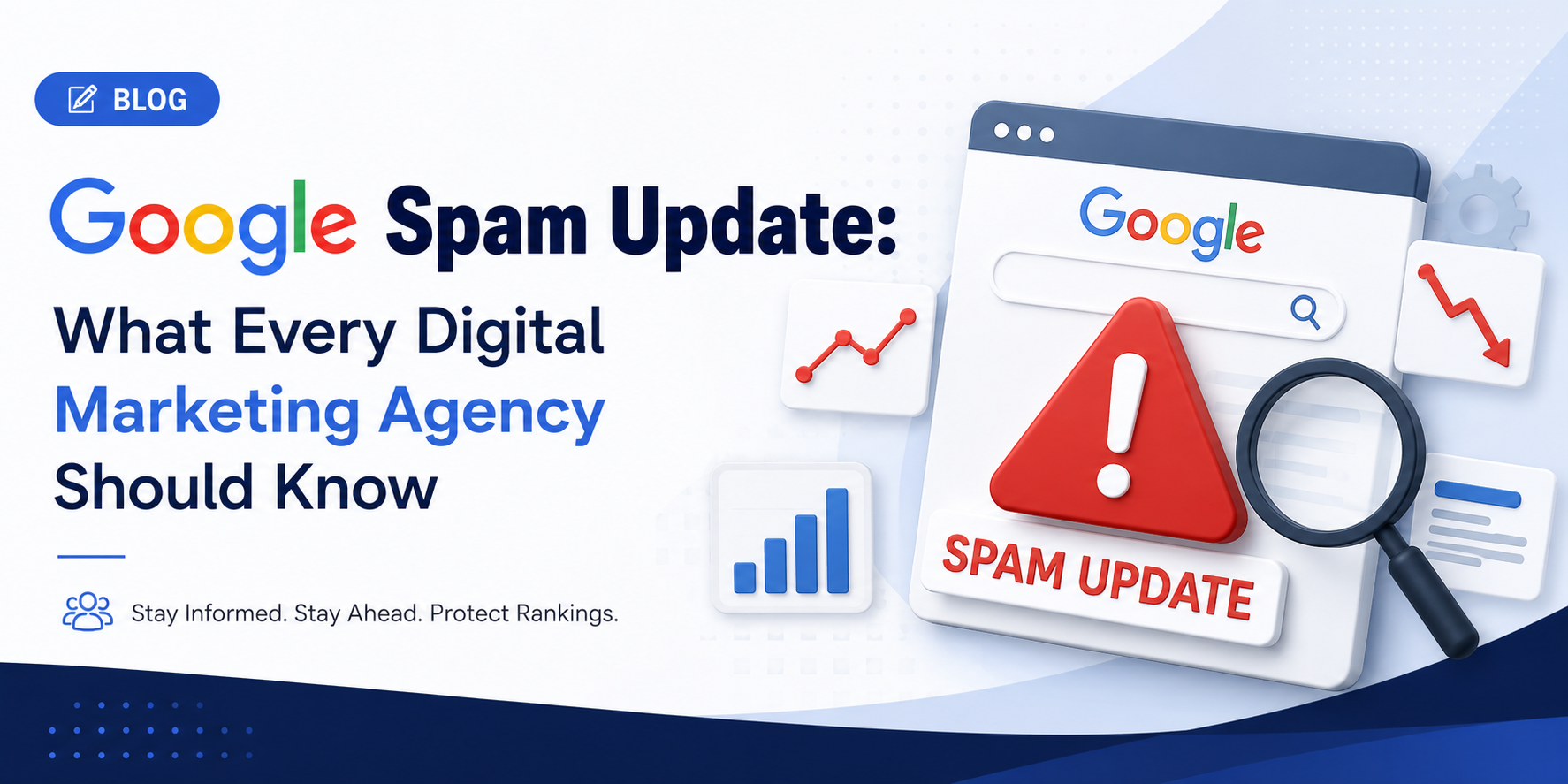
Google rolled out its second spam update of 2026 in late June, and if you run or work inside a digital marketing agency, the ripple effects have probably already reached your client reports. Whether you manage SEO for five clients or fifty, understanding what a spam update actually does — and, just as importantly, what it doesn’t — is now a core part of managing client expectations and protecting your agency’s credibility.
This guide breaks down the June 2026 Google Spam Update in plain terms, explains how it differs from a core update, and gives your agency a practical framework for diagnosing impact, communicating with clients, and building spam-resistant content strategies going forward.
In This Article
- What Happened: The June 2026 Spam Update
- Spam Update vs. Core Update: Why the Difference Matters
- What This Update Targets — and What It Doesn’t
- Why This Matters More for Agencies Than Solo Site Owners
- How to Diagnose Whether a Client Was Hit
- Recovery Timeline: Setting Realistic Client Expectations
- Agency Checklist: Building Spam-Resistant Content
- Frequently Asked Questions
What Happened: The June 2026 Spam Update
Google began rolling out the June 2026 spam update on June 24 at around 9:00 AM Pacific, and confirmed completion two days later on June 26 via its Search Status Dashboard. It applied globally, across all languages, and Google described it simply as a normal spam update rolling out to “all languages and locations.”
This was the second spam update Google announced in 2026, following one in March. Unlike a core update, Google did not attach any new spam policies to the release — it framed the update as an improvement to its existing automated detection systems, including SpamBrain, its AI-based spam-prevention system.
Quick fact: According to reporting from Search Engine Roundtable, Google confirmed this update does not target link spam or the site reputation abuse policy — a detail worth flagging to any client who instinctively wants to start disavowing backlinks after a traffic dip.
Spam Update vs. Core Update: Why the Difference Matters
Agencies that blur the line between spam updates and core updates end up giving clients the wrong remediation advice. The two work in fundamentally different ways, and the fix for one rarely fixes the other.
| Factor | Spam Update | Core Update |
| Purpose | Improves detection of manipulative tactics | Broadly recalibrates how relevance and quality are assessed |
| Who it affects | Sites actively violating spam policies | Any site, even those following best practices |
| Typical rollout time | 1 day to a few weeks | 2 to 4 weeks, sometimes longer |
| Recovery path | Remove the violation; wait for reassessment | Broad content and E-E-A-T improvements over time |
| Link-based penalties | May be permanent if link-scheme related | Not typically link-focused |
What This Update Targets — and What It Doesn’t
Google rarely spells out exactly what a spam update is tuned to catch, but based on its published spam policies, the general categories these updates enforce include:
- Scaled content abuse — generating large volumes of pages, often AI-assisted, primarily to rank rather than to help users
- Cloaking — showing search engines a different version of a page than what users see
- Keyword stuffing — unnatural repetition of exact-match keywords in headings, body copy, or anchor text
- Hidden text and sneaky redirects — content invisible to users or redirects that lead somewhere other than the indexed page
- Expired domain abuse — repurposing an aged domain’s authority for unrelated, low-value content
- Doorway pages — thin pages built purely to funnel traffic toward another destination
Notably, this particular update excludes link spam and the site reputation abuse policy — meaning agencies shouldn’t reflexively blame a client’s backlink profile for a June-window drop. The more productive place to look is on-page and content quality.
Context worth noting: About forty days before this rollout, Google updated its spam policy to explicitly name manipulation of AI-generated answers in Search as a spam violation, alongside publishing its first official guidance on optimizing for AI features legitimately. Agencies producing AI Overview- and AEO-optimized content should treat that policy update, not just the June spam update, as the real signal to watch — reported by Digital Applied.
Why This Matters More for Agencies Than Solo Site Owners
A single site owner absorbs one ranking hit. An agency absorbs it multiplied across every client account it manages — plus the reputational cost of explaining it. A few reasons this deserves agency-level attention rather than a one-off blog note:
- Client trust is on the line. A client who sees a traffic drop the same week as a Google update wants an immediate, accurate explanation — not a guess.
- Scaled content programs are exposed. Agencies running AI-assisted content production at volume are precisely the profile scaled content abuse policies are built to catch, even unintentionally.
- Reporting accuracy affects retention. Misattributing a ranking dip to the wrong update (spam vs. core vs. algorithm drift) undermines the agency’s credibility in monthly reporting.
- Recovery timelines shape contracts. Google is explicit that recovery can take months, and some link-related penalties never fully reverse — that needs to be reflected in how agencies set retainer expectations.
How to Diagnose Whether a Client Was Hit
Before telling a client “this was the spam update,” confirm it with data. Google Search Console remains the single most reliable source for this.
- Pin down the exact rollout window. The June 2026 update ran June 24–26. A decline that started earlier likely traces to a different cause, such as the May 2026 core update.
- Check Performance > Search Results. Compare clicks and impressions before and after the rollout dates, filtered by page and country.
- Look at spread, not just depth. Spam updates typically hit many URLs across a site rather than a single page — if only one page dropped, look elsewhere first.
- Review the Manual Actions report. Spam updates are algorithmic, not manual, but ruling out a manual action removes one variable.
- Audit against the spam policy list. If timing and spread both line up, check your lowest-performing pages against the categories above — thin content, doorway patterns, cloaking, or keyword stuffing are the usual suspects.
Recovery Timeline: Setting Realistic Client Expectations
This is the part agencies most often get wrong in client communication. Google’s own documentation says a site typically improves only after its automated systems reassess compliance over a period of months — not days. For link-scheme penalties specifically, Google has stated that any ranking benefit those links once generated is not recoverable, even after the links are removed.
What to tell clients: If a page is affected, fixing the underlying issue is step one — but visible recovery is a multi-month process, not a next-week fix. Setting this expectation early prevents a much harder conversation later.
Agency Checklist: Building Spam-Resistant Content
Rather than reacting update by update, the more durable move for an agency is to build content operations that never come close to the line. A few standing practices worth locking into your production workflow:
- Cap AI-assisted content production against a genuine editorial review step — volume without human review is exactly what scaled content abuse policies target
- Avoid programmatic page generation unless each page offers genuinely distinct value to a user
- Keep keyword usage natural; write for the query intent, not the exact-match phrase
- Audit expired or acquired domains before repurposing them for unrelated client content
- Document E-E-A-T signals — author bios, credentials, original data — on every client site
- Track update rollout dates against client reporting so attribution is evidence-based, not assumed
Frequently Asked Questions
What is the Google June 2026 spam update?
It’s the second spam update Google released in 2026, rolled out globally from June 24–26. It refined Google’s automated spam-detection systems, including SpamBrain, without introducing new spam policies.
How is a spam update different from a core update?
A spam update specifically targets sites violating Google’s spam policies, such as scaled content abuse or cloaking. A core update broadly recalibrates ranking systems and can affect sites regardless of whether they violate any policy.
Does this update target backlinks?
No. Google confirmed the June 2026 spam update does not target link spam or the site reputation abuse policy, so disavowing links is unlikely to resolve a drop tied to this rollout.
How long does recovery take after a spam update penalty?
Google states that improvement typically requires its systems to reassess a site’s compliance over a period of months. Some link-scheme penalties do not reverse even after the links are removed.
Does using AI to write content automatically trigger a spam penalty?
No. Google has repeatedly clarified that content is not penalized simply for being AI-assisted. The policy targets scaled, low-value content produced primarily to manipulate rankings, regardless of whether AI was involved in producing it.
Sources
- Search Engine Journal — Google Finishes Rolling Out The June 2026 Spam Update
- Search Engine Land — Google Releases June 2026 Spam Update
- Search Engine Roundtable — Google June 2026 Spam Update Is Done Rolling Out
- Google Search Central — Spam Policies for Google Web Search
- Google Search Central — How We Fight Search Spam
Keep Your Clients Protected Through Every Google Update
Click Catcher monitors algorithm and spam updates continuously, so your content strategy stays compliant and your rankings stay stable — before an update becomes a client emergency.