Every few years, someone declares SEO dead. It survived mobile-first indexing, the rise of voice search, and more core algorithm updates than most marketers can count. Each time, the panic faded, budgets stayed put, and SEO adapted. Now there’s a new challenger, and this one feels different: AI-generated answers that sit right at the top of the search page — or replace the search page entirely.
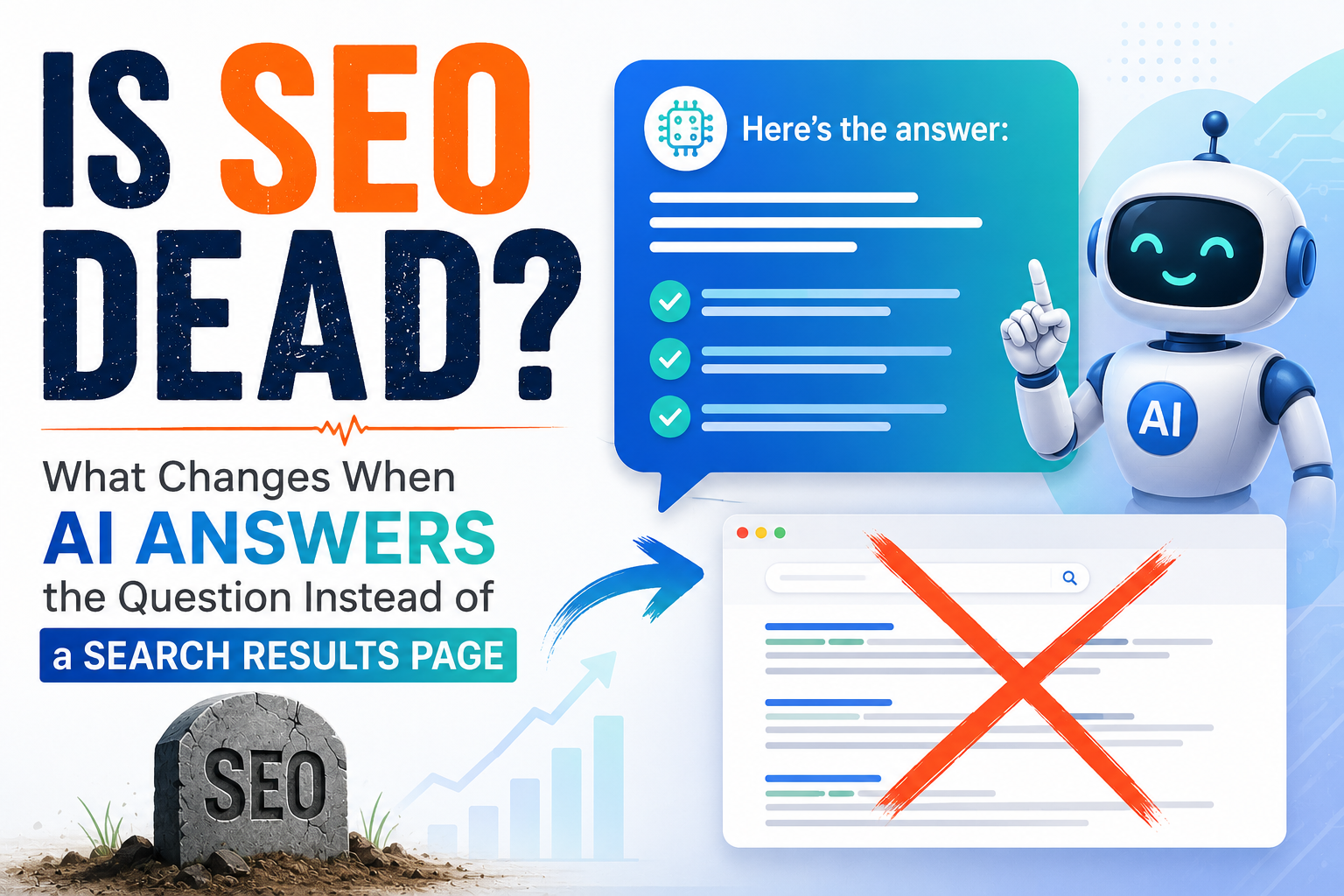
Type a question into Google today and there’s a decent chance you’ll see a full paragraph answer before you see a single blue link. Ask the same question in ChatGPT, Perplexity, or a similar assistant, and you may get a complete, synthesized answer with no results page at all. For a growing share of searches, the traditional “ten blue links” experience simply doesn’t happen anymore.
So is SEO actually dying this time? Not exactly — but it is changing shape faster than most businesses have adjusted for. The old goal was ranking in the top ten results. The new goal, increasingly, is being the source an AI model trusts enough to cite, quote, or summarize when it answers someone’s question directly. That’s a meaningfully different game, with different rules, different metrics, and different content requirements. Businesses that don’t adapt will quietly lose visibility even while their traditional rankings look perfectly healthy on paper.
This post breaks down what’s actually changing, what still matters as much as ever, what’s genuinely new, and what to do about it — with a practical framework you can start applying this week.
The Shift: From “Rank on the Page” to “Get Cited by the Answer”
Traditional SEO optimized for a results page a human would scroll through, compare, and click on. It was built around the assumption that a person would see several competing options side by side and make a choice. AI search — Google’s AI Overviews, ChatGPT, Perplexity, and similar tools — often skips that step altogether and hands the user one synthesized answer, sometimes with a small citation link buried underneath, sometimes with no link at all.
That means the competition isn’t just “who ranks #1” anymore. It’s “whose content did the AI decide was worth quoting or summarizing.” A business could theoretically rank #1 in classic organic results and still get zero mentions in the AI-generated answer above it — or the reverse: a smaller, lesser-known site could be the one an AI system trusts and cites, simply because its content answered the question more clearly and credibly.
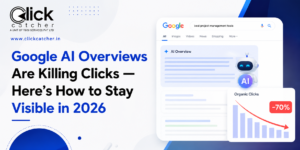
This is also changing how much traffic search sends at all. When an AI system fully answers a question in the search results themselves, many users never click through to any website. That’s a hard adjustment for businesses used to measuring SEO success purely by traffic volume — visibility and citations now matter even when they don’t show up as a session in your analytics.
| Old SEO Model | AI Search Model |
| Goal: rank in top 10 results | Goal: get cited/summarized in the AI answer |
| Success metric: click-through rate | Success metric: citation share, brand mentions |
| Optimization unit: a single page | Optimization unit: the whole site’s topical authority |
| Primary signal: backlinks + keywords | Primary signal: credibility, clarity, structured facts |
| User behavior: scrolls, compares, clicks | User behavior: reads the AI summary, may never click through |
What Still Matters (Don’t Throw This Out)
Before you rip up your entire content strategy, it’s worth being clear-eyed about what hasn’t actually changed. Some SEO fundamentals aren’t going anywhere — AI systems still rely on many of the same signals search engines have used for years to figure out what’s true and who’s credible.
- Technical health. Crawlability, site speed, mobile usability, and clean site structure still determine whether your content gets indexed and understood at all. An AI system can’t cite a page it can’t reliably access.
- Backlinks and mentions. AI models weigh authority signals that look a lot like traditional link equity, plus how often you’re mentioned across the web, even in places that don’t link back to you directly.
- Clear, well-organized content. Headers, lists, tables, and direct answers placed near the top of a page are easier for both humans and AI systems to extract, summarize, and quote accurately.
- Fresh, accurate information. Outdated statistics, stale pricing, or vague claims are exactly the kind of content an AI system will skip in favor of a more current, more specific source.
- Genuine topical depth. Sites that cover a subject thoroughly, across many related pages, tend to be treated as more authoritative than a single isolated article trying to cover everything at once.
In other words, a site with weak fundamentals was never going to succeed in an AI-driven search world either. The floor hasn’t moved. What’s changed is what happens above that floor.
What’s Genuinely New
This is the part worth paying attention to, because it’s where most businesses are furthest behind. These aren’t cosmetic tweaks to an existing playbook — they represent a real shift in how visibility gets earned.
| What Changed | Why It Matters |
| EEAT is now a visibility requirement, not a bonus | AI systems favor content that demonstrates real experience, expertise, authoritativeness, and trust — thin or generic content gets filtered out before it’s ever considered for citation. (Gartner’s 2026 marketing predictions point to AI reshaping discovery and decision-making around exactly these trust signals.) |
| Zero-click search is rising | Users increasingly get their answer without visiting any site, so traffic-based metrics alone can understate (or overstate) your real visibility. |
| Structured, extractable answers win | Content written as a direct, well-labeled answer to a specific question is far more citable than content that buries the answer in paragraph five. |
| Brand mentions matter even without links | AI models often draw on how frequently and consistently a brand is discussed across the web — press, reviews, forums — not just who links to it. |
| Multi-platform presence is now an SEO input | Being cited or well-reviewed on Reddit, YouTube, or industry publications feeds into how “trustworthy” an AI system judges your brand to be. |
| Conversational, question-based queries are growing | People phrase AI searches more like full questions than keyword fragments, which rewards content written to answer specific, natural-language questions directly. |
| Synthetic sameness is a real risk | As more brands lean on AI to generate content, a growing share of the web starts to sound identical — which makes genuinely original insight and a distinct voice a bigger competitive advantage, not a smaller one. |
Put simply: the businesses winning in this new environment aren’t necessarily the ones with the biggest content teams. They’re the ones producing content that’s specific, credible, and clearly attributable to real expertise — because that’s exactly what AI systems are trained to prioritize when deciding what to trust. AdCellerant’s 2026 trends analysis frames this shift as engineering credibility through EEAT rather than chasing keywords alone.
How to Actually Measure This
One of the trickiest parts of this shift is that your usual dashboards won’t show it. Google Analytics won’t tell you whether ChatGPT quoted your blog post last week. That means measurement has to expand alongside strategy.
| Old Metric | New Metric to Add |
| Keyword rankings | Share of voice in AI-generated answers for target queries |
| Organic click-through rate | Citation frequency across AI platforms (manually spot-checked or tool-tracked) |
| Backlink count | Brand mention frequency across the web, linked or unlinked |
| Sessions from organic search | Branded search volume and direct traffic (a sign people heard about you elsewhere and came looking) |
| Bounce rate | Depth of engagement on pages that do get clicked, since zero-click users are already filtered out by the time they arrive |
None of these new metrics are perfectly standardized yet — the tooling is still catching up to the behavior. Smartly’s 2026 Digital Advertising Trends Report notes that most marketers are still in early testing with generative AI tools rather than full-scale trust, which is a useful reminder that measurement frameworks here are genuinely still being built. Even a manual monthly check — testing your top ten target questions across two or three AI tools — will tell you more about your real visibility than a rankings report alone.
So What Should You Actually Do?
- Write for the answer, not just the ranking. Structure content so the core answer appears early and clearly — a strong first paragraph, a direct definition, or a summarized takeaway box near the top, rather than making the reader (or the AI) dig for it.
- Invest in real expertise signals. Author bios, credentials, original research, first-hand data, and case studies do more work now than keyword density ever did. If a page could have been written by anyone about anything, it’s not going to stand out.
- Track citation visibility, not just rankings. Start monitoring whether your brand shows up in AI Overviews, ChatGPT answers, or Perplexity results for the questions your customers actually ask. This is a new, separate metric worth building into your monthly reporting.
- Build a genuine multi-channel footprint. Reviews, forum presence, PR mentions, and social proof increasingly feed the same trust signals AI systems rely on — a strong single-channel strategy is no longer enough on its own.
- Keep content fresh and specific. Vague, evergreen filler is exactly the kind of content AI systems skip in favor of something more precise and current. Revisit and update older posts rather than only publishing new ones.
- Don’t abandon technical SEO. Site speed, indexing, and mobile performance are still the entry ticket. None of the above matters if an AI system’s crawler can’t reliably access your content in the first place.
- Protect your brand voice. As more of the web starts to sound AI-generated and interchangeable, a distinct point of view and original insight become one of the few remaining differentiators that’s genuinely hard to copy.
The Bottom Line
SEO isn’t dead. It’s being absorbed into something bigger — call it AI search optimization, answer engine optimization, or just “earning trust at scale.” The core discipline of understanding what your audience is asking and answering it better than anyone else hasn’t gone anywhere. What’s changed is who — or what — is reading that answer first, and how quickly it’s willing to hand your insight to someone else without ever sending them your way.
Businesses that treat this moment as a natural evolution of good SEO practice, rather than panicking and abandoning the fundamentals, will be the ones AI systems — and humans — keep citing. The page-one ranking still matters. It’s just no longer the finish line.
The safest move right now isn’t choosing between “old SEO” and “new AI search optimization.” It’s doing both at once, deliberately, before your competitors figure out which one actually moves the needle.
Frequently Asked Questions
1. Is SEO actually dead because of AI search?
No. SEO isn’t dead, but it is evolving. Technical fundamentals, backlinks, and content quality still matter — what’s changed is that visibility now also depends on whether AI tools like Google’s AI Overviews, ChatGPT, or Perplexity cite your content when answering a question directly.
2. What is AEO or GEO, and how is it different from SEO?
AEO (Answer Engine Optimization) and GEO (Generative Engine Optimization) refer to optimizing content so AI systems are more likely to cite, quote, or summarize it in a generated answer. Traditional SEO optimizes for ranking position on a results page; AEO/GEO optimizes for being the trusted source behind an AI-written answer.
3. Will I lose website traffic because of AI Overviews and zero-click search?
Many businesses are seeing some traffic shift as users get answers directly in the search results without clicking through. This makes it important to track brand visibility and citation frequency alongside traffic, rather than relying on click-through metrics alone to measure your SEO performance.
4. How can I tell if AI tools are citing my website?
Manually test the questions your customers are likely to ask inside tools like ChatGPT, Perplexity, and Google’s AI Overviews, and note whether your brand or content is mentioned. Dedicated tracking tools for AI citation visibility are also emerging, though the space is still maturing.
5. What’s the single most important thing to focus on for AI search visibility?
Genuine expertise and credibility (EEAT) matter more than ever. Content that clearly demonstrates real experience, cites original data, and answers a specific question directly near the top of the page is far more likely to be trusted and cited by an AI system than generic, keyword-stuffed content.