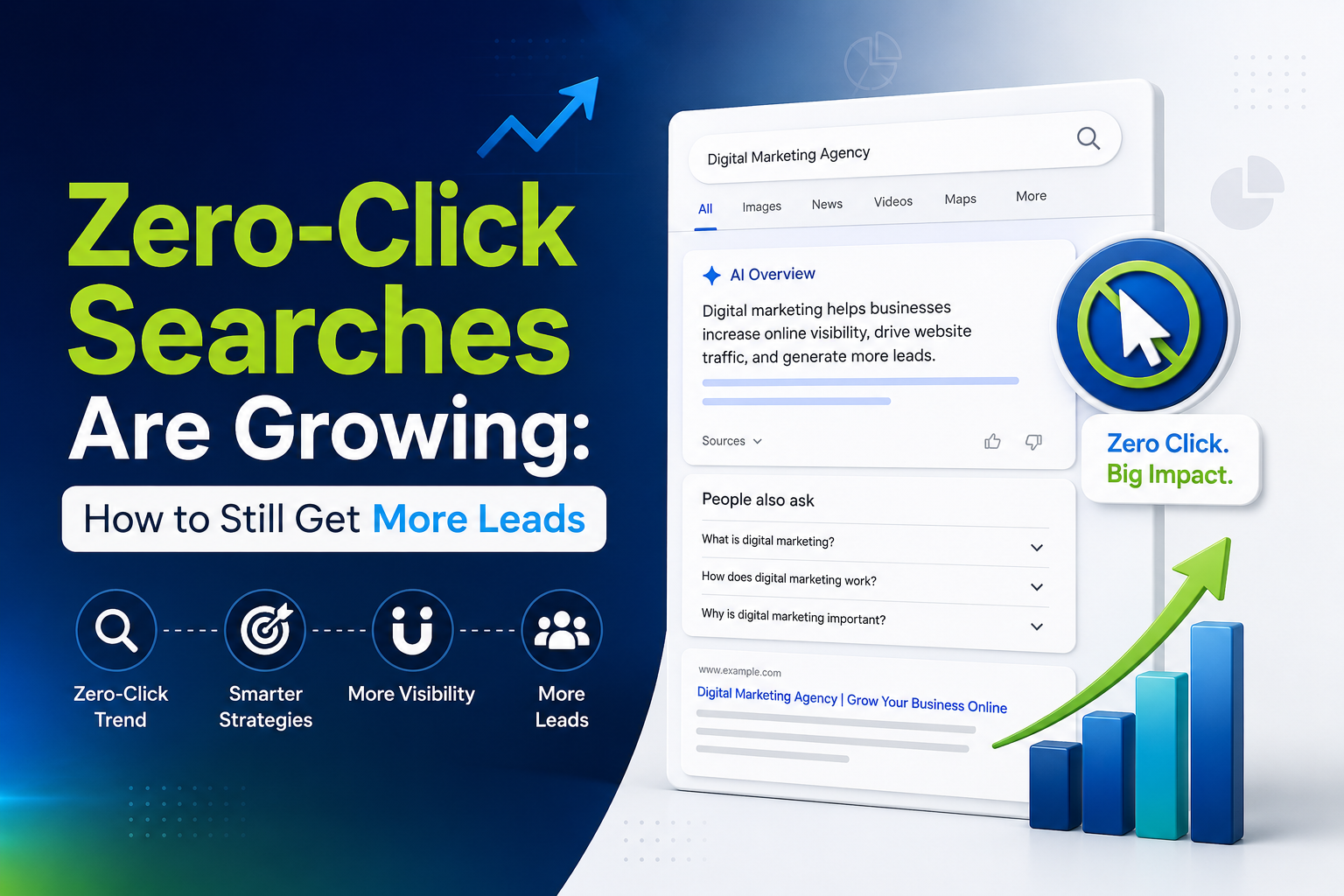
Search used to work like a simple handshake: you asked Google a question, Google handed you a list of blue links, and you clicked one. That handshake is breaking down. Today, most searches never end in a click at all — the answer just appears on the results page, and the user moves on.
For marketers, this isn’t a minor inconvenience. It’s a structural shift in how visibility, trust, and leads are earned online. The good news: zero-click doesn’t mean zero opportunity. It means the rules for generating leads have changed — and the brands that adapt their SEO, AEO (Answer Engine Optimization), and GEO (Generative Engine Optimization) strategy now will win the next decade of search.
This guide breaks down what zero-click search really is, how big the trend has become, and exactly how to keep generating leads even when fewer people ever land on your website.
What is a Zero-Click Search?
A zero-click search happens when a user types a query into Google (or Bing, or an AI engine like ChatGPT or Perplexity) and gets their answer directly on the results page — without clicking through to any website. This happens through:
- Featured snippets – the highlighted answer box at the top of results
- Knowledge panels – entity information pulled from structured data
- AI Overviews – Google’s generative AI summaries that synthesize multiple sources
- People Also Ask boxes
- Local packs and Google Business Profile listings
- Direct answer boxes (unit conversions, weather, definitions, calculations)
If someone searches “when is the next leap year” or “15 USD to GBP,” Google answers instantly — no website visit required.
Just How Big is the Zero-Click Trend?
The numbers are striking, and they’ve moved fast. According to research from SparkToro, roughly 68% of U.S. Google searches in early 2026 ended without a click to any website — up sharply from about 50% back in 2019, when Rand Fishkin first quantified the phenomenon.
A few other data points worth knowing:
- Zero-click behavior jumps to around 83% on queries that trigger an AI Overview, compared to about 60% on queries without one, per data cited by Similarweb.
- Pew Research Center found that users click through on only about 8% of searches when an AI Overview is present, versus roughly 15% without one — nearly cutting click-through probability in half.
- Mobile is hit hardest: mobile zero-click rates run significantly higher than desktop, since mobile users lean on quick, on-screen answers rather than deep research sessions (Search Engine Land).
- Bain & Company’s February 2025 consumer research found that 80% of consumers now rely on AI-generated results for at least 40% of their searches — and organic web traffic has dropped an estimated 15–25% across many sectors as a result.
The takeaway isn’t “SEO is dead.” It’s that clicks are no longer the only — or even the primary — measure of search value. Brands that show up inside the answer are earning trust and awareness even when the visit never happens.
Why This Still Matters for Lead Generation
It’s tempting to panic when you see traffic numbers flatten or dip. But zero-click search is really a redistribution of attention, not a disappearance of it. Consider this: if your brand is named inside an AI Overview or a featured snippet, a potential customer is reading your expertise, your name, and your recommendation at the exact moment they’re deciding what to do next — click or no click.
That’s the logic behind treating search visibility the way you’d treat a billboard or a sponsorship: you don’t measure a billboard by how many people photographed it, you measure it by how many people remember your brand when they’re ready to buy. The same shift is happening in search. Visibility inside the answer is becoming the new currency, and it still converts into leads — just through different paths: direct brand searches, return visits, phone calls, and AI-assisted recommendations.
SEO vs. AEO vs. GEO: What’s the Difference?
To build a lead-generation strategy for the zero-click era, it helps to separate three related but distinct disciplines:
- SEO (Search Engine Optimization) — optimizing your site to rank in traditional search results (blue links, local packs, images).
- AEO (Answer Engine Optimization) — optimizing content to be the answer Google features in a snippet, knowledge panel, or voice response. This is about structuring content so machines can lift a clear, correct answer out of it.
- GEO (Generative Engine Optimization) — optimizing to be cited, quoted, or recommended by generative AI tools like Google AI Overviews, ChatGPT, Perplexity, and Copilot. This focuses on authority signals, structured data, and content that AI models trust enough to summarize and attribute.
None of these replace each other — they layer on top of one another. A page that ranks well (SEO), answers a specific question clearly (AEO), and is backed by credible, well-structured, citable data (GEO) has the best shot at showing up everywhere a buyer might look.
How to Still Generate Leads in a Zero-Click World
1. Structure content to win featured snippets and AI citations
Answer engines and AI Overviews pull from content that answers a question in the first 40–60 words, uses clear formatting, and avoids fluff. For every important topic:
- Open sections with a direct, quotable answer to the implied question
- Use descriptive H2/H3 headers phrased as questions
- Add bullet points, numbered steps, and comparison tables — these are easier for AI systems to extract and cite
- Back claims with specific numbers, dates, and named sources
2. Use structured data (schema markup)
Schema markup tells search engines exactly what your content means — a product, a review, a FAQ, an event, a local business. Adding FAQPage, HowTo, Product, Review, and Organization schema increases your odds of appearing in rich results, knowledge panels, and AI-generated answers. Google’s own Structured Data documentation is the best starting reference.
3. Own your local presence
Local and “near me” searches remain some of the most click-resistant and lead-rich zero-click queries — someone searching “plumber near me” often calls or gets directions straight from the map pack, no website visit needed. Keep your Google Business Profile complete, accurate, and active with:
- Updated hours, services, and photos
- Regular posts and Q&A responses
- Consistent NAP (name, address, phone) data across directories
- Fresh, specific customer reviews
4. Build first-party data capture into every asset
If fewer people are clicking through, make every click count. Replace generic “contact us” pages with:
- Gated calculators, templates, or industry reports in exchange for an email
- Newsletter sign-ups with a clear, specific value proposition
- Chat widgets or quick-quote tools that capture intent immediately
- Retargeting pixels on every page, since even non-converting visits are valuable data
5. Invest in brand and entity authority (the real GEO move)
AI systems are far more likely to cite brands they already recognize as authoritative entities. That authority is built off-site:
- Earn mentions and backlinks from respected industry publications (digital PR)
- Get listed in comparison articles, review sites, and “best of” roundups in your niche
- Publish original research, data, or surveys that other sites want to cite
- Keep your Wikipedia, Wikidata, LinkedIn, and Crunchbase profiles (where relevant) accurate and complete — many AI systems draw entity understanding from these sources
6. Show up where the audience already is, not just on your website
Rand Fishkin’s advice, cited by SparkToro, is blunt: invest in brand awareness on the platforms your audience already spends time on, regardless of whether it drives a direct site visit. That means:
- Active, helpful participation on Reddit, Quora, and niche forums (Google increasingly surfaces this content directly, and AI models heavily cite forum discussions)
- A consistent, useful YouTube presence — video transcripts are a major source for AI Overviews and voice answers
- LinkedIn or industry-specific communities where decision-makers actually hang out
7. Track visibility, not just clicks
Traditional metrics like sessions and click-through rate no longer tell the whole story. Add these to your dashboard:
- Share of voice in AI Overviews and featured snippets for your target queries (tools like Semrush, Ahrefs, and Profound track this)
- Branded search volume — a strong proxy for the awareness zero-click impressions generate
- Assisted conversions from users who saw your brand in search but converted later, directly
- Citation tracking in AI answer engines, now offered by several GEO-focused platforms
The Bottom Line
Zero-click search isn’t a temporary glitch — it’s the direction search is permanently heading, accelerated by AI Overviews and conversational AI tools. But “zero-click” doesn’t mean “zero value.” Every time your brand appears inside an answer, you’re earning a trust impression that traditional analytics simply weren’t built to measure.
The businesses that keep growing leads through this shift are the ones treating SEO, AEO, and GEO as one connected discipline: rank where you can, answer clearly enough to get featured, and build the kind of off-site authority that makes AI systems want to recommend you by name.
FAQs
What is a zero-click search?
A zero-click search is a query where the user finds their answer directly on the search results page — through a featured snippet, knowledge panel, AI Overview, or similar feature — without clicking through to any website.
How common are zero-click searches in 2026?
Estimates vary by source and methodology, but multiple studies from SparkToro, Similarweb, and Bain & Company put the zero-click rate for U.S. Google searches somewhere between roughly 60% and 68% in 2026, with rates climbing above 80% on queries that trigger an AI Overview.
Does zero-click search mean SEO is no longer worth doing?
No. SEO still determines whether your content is eligible to be featured, cited, or ranked in the first place. What’s changed is the goal — instead of optimizing purely for clicks, brands need to optimize for visibility inside the answer itself, which is what AEO and GEO are built for.
What’s the difference between AEO and GEO?
AEO (Answer Engine Optimization) focuses on getting featured in structured, rule-based answer formats like featured snippets, knowledge panels, and voice search results. GEO (Generative Engine Optimization) focuses specifically on being cited or recommended by generative AI tools like AI Overviews, ChatGPT, and Perplexity, which rely more on overall content authority and clarity than exact-match keywords.
How can a small business still get leads if fewer people click through?
Focus on channels where zero-click search still drives direct action, like Google Business Profile listings for local searches (calls, directions, messages), and pair that with first-party data capture — gated resources, email sign-ups, and chat tools — so every click that does happen converts into a trackable lead.
Can I track whether my brand is showing up in AI Overviews or AI chatbots?
Yes. Several SEO platforms now offer AI citation and visibility tracking alongside traditional rank tracking, letting you monitor how often your brand or content is referenced in AI-generated answers across tools like Google AI Overviews, ChatGPT, and Perplexity.