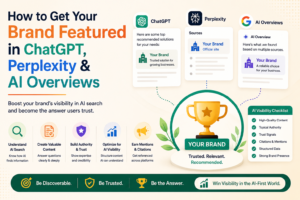
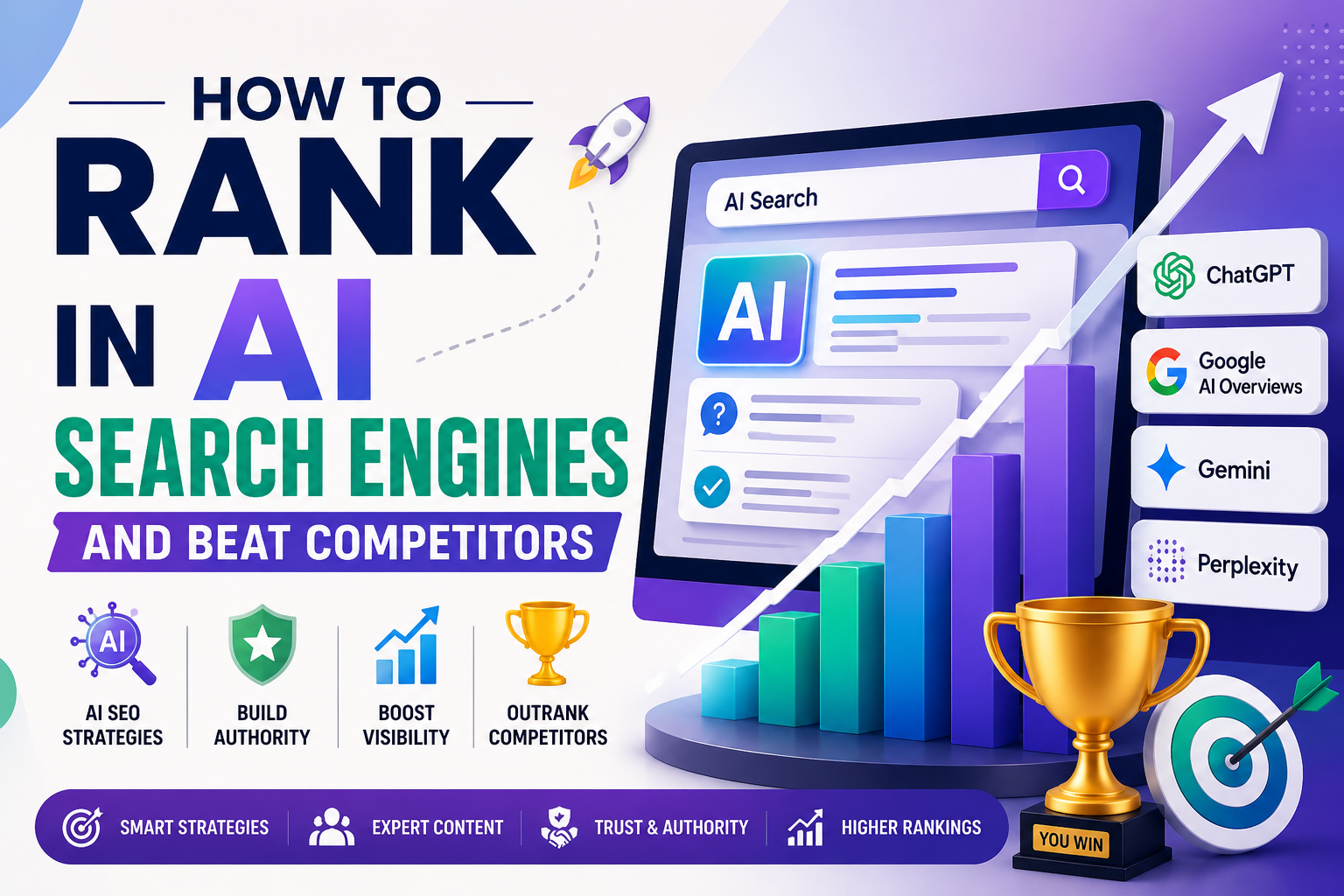
To rank in AI search engines such as ChatGPT, Google AI Overviews, Gemini, and Perplexity, focus on creating expert-led content, answering user questions directly, building topical authority, improving website trust signals, optimizing for structured data, and publishing content that demonstrates Experience, Expertise, Authoritativeness, and Trustworthiness (E-E-A-T). Businesses that provide clear, factual, and comprehensive information are more likely to be cited and recommended by AI-powered search systems.
Introduction
Search is changing rapidly. Traditional search engines no longer rely solely on keywords and backlinks. AI-powered platforms now generate answers directly for users, often without requiring them to visit multiple websites.
Today, platforms such as ChatGPT, Google AI Overviews, Gemini, and Perplexity analyze content differently. They prioritize authoritative sources, accurate information, expert insights, and content that directly solves user problems.
If your website is not optimized for AI search, competitors may receive the visibility and traffic that could have been yours.
The good news is that businesses can adapt. By understanding how AI search engines evaluate content, you can increase visibility, generate qualified leads, and establish authority in your industry.
Understanding How AI Search Engines Work
Unlike traditional search engines that display a list of links, AI search engines generate direct answers using information gathered from trusted sources.
AI systems evaluate:
- Content quality
- Expertise and credibility
- User intent satisfaction
- Website authority
- Content freshness
- Structured data
- Semantic relevance
Instead of matching exact keywords, AI focuses on understanding context and delivering the most helpful response.
What AI Search Engines Look For
| Ranking Factor | Importance |
| Expertise | Very High |
| Content Depth | Very High |
| Trust Signals | Very High |
| User Experience | High |
| Structured Data | High |
| Fresh Information | High |
| Backlinks | Moderate to High |
| Keyword Usage | Moderate |
Build Strong Topical Authority
One of the most effective ways to rank in AI search engines is to become a recognized authority in your niche.
Rather than publishing random articles, create content clusters around core topics.
Example
If you provide digital marketing services, your content should cover:
- SEO strategies
- Local SEO
- Technical SEO
- Content marketing
- AI SEO
- Link building
- Conversion optimization
When AI systems consistently find high-quality content covering an entire subject area, they are more likely to trust and reference your website.
Action Tip
Create pillar pages supported by multiple detailed subtopics.
Focus on E-E-A-T
Google and AI systems increasingly evaluate content based on E-E-A-T:
Experience
Demonstrate real-world involvement and practical knowledge.
Expertise
Show professional knowledge and industry understanding.
Authoritativeness
Build recognition through citations, mentions, and quality content.
Trustworthiness
Provide accurate information, transparent policies, and secure browsing experiences.
How to Improve E-E-A-T
- Add author profiles
- Showcase credentials
- Include case studies
- Display testimonials
- Cite reliable sources
- Maintain updated content
Businesses with strong E-E-A-T signals are significantly more likely to appear in AI-generated answers.
Answer Questions Directly
AI engines prioritize content that answers questions clearly and quickly.
Many users ask conversational queries such as:
- How do AI search engines rank websites?
- What is AI SEO?
- How can I appear in ChatGPT results?
- How do I optimize for Google AI Overviews?
Your content should provide concise answers immediately before expanding on the topic.
Best Practice
Use:
- FAQ sections
- Question-based headings
- Conversational language
- Clear definitions
This structure helps AI systems extract and cite your content more easily.
Optimize for AI Overviews and Featured Snippets
Google AI Overviews frequently pull information from content that is:
- Well-structured
- Easy to scan
- Factually accurate
- Directly relevant
Content Formatting Tips
Use:
- Bullet points
- Tables
- Numbered lists
- Short paragraphs
- Descriptive headings
Example
Instead of:
“AI search optimization involves multiple complex processes.”
Use:
“AI search optimization includes:
- Creating expert content
- Building topical authority
- Improving technical SEO
- Using structured data
- Answering user questions”
This format is easier for AI systems to understand and quote.
Use Schema Markup and Structured Data
Structured data helps search engines understand your content.
Important schema types include:
- Article Schema
- FAQ Schema
- Organization Schema
- Local Business Schema
- Review Schema
- Product Schema
Structured data improves the likelihood of appearing in:
- AI Overviews
- Rich results
- Knowledge panels
- Voice search responses
Create Original Research and Insights
AI platforms prefer unique information over repeated content.
If every article says the same thing, there is little reason for AI systems to reference it.
Valuable Content Ideas
- Industry surveys
- Case studies
- Customer success stories
- Original statistics
- Market research
- Expert interviews
For example, publishing a study showing how AI search impacted website traffic can generate citations from both search engines and industry publications.
Improve Technical SEO
Technical SEO remains critical for AI visibility.
AI systems must be able to access, understand, and index your content efficiently.
Technical SEO Checklist
- Fast loading speed
- Mobile-friendly design
- Secure HTTPS connection
- Clean URL structure
- XML sitemap
- Internal linking
- Optimized Core Web Vitals
- Crawlable pages
A technically sound website improves both traditional and AI search performance.
Optimize for Voice Search
Voice search continues to influence AI-driven search behavior.
Users often ask complete questions rather than typing short keywords.
Example
Instead of typing:
“AI SEO”
Users ask:
“How can my website rank in AI search engines?”
Voice Search Optimization Tips
- Use natural language
- Create FAQ pages
- Answer questions directly
- Target long-tail keywords
- Write conversational content
Voice-friendly content aligns perfectly with AI search requirements.
Build High-Quality Brand Mentions
AI systems often evaluate online reputation and recognition.
The more trusted websites mention your brand, the stronger your authority becomes.
Focus On
- Guest posting
- Industry publications
- Podcasts
- Press releases
- Expert roundups
- Professional directories
Brand mentions contribute to authority signals that AI systems use when selecting sources.
Keep Content Updated
AI engines prioritize current and relevant information.
Outdated content may lose visibility over time.
Content Refresh Strategy
Update:
- Statistics
- Screenshots
- Examples
- Industry trends
- Search algorithm changes
Regular updates signal ongoing expertise and relevance.
Measure AI Search Visibility
Traditional rankings alone no longer tell the full story.
Monitor:
- AI Overview appearances
- Featured snippets
- Branded searches
- Organic traffic growth
- Engagement metrics
- Referral traffic from AI platforms
These metrics provide a clearer picture of your AI search performance.
Common Mistakes to Avoid
Many businesses struggle because they focus on outdated SEO tactics.
Avoid:
- Keyword stuffing
- Thin content
- AI-generated content without editing
- Clickbait headlines
- Duplicate pages
- Poor user experience
- Lack of expertise signals
AI systems increasingly reward quality over quantity.
The Future of AI Search Optimization
AI search is becoming more personalized, conversational, and context-driven.
Businesses that invest in:
- Expert content
- Brand authority
- User trust
- Structured information
will gain a significant advantage over competitors.
Rather than chasing algorithms, focus on becoming the most reliable source of information in your niche.
That is exactly what AI search engines are designed to reward.
Frequently Asked Questions
1. How do I rank in ChatGPT search results?
Create authoritative content, answer user questions clearly, build topical authority, and maintain strong trust signals across your website.
2. What is AI SEO?
AI SEO refers to optimizing content and websites to improve visibility in AI-powered search engines, AI Overviews, chatbots, and answer engines.
3. Does traditional SEO still matter?
Yes. Technical SEO, content quality, backlinks, and user experience remain important foundations for AI search visibility.
4. How can my website appear in Google AI Overviews?
Publish comprehensive content, use structured formatting, implement schema markup, and provide direct answers to common search questions.
5. What is the most important ranking factor for AI search?
Content quality combined with E-E-A-T signals remains one of the strongest factors influencing AI-generated search results.
Conclusion
Ranking in AI search engines requires more than traditional SEO. Businesses must demonstrate expertise, authority, trustworthiness, and genuine value. AI systems prioritize content that answers questions effectively, provides unique insights, and delivers a superior user experience.
Organizations that focus on building topical authority, improving technical SEO, optimizing for AI Overviews, and creating people-first content will be better positioned to outperform competitors and gain long-term visibility in AI-driven search environments.
Contact Us Today
Want your business to rank in Google AI Overviews, ChatGPT, Gemini, and Perplexity?
Contact us today for AI SEO, Answer Engine Optimization (AEO), Content Strategy, Technical SEO, and AI Search Visibility solutions.
Call now to discover how your website can attract more qualified traffic, generate more leads, and stay ahead of competitors in the era of AI search.